Hunting season in Aargau: What the recreational hunters' leaflet leaves out
At the start of the driven hunt season, a leaflet tells the public how to make way for recreational hunters. It says nothing about animal suffering, unnecessary kills or the hunters' own hunting stands.
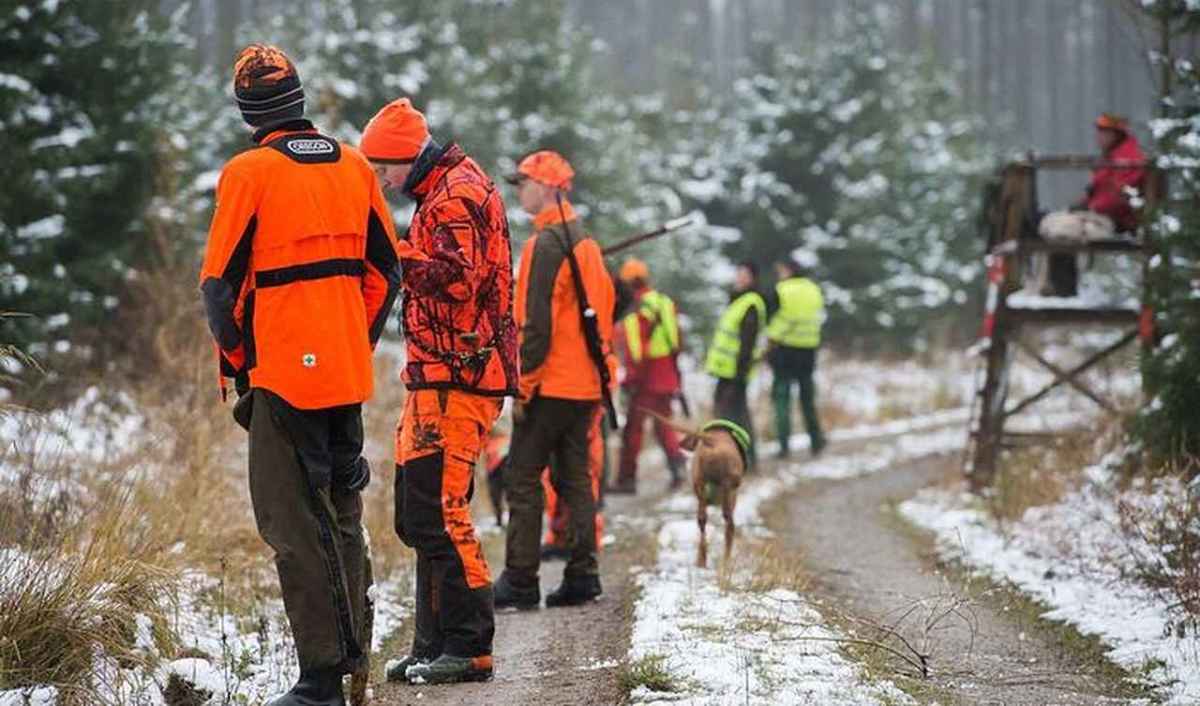
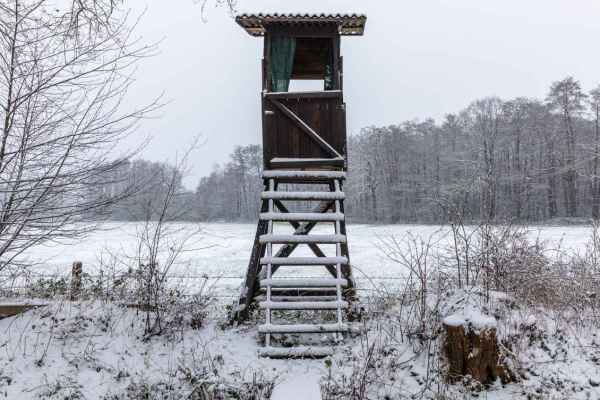
Symbolic image: driven hunt with a high seat in the background.
«When the dogs come»
From October to December, large driven hunts take place in Aargau.
The Aargauer Zeitung therefore explains to its readers what now applies in the forest, based on a leaflet from Jagd Aargau, the association of Aargau's recreational hunters. The message: take "Beware of hunting" warning signs seriously, keep dogs on a leash, make way on horseback, stay on paved paths when cycling, and wear conspicuous clothing. According to the leaflet, anyone who deliberately obstructs hunting operations risks a fine of up to 20,000 francs.
This is read as safety information. In fact, it is a set of behavioural instructions with which a small leisure group tailors the vast majority of forest visitors to its own needs. What the leaflet does not mention is at least as revealing as what it does.
Driven hunt means driven hunt
«Driven hunt» sounds organised and professional. What it actually means is that wild animals are chased out of their shelters by beaters and dogs and shot at while fleeing. Roe deer, wild boars and foxes are driven in panic towards the line of shooters, and family groups are torn apart.
Anyone who shoots at a fleeing animal hits it less accurately. If the shot does not kill instantly, the animal flees further with wounds to its legs, jaw or abdomen. Many cantons don't even want to know exactly how often this happens: in a survey of cantonal hunting authorities conducted by the Swiss Animal Protection organisation STS, nine cantons failed to provide an answer. Where figures are available, follow-up searches find only 35 to 65 percent of injured animals, depending on the canton (STS report «Grazing shots and follow-up searches in Swiss hunting»). Around half of the wounded non-human animals are therefore never released from their suffering. More on this in the article on Missed Shots in Recreational Hunting. A concrete case from a forest in Aargau is documented in the TierCrime episode No Escape from the Driven Hunt.
This is not necessary. Driven hunts of this kind are a characteristic feature of the territorial hunting cantons. Grisons, for example, bans loud driven hunts and recreational hunting in groups of more than four people in its hunting act, and Geneva has managed entirely without recreational hunting since 1974. The fact that Aargau holds on to driven hunts is a hunting-policy decision, not an ecological one (more on this in the comparison Licence Hunting and Territorial Hunting).
Small Game Without Justification
In autumn, not only roe deer and wild boars are shot, but also foxes, badgers, martens, carrion crows and, more recently, raccoons as a specific target. There is no wildlife-biological justification for blanket hunting of foxes, badgers and martens. Foxes regulate their populations themselves through their social structure; where they are hunted, the reproduction rate rises, and the gaps quickly fill again. The Animal Welfare Act prohibits inflicting unjustified pain, suffering or distress on an animal. That a recreational pastime, of all things, should provide this justification is anything but self-evident. Background on this is provided in the articles on Small game hunting and wildlife diseases and the campaign End fox hunting.
The argument of damage prevention also only holds to a limited extent. In Aargau, more animals are being shot, yet the wild boar damage remains high nonetheless. Shooting lead sows can destroy the social structure of the sounders, thereby fuelling reproduction and damage rather than curbing them.
The Psychology Behind It
Territorial hunting turns the forest into a perceived possession. Hunting grounds are leased, managed and defended, even though wild animals belong to no one. This creates a clear us-and-them mentality: those who hunt belong, those who ask questions are a disturbance. The Psychology of Recreational Hunting in Aargau describes this pattern in detail.
The information sheet fits seamlessly into this picture. Walkers, horse riders and cyclists are expected to give way, adapt and make themselves visible. Disturbing the hunting operation is punishable by fines running into five figures. The question of what recreational hunters owe to the general public is not raised in the text. How self-evidently this self-image is cultivated was also apparent at the certification ceremony at Habsburg Castle, where the managing director of Jagd Aargau told the young hunters that they shouldn't let anyone convince them that the public doesn't stand behind recreational hunting.
Rules don't apply equally to everyone
How uneven the standards are is shown by a case from the lower Aare valley. There, the IG Wild beim Wild has documented four hunting blinds: enclosed wooden cabins with a door, roof and window openings on tall steel frames, located outside the building zone. The canton declared them exempt from building permits. Yet its own circular letter of 15 December 2015 explicitly subjects enclosed hunting blinds to the building permit requirement. And Jagd Aargau itself also describes the enclosed hunting blind in a 2023 presentation as "subject to building permit". The association, which is now explaining the rules to the public, has thus itself documented the permit requirement for enclosed hunting blinds. The full investigation: Hunting blinds in the Aare valley.
Checks are only carried out when someone pays attention. In Aargau, the municipality is responsible, and it usually only learns of unauthorised structures through tip-offs from outside.
What you can report
Anyone out and about in the forest and along forest edges these weeks can help. We are collecting tip-offs about anything that is not right with recreational hunting, for example:
- Recreational hunters who hunt while intoxicated or carry loaded weapons on paths and roads
- Animal cruelty: shot or injured non-human animals left behind, abandoned follow-up searches, dogs that chase or maul wild animals
- Shots fired near paths, houses, pastures or people
- Driven hunts without warning signs or barriers
- Carcasses or offal left lying at the edges of paths and in bodies of water, as well as suspicious traps
- Enclosed or oversized hunting blinds, concrete-anchored high seats and high seats in open countryside
Photos or videos are helpful, as is the location (municipality, ideally with coordinates or a map excerpt), date and time, and a brief description. Please send tip-offs via our contact form; we treat them confidentially.
In the event of acute danger, for instance if an intoxicated recreational hunter is out with a weapon or shots are being fired towards people, first alert the cantonal police on 117. You can then report the incident to us.
How to stay on the safe side
Only photograph and film from public paths and keep your distance from armed persons. Do not confront recreational hunters. Where warning signs are posted, come back another day. Do not enter hunting installations, do not climb up onto them, and do not alter anything. Those who document calmly give no one a pretext to speak of obstruction of hunting operations.
Further cases from the canton can be found under Aargau, the legal basis in the article on legal situation regarding high seats in Switzerland.
More on the subject of recreational hunting: In the dossier The Role and Criticism of Recreational Hunters we shed light on the training, power and self-image of recreational hunters. The scientific evidence is presented in the overview Studies on the Effects of Recreational Hunting.
The position of IG Wild beim Wild: IG Wild beim Wild rejects recreational hunting. Our model is the canton of Geneva, which has managed without recreational hunting since 1974: without hunting seasons, without hunting dogs, without driven hunts, without high seats, without the animal cruelty and crime that go hand in hand with hunting season elsewhere. What has worked there for over fifty years disproves every position paper by JagdSchweiz. An association that bases its policy on claims it refutes in its own documents is not a professional organisation, but a factory for misinformation.

All articles are written by IG Wild beim Wild as well as by external co-authors. Research, structuring and editorial processes may be supported by AI-assisted tools.
Support our work
With your donation you help protect animals and give their voice a hearing.
Donate now →