The resignation that conceals a bloody record: Salzburg's top recreational hunter and his enclosure of horror
How a Natura 2000 site became a backdrop for mass kills and how the public purse ultimately paid millions.

Maximilian «Max» Mayr-Melnhof has announced his withdrawal as Salzburg's Landesjägermeister for 2027.
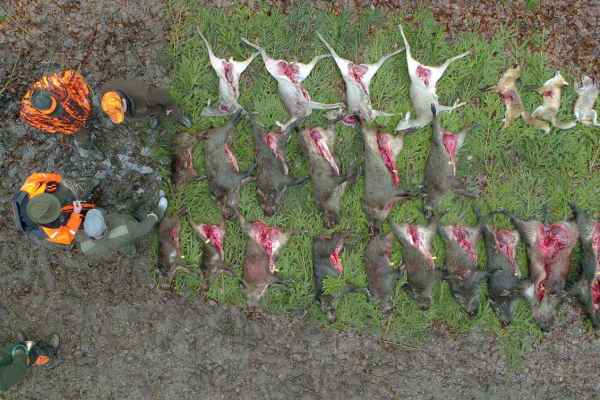
Yet the friendly farewell announcements omit the decisive part of his record: for years, Mayr-Melnhof was among the most prominent operators of Austrian fenced hunting. In the Antheringer Au, wild boars were chased by dogs and beaters within a fenced hunting area during driven hunts and driven towards shooters. The animals could flee within the enclosure, but not out of the hunting system itself.
«Two terms are enough»
The announcement sounds like an orderly handover. After ten years at the helm of around 11,800 Salzburg recreational hunters, Mayr-Melnhof does not intend to stand again at the 80th Landesjägertag on 24 April 2027. «Two terms are enough,» he is quoted as saying, adding that it had been the greatest honour to serve his recreational hunters. He officially names former racing driver and entrepreneur Markus Friesacher as his preferred successor. The goal: an election without a rival candidate, to avoid a contested vote.
What gets lost in the brief news items: Mayr-Melnhof was not only Salzburg's Landesjägermeister. From 1 January to 31 December 2024, he served as president of «Jagd Österreich», the umbrella association of the nine provincial hunting associations with around 132,000 members. The chairmanship there rotates annually among the Landesjägermeister; since 1 January 2025, Mayr-Melnhof has been second vice-president, with Styrian Landesjägermeister Franz Mayr-Melnhof-Saurau as president since then. His role in Salzburg and his position at federal level show just how far his institutional reach extended beyond a single hunting ground.
The enclosure in the Antheringer Au
North of the city of Salzburg, on the border with Germany, the Mayr-Melnhof family ran a roughly 500-hectare fenced hunting ground for decades. Since 1989, the Antheringer Au had been legally recognised as a fenced hunting ground; it was established under Mayr-Melnhof's father Friedrich, who was responsible for agriculture and the environment as a Salzburg provincial councillor. According to a detailed investigation by the magazine «profil», around 600 wild boars lived within this fenced area, along with fallow deer.
The decisive point for any accurate assessment: this is not about the narrative of «necessary wildlife regulation» in the wild. This is about the systematic killing of a specifically managed, intensively maintained animal population in a fenced-in area. The animals are tended, fed and kept at high density, only to be shot in large driven hunts on a few days each year. It is a form of hunting rooted in feudal traditions, historically serving less to procure food than to project social status.
This practice of fenced hunting has been criticised internationally for years, whether involving lions bred for trophy hunting or wild boars in Central European enclosures.
Driven hunt behind fences: why this carries different ethical weight
In a driven hunt within an enclosure, the animals are startled by beaters and dogs and set in motion, while the fence rules out any escape into adjoining habitats. Shooters fire from high seats at the running animals. Mayr-Melnhof himself admitted to «profil» that shooting at moving animals makes hitting them more difficult and that grazing shots are not entirely avoidable.
This is the core of the animal welfare problem: shooting at moving animals increases the risk of missed or wounding shots. And unlike in an open habitat, the space to flee is structurally limited. Under Salzburg hunting law, an enclosure is defined precisely by the fact that it is sealed off against the movement of the managed game to and from neighbouring areas. The animals can move around and hide within the grounds, but they cannot escape the hunting system as such. An investigation by the magazine «Profil» reported kill figures of up to 200 wild boars on a single hunting day. Critics also documented that hunting dogs were regularly injured or killed during the driven hunts.
The Association Against Animal Factories (VGT) fought this form of hunting for years as cruel and anachronistic. That is the position of an animal welfare organisation, not a court finding. The documented practice of the enclosure itself, namely high wildlife density, feeding, driven hunts and mass kills within a fenced area, is independently verifiable and telling in its own right.
Natura 2000 site as a pig farm
Particularly explosive: the Antheringer Au was already reported to the EU as a European protected area at the end of the 1990s and is designated a Natura 2000 site. It was precisely there that an intensively managed wildlife population was maintained for years. Animal welfare advocates, and even expert reports commissioned by the provincial government, described the consequences: waterways fouled with excrement, meadows dug up, trees browsed and bark-stripped, young plants destroyed. The combination of protected status on paper and actual overuse within the fenced enclosure made the case a symbol of how far formal nature conservation and real practice can diverge.
The legal dispute: what applies and what does not
Around a fenced hunt in November 2017, the conflict escalated between animal welfare activists filming the hunt from outside and those involved in the hunt. A whole series of mutual complaints and trials followed. Precision matters here, because the various legal strands are often muddled together:
- Following a ruling by the Salzburg Administrative Court, cited by the VGT and later court proceedings, it was established that Mayr-Melnhof had unlawfully used force to take a camera from an animal welfare activist, injuring him in the process. As part of an official liability proceeding, the province subsequently reimbursed the VGT for the value of the camera.
- Under criminal law, things unfolded differently. Mayr-Melnhof was not charged over the documented use of force and the seizure of the camera: the Salzburg public prosecutor's office discontinued the original investigation. Only a request by the victim's side to continue proceedings led to a criminal trial, and solely on the charge of giving false testimony. In that trial, the Salzburg Regional Court acquitted him in 2021; the judge pointed to a subjective, not necessarily deliberately false, perception.
- Conversely, several animal welfare activists, who had been charged with defamation or false testimony following the incidents, were acquitted. One judge described the witnesses called by Mayr-Melnhof as not credible.
To put it cleanly: the allegation of violence and the seizure of the camera was addressed by an administrative court and linked to an official liability proceeding with cost consequences. There is no criminal conviction of Mayr-Melnhof; the only criminal trial brought against him, concerning false testimony, ended in acquittal. The presumption of innocence applies to all allegations not settled by a final conviction. Anyone presenting the case responsibly must name both levels, rather than playing one off against the other.
The costly ending: 35.6 million and a lease of 1,000 euros
What the current resignation announcements also leave out: the Antheringer Au chapter has long since become a fiscal-policy controversy. In 2022, the Province of Salzburg purchased the Au, officially justified by flood protection and the expansion of the Salzachauen nature park. The purchase price was around 35.6 million euros for roughly 520 hectares; the underlying appraisals ranged between 32.5 and 34.3 million euros. More than two-thirds of the sum came from the federal government and the EU.
The Salzburg State Audit Office later assessed the purchase as neither economical, nor efficient, nor appropriate. Particularly striking: after the purchase, the state leased the private hunting ground back to Mayr-Melnhof until the end of the 2024 hunting period for 1,000 euros per year. Given a rental value of 50 euros per hectare per year set out in the 2020 expert report, the Audit Office explicitly deemed this amount incomprehensible. The same expert had put the value of the hunting ground at 3.1 million euros. Both facts are scandalous, but must be read as economically distinct: the capital value of the hunting ground on one hand, the annual lease on the other.
In parallel, the statutory end of enclosed hunting is approaching in Salzburg. Section 68(9) of the Salzburg Hunting Act stipulates that fully artificially fenced-in game enclosures will no longer be permitted from 1 January 2027. The fences must therefore be removed or opened up so that free movement of wildlife becomes possible again; the authority may order the necessary steps as early as before the end of 2026.
This is how the true picture of these ten years emerges: a major landowner runs a highly controversial enclosed hunt in a protected area for decades, while at the same time shaping the official representation of hunting interests as provincial hunting master and, for a time, federal president of hunting — and in the end, the public authorities resolve the conflict with a multi-million-euro purchase that the state's own audit office picks apart.
An 'orderly retirement' is the wrong framing
Mayr-Melnhof's argument that enclosed hunting is a legitimate use of his own land is a political position of interest, not an answer to the animal welfare question. Max Mayr-Melnhof's record includes decades of enclosed hunting in a Natura 2000 area, documented driven hunts on an artificially confined wildlife population, a conflict with animal welfare advocates that was dealt with by an administrative court, and a multi-million-euro purchase by the public authorities that the Salzburg State Audit Office assessed as neither economical, nor efficient, nor appropriate.
This case illustrates, in exemplary fashion, how closely large landownership, hunting interests, politics, and institutional representation can be intertwined in recreational hunting. Precisely for this reason, this departure deserves more than a benevolent send-off with 'Weidmannsruh'.
IG Wild beim Wild documents the practice and politics of recreational hunting throughout the German-speaking world. Further analyses on recreational hunting in Austria as well as on the internationally criticised fenced hunting can be found in our dossiers.
More on the subject of recreational hunting: In the dossier The Role and Criticism of Recreational Hunters we shed light on the training, power and self-image of recreational hunters. The scientific evidence is presented in the overview Studies on the Effects of Recreational Hunting.
The position of IG Wild beim Wild: IG Wild beim Wild rejects recreational hunting. Our model is the canton of Geneva, which has managed without recreational hunting since 1974: without hunting seasons, without hunting dogs, without driven hunts, without high seats, without the animal cruelty and crime that go hand in hand with hunting season elsewhere. What has worked there for over fifty years disproves every position paper by JagdSchweiz. An association that bases its policy on claims it refutes in its own documents is not a professional organisation, but a factory for misinformation.

All articles are written by IG Wild beim Wild as well as by external co-authors. Research, structuring and editorial processes may be supported by AI-assisted tools.
Support our work
With your donation you help protect animals and give their voice a hearing.
Donate now →