Voyageurs National Park: wolf population has fallen by 44 per cent since 2023 because prey is lacking
Without a kill quota and without recreational hunting, the wolf population in Minnesota adjusts to the available food supply.
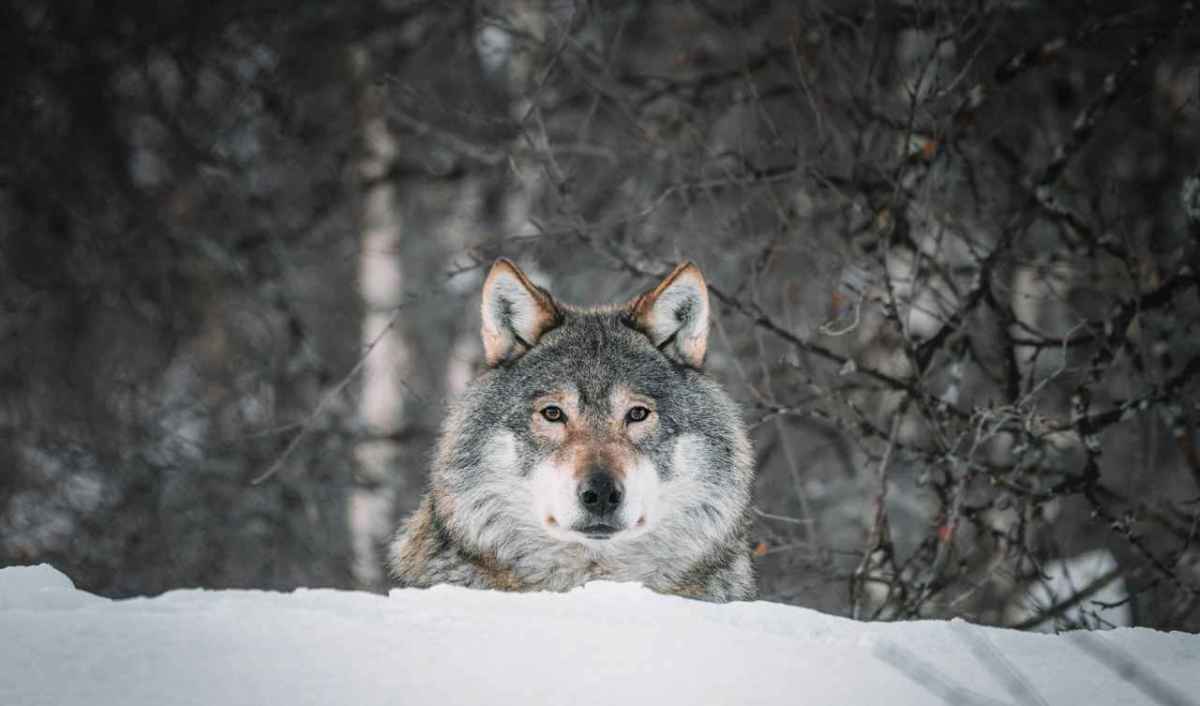
Illustrative image. Photo: Federico Di Dio / Unsplash
In the Pack
In the area around Voyageurs National Park in northern Minnesota, there are fewer wolves than at any time since research began twelve years ago. The population has fallen for the third year in a row, by a total of 44 per cent since 2023. There is no kill quota there. The cause is the food supply.
What the researchers measured
The Voyageurs Wolf Project monitors the wolves in the so-called Greater Voyageurs Ecosystem, an area of around 2,400 km² in and around the national park on the border with Canada. The researchers work with GPS collars and hundreds of wildlife cameras; in winter 2024/25 there were 378.
What is measured is wolf density. It fell in winter 2023/24 by 15 per cent, in 2024/25 by 19 per cent and last year by a further 18 per cent. Added together, that makes a decline of 44 per cent compared with winter 2022/23. In winter 2024/25 the researchers counted 99 wolves, 22 of them lone animals.
Fewer deer, larger territories, fewer pups
The trigger was the harsh winters of 2021/22 and 2022/23. Afterwards the population of white-tailed deer in the area collapsed by more than half. The wolves responded in two ways. The packs needed larger territories to find enough food: within two years their territories grew by over 50 per cent to an average of almost 150 km². That leaves room for fewer packs in the same area. In addition, hardly any pups survived. Of the young born in spring 2024, only about one in five made it to winter, according to the project report; across the whole area only 19 pups grew up.
Project leader Tom Gable names deer numbers and overall prey availability as the most important factor in how many wolves a landscape can support. The researchers are not worried: they speak of the natural rise and fall of a wolf population that adjusts to its prey. If the deer recover, the wolves are likely to follow.
What the finding says and what it does not
The figures apply to this one area and say nothing about Minnesota's statewide population. Whether the pattern appears elsewhere, Gable leaves open. What is clear: the decline happened without recreational hunting and without a kill quota. Since February 2022, the wolf in Minnesota has once again been protected under federal law and may only be killed in defence of human life. That could change: in September, President Trump demanded by executive order that the wolf be removed from the list of protected species. Interior Secretary Doug Burgum must decide by 3 December.
What this means for Switzerland
In Swiss politics it is taken as given that wolves must be "regulated" because the population would otherwise grow unchecked. With the revised hunting act, since February 2025 preventive kills have been permitted. Minnesota shows that a wolf population does not grow unchecked even without kills. Two mechanisms limit it, and both also operate in Switzerland.
The first is prey. In Grisons, according to an analysis by the Gruppe Wolf Schweiz, the density of hoofed game is more than three times as high as in Yellowstone National Park. Recreational hunting does not get the ungulates under control: over 25 years of hunting statistics, red deer kills have almost doubled, yet the population keeps growing. The wolf fills this gap. It finds plentiful food here because recreational hunting does not fulfil its supposed purpose. By reducing ungulate numbers, it shrinks its own foundation. When numbers fall, the wolf follows, just as now in Minnesota. For the protection forest, this is a gain.
The second is territory. Wolf packs defend their territories against foreign wolves, and young wolves must disperse and first find a free area. A re-analysis of 32 wolf populations in North America concluded in 2011 that such social mechanisms limit density at least as strongly as prey availability does. Other researchers, including the wolf biologist L. David Mech, regard prey as the decisive factor. For the debate over kills, this dispute is of secondary importance: according to both explanations, it is the ecosystem that sets the limit, not the kill quota. Further evidence is collected on the study page «Hunting Fact-Checked».
Instead, the shooting goes on. In the Chöpfenberg pack, Schwyz killed four pups rather than the animals identified by DNA as responsible for the kills, and the FOEN has approved the removal of the entire Jougne-Suchet pack. How many wolves have already been killed in this period is shown by the continuously updated wolf counter. What such interventions do to the packs is documented in the dossier “Recreational hunters regulate, not predators”.
Commentary: Nature Needs No Kill Quota
A wolf population that shrinks by 44 per cent because its prey is becoming scarce is not an emergency but ecology in textbook form. In Switzerland, by contrast, every wolf is treated as a problem that can only be solved with ammunition, while recreational hunting has been failing to manage ungulates for decades. Anyone who is serious about regulation should let the predators do their work instead of shooting them. How this has already worked in Minnesota is shown in our article on wolf management in Minnesota.
More on the subject of recreational hunting: In our dossiers on recreational hunting gather fact-checks, analyses and background reports. The scientific evidence is presented in the overview Studies on the Effects of Recreational Hunting.
The position of IG Wild beim Wild: IG Wild beim Wild rejects recreational hunting. Our model is the canton of Geneva, which has managed without recreational hunting since 1974: without hunting seasons, without hunting dogs, without driven hunts, without high seats, without the animal cruelty and crime that go hand in hand with hunting season elsewhere. What has worked there for over fifty years disproves every position paper by JagdSchweiz. An association that bases its policy on claims it refutes in its own documents is not a professional organisation, but a factory for misinformation.
Wild animals need a voice
Once a week: research, petitions and background information on recreational hunting. Free of charge and can be unsubscribed from at any time.

All articles are written by IG Wild beim Wild as well as by external co-authors. Research, structuring and editorial processes may be supported by AI-assisted tools.
Support our work
With your donation you help protect animals and give their voice a hearing.
Donate now →