Podcast episode: hunting, wild animals and protection
The 2026/27 hunting season in the Grisons, Valais and Ticino: wolf kills by quota, hunting planning driven by demand, and what 25 years of hunting statistics reveal about the promise of regulation.

Podcast episode: hunting, wild animals and protection
This edition of 'Wild beim Wild' looks at the current 2026/27 hunting season in the Grisons, Valais and Ticino, and at the question of who is actually regulating whom. It also covers conflicts over private land and wildlife accidents, a parasite introduced with hunted game, and 25 years of hunting statistics.
Wolf regulation: kills by quota
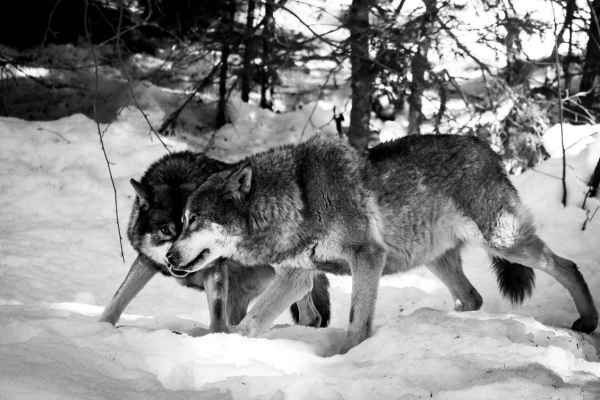
The Grisons is starting the season with 4,616 planned red deer kills and its third proactive wolf regulation in a row, as the Bündner Ticker documents. The canton reports a record 88 wolf pups, while livestock killed by wolves fell by around a third to 128 by the end of September. According to wolf counter at least 42 wolves have been killed since 1 September. In Schwyz the regulation hit four pups of the Chöpfenberg pack, whereas the individually identified livestock-killing animals came from the previous year's litter.
Valais wanted to have four of its eleven packs killed in their entirety. For Réchy-Anniviers the federal government refused the total cull because the criteria for herd protection had not been met. In the territory of the Nanz pack the cantonal table has recorded 17 wolves killed since December 2023, and yet an entire wolf family once again lives there: vacated territories are reoccupied. In Ticino the canton pays recreational hunters in the wolf programme 500 francs per wolf killed, while in Valais the shooting of a protected she-wolf in Herbriggen cost the shooter 300 francs.
Hunting policy: planning by demand
In the consultation on the hunting act Valais is demanding wolf quotas and pup culls from June, and the Grisons government a regulation window from 1 June, in the middle of the rearing season. The Grisons farmers' association wants to tolerate two packs at most, while today 19 are present in the canton in whole or in part. In addition, in the Grisons 2,159 foxes and badgers were killed without any documented wildlife-biological benefit, a game fence around the protection forest in Sumvitg costing around 1.5 million francs and the RTR draw, in which a game warden drew lots for the hunting licence again a week after IG Wild beim Wild lodged a complaint with the ombudsman's office.
In the Ticino the office explains the 30 per cent decline in roe deer partly by lower interest in hunting. The authority thus itself confirms that the bag follows the preferences of the shooters and not the need used to justify recreational hunting.
Wildlife protection and conflicts
Two Ticino members of the cantonal parliament have submitted an Interrogazione because recreational hunters are entering private woodland where donkeys graze, despite prohibition signs. The motion does not, however, address hunting pacification, that is, the right of landowners to refuse recreational hunting on their land on grounds of conscience.
After the clock change the evening rush hour suddenly falls into twilight. In a US study, the number of deer collisions rose by 16 per cent in the week afterwards. At the end of October, fox and badger are open to hunting in all cantons except Geneva, while Ticino restricts small-game hunting to daylight hours. France has placed the Rock ptarmigan under permanent protection following a ruling by the highest administrative court, while in the Grisons and Valais it continues to be shot. And for World Day Against Hunting on 11 November, IG Wild beim Wild calls for a minute of silence at 11:11, for the 341 wild animals who, statistically, died every day in 2025 as a result of recreational hunting.
Poaching, parasites and 25 years of hunting statistics
In the Sologne, the American giant liver fluke was detected for the first time in France. The parasite came to Europe in the 19th century with wild animal imports for enclosure breeding and can be fatal for roe deer and chamois. Near Brescia, Operation “Pettirosso” shows how organised bird poaching is: in 2025 the Carabinieri seized more than 2,460 birds along the migration routes in the Pre-Alps.
The analysis of the Hunting statistics 2000 to 2025 shows: fox hunting has halved, bird hunting has more than halved. For red deer, by contrast, kills have almost doubled, and the population has kept growing regardless. The promise of regulation dissolves in the hunters' own statistics.
Whether wolf quotas, protective-forest fences or parasites from hunting enclosures: the costs are mostly borne by the general public. The question of the episode is: Who is actually regulating whom here?
More on the subject of recreational hunting: What the research says about this is shown by Hunting fact-checked: the state of research.
The position of IG Wild beim Wild: IG Wild beim Wild rejects recreational hunting. Our model is the canton of Geneva, which has managed without recreational hunting since 1974: without hunting seasons, without hunting dogs, without driven hunts, without high seats, without the animal cruelty and crime that go hand in hand with hunting season elsewhere. What has worked there for over fifty years disproves every position paper by JagdSchweiz. An association that bases its policy on claims it refutes in its own documents is not a professional organisation, but a factory for misinformation.
Wild animals need a voice
Once a week: research, petitions and background information on recreational hunting. Free of charge and can be unsubscribed from at any time.
All articles are written by IG Wild beim Wild as well as by external co-authors. Research, structuring and editorial processes may be supported by AI-assisted tools.
Support our work
With your donation you help protect animals and give their voice a hearing.
Donate now →