Hunting statistics 2000 to 2025: half as many foxes killed, red deer population keeps growing
The Federal Hunting Statistics show half as many foxes killed since 2000, more kills of red deer and wild boar, and a growing red deer population.
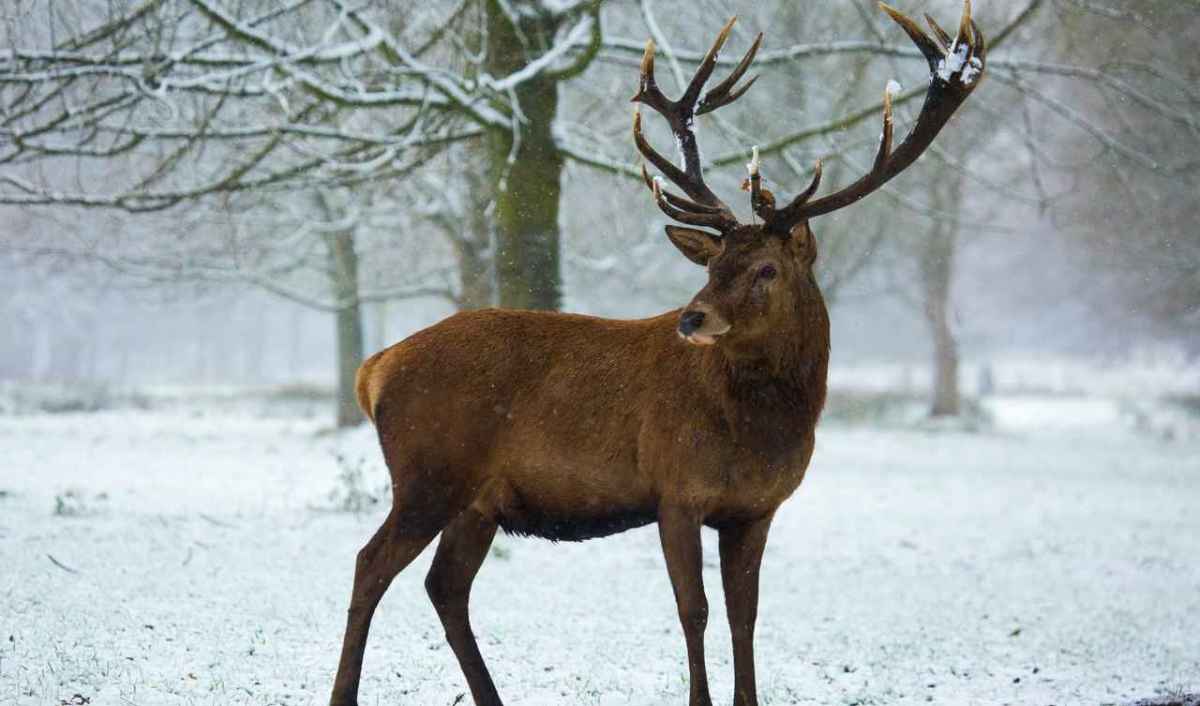
Photo: Diana Parkhouse / Unsplash
More Shots, More Animals
Twenty-five years ago, recreational hunters in Switzerland killed over 39,000 foxes a year; today the figure is around 19,000. The decline is even greater for birds. At the same time, red deer populations are growing, even though almost twice as many red deer are killed today as in 2000. The analysis of the Federal Hunting Statistics over a quarter of a century shows where recreational hunting has eased off, where it has increased, and where it fails to deliver on its own promise.
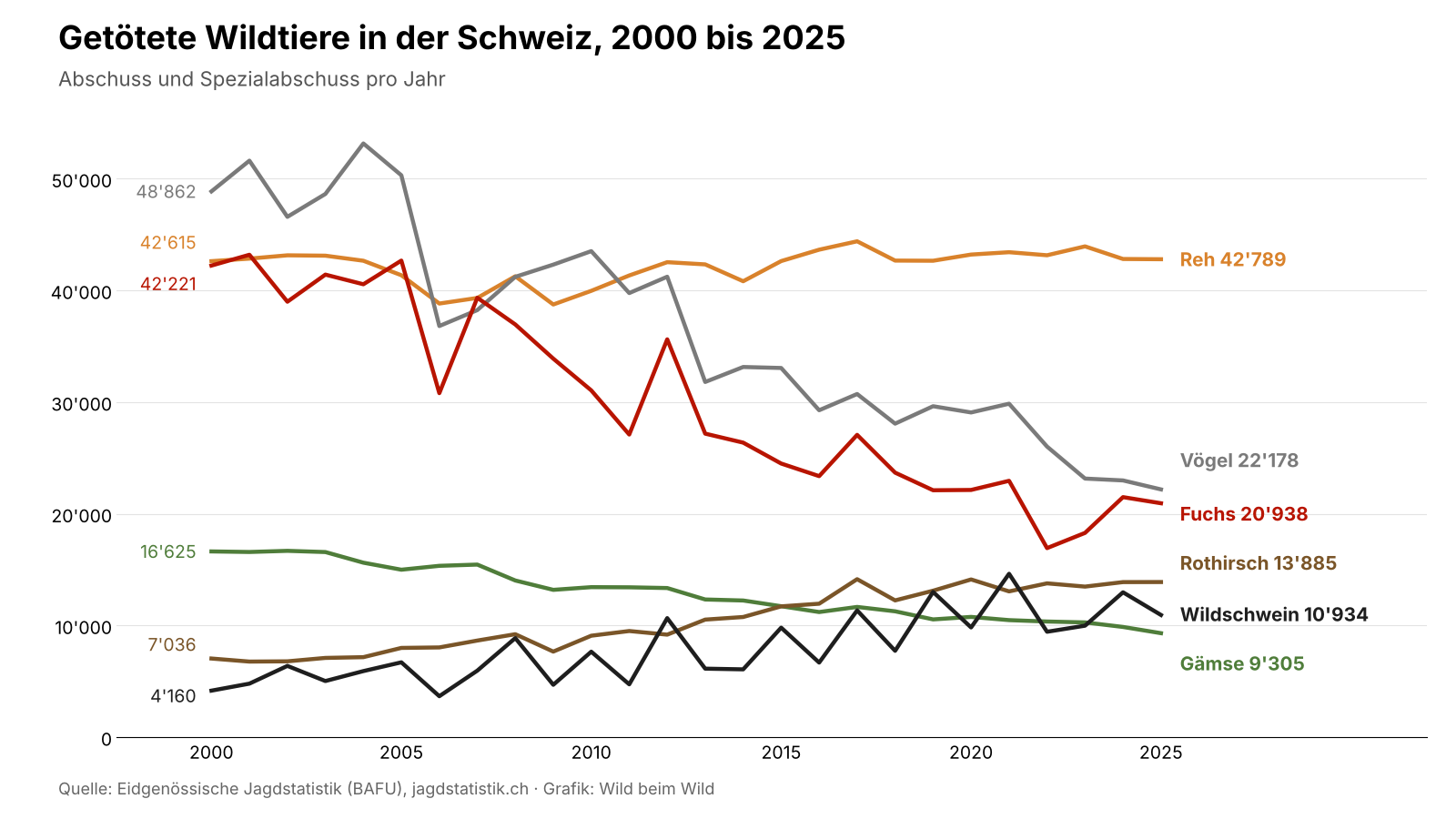
We compare the years 2000 and 2025. 'Killed' means the sum of 'kills' (regular recreational hunting) and 'special kills' (operations outside the regular hunting season, usually carried out by wildlife wardens). We have analysed the figures for individual years in our annual dossiers on the Swiss hunting statistics.
A quarter fewer wild animals killed
In 2000, 179,340 wild animals were killed in Switzerland; in 2025 the figure was 133,508. That is around 26% fewer. The decline concerns regular recreational hunting: the 'kill' category fell from 174,361 to 124,601 animals (−29%). Special kills, by contrast, rose from 4,979 to 8,907 (+79%).
Fox: halved
Fox hunting peaked in 1998 with 44,155 foxes killed. In 2000 the figure was 42,221, and in 2025 it was down to 20,938. The kills by recreational hunters alone fell from 39,208 to 19,208, a drop of 51%. The low point was in 2022, with 16,922 foxes.
Fox hunting fell most sharply in these cantons:
- Bern: from 7,975 to 2,355 foxes killed (−70%)
- Vaud: from 3,514 to 478 (−86%)
- Fribourg: from 2’682 to 1’004 (−63%)
- Jura: from 1’830 to 427 (−77%)
- Ticino: from 609 to 76
The decline was considerably smaller in Grisons (2’725 to 2’027, −26%) and in Valais (1’865 to 1’556, −17%). In Lucerne the figure remained almost unchanged (2’696 to 2’582).
The figures for found-dead animals are revealing, i.e. foxes discovered dead, mostly road casualties. They have not fallen but risen slightly: from 10’686 in 2000 to 11’922 in 2025, with a peak of 13’793 in 2021. Found-dead numbers also depend on traffic and are not a population count. But they show that foxes have not disappeared. And the statistics provide no evidence that the earlier high kill figures were necessary. We explain more about the role of the fox in our dossiers “The Fox in Switzerland” and “Self-regulation of Wildlife Populations”.
Birds: more than halved
In 2000, 48’862 birds were killed; in 2025 it was 22’178. That is 55% fewer. The decline runs across almost all species:
- Eurasian jay: from 8’895 to 1’007 (−89%)
- Carrion crow: from 13’643 to 6’537
- Magpie: from 3’262 to 643
- Feral pigeon: from 7’612 to 4’409
- Mallard: from 6’749 to 3’792
- Pheasant: from 155 to 2
The largest share of the decline is accounted for by the canton of Bern: there, the number of birds killed fell from 13’559 to 1’723. In Zurich it halved from 8’159 to 4’189, in Ticino from 3’700 to 1’862.
Even so, recreational hunters in Switzerland still kill over 19’000 birds every year, including around 1’000 Eurasian jays. A further 2’500 or so birds are killed in special culls. Why this happens is shown in the dossiers “The Eurasian Jay in Switzerland”, “Corvids in Switzerland” and “Waterfowl in Switzerland”.
Ungulates: more kills, yet more red deer
For ungulates, the trend runs in the opposite direction. The number of red deer killed has almost doubled, from 7’036 to 13’885. The population nevertheless continued to grow steadily: according to the cantonal population figures in the hunting statistics, from 23’332 red deer in 2000 to 28’784 (2010) and 38’570 (2020), reaching 39’186 in 2025. That is an increase of 68%.
In 2025, 42’789 roe deer were killed, the same number as in 2000 (42’615). Over the same period, the reported population rose from 128’133 to 135’600. The number of wild boars killed rose from 4’160 to 10’934, more than two and a half times as many. Instead of population figures, the statistics record damage for wild boars. Since 2016 this has fluctuated between 2.7 and 4.3 million francs per year; in 2025 it was 4.1 million. The figures show no decline, even though far more wild boars are killed today than in 2000.
The number of chamois killed fell from 16’625 to 9’305 (−44%), while the reported population remained practically the same at around 90’000 animals.
In the case of red deer, recreational hunting has therefore almost doubled the number of kills since 2000 without getting the population under control. More on this in the dossiers “The Red Deer in Switzerland” and “The Wild Boar in Switzerland”.
Other species
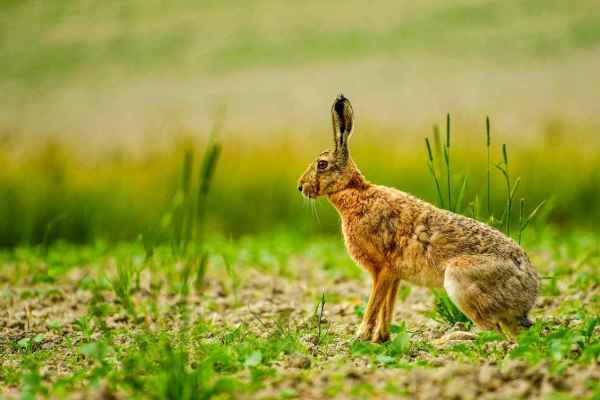
- Brown hare: from 2’584 to 1’343 animals killed. The brown hare is listed as vulnerable on the Red List.
- Marmot: from 7’720 to 5’833
- Rock ptarmigan: from 458 to 223. The species is considered near threatened.
- Male black grouse: from 508 to 292. The black grouse is considered near threatened.
For badgers, by contrast, the number of animals killed rose from 2’693 to 4’049 (+50%).
13% fewer recreational hunters, 26% more game wardens
The number of foxes and birds killed has fallen far more sharply than the number of recreational hunters. The number of people hunting fell from 33’593 in 2000 to 29’328 in 2025, a drop of 13%. For small-game hunting, which includes fox and bird hunting, the number remained almost unchanged: 9’473 in 2000, 9’206 in 2025 (−3%). For the high hunt, the figures were 15’112 and 14’678 (−3%).
The statistics have only reported women separately since 2014. Since then, their number has risen from 355 to 1’463.
The number of full-time game wardens grew from 172 to 216 (+26%). That works out at roughly 136 hunters per game warden. The number of hunting supervisors remained almost the same, at 1’499 and 1’455.
The figures on hunters are the sum of the cantons' returns. Anyone who hunts in several cantons may be counted more than once.
What the statistics do not tell us
The hunting statistics do not record the causes. Whether fewer foxes are being shot because hunting behaviour has changed, because cantons have adapted their regulations or for other reasons cannot be read from the figures.
We have chosen the year 2000 as the starting point for a comparison spanning a quarter of a century. Earlier years are only of limited comparability for birds, because until 1991 the statistics recorded them only in aggregate, for example under “wild duck” rather than by species.
Analysis: Where recreational hunting fails
The figures refute two core claims of recreational hunters at the same time.
First, the claim that without intensive hunting of foxes and birds, nature would fall out of balance. Fox hunting has halved, bird hunting has more than halved. The statistics offer no indication that nature has fallen out of balance as a result. The recreational hunters who have been asserting this for decades have failed to provide proof.
Second, the claim that recreational hunting regulates ungulates. Today almost twice as many red deer are shot as in 2000, and the population continues to grow regardless. When it comes to ungulates, recreational hunting fails completely. The forest bears the consequences: according to the 2025 Forest Report, regeneration cover on 30% of protection forest area is below 5%. The report cites lack of light and heavy browsing damage as the causes, as we show in the dossier “Forest-Wildlife Conflict”. Where the wolf lives, the picture looks different: in the core territory of the Calanda pack, browsing damage to fir, maple and rowan declined markedly. Preserving protection forest requires the wolf, not more kills. Why this is so is explained in the dossier “Wolf: Ecological Function and Political Reality”.
Nevertheless, the cantons, with the blessing of the Confederation, have wolves shot, that is, precisely the actor that demonstrably has an effect on ungulates. That special hunts and the number of game wardens are increasing at the same time shows that professional wildlife management is gaining weight. The canton of Geneva has demonstrated since 1974 that it is possible without recreational hunting. How such a model works is described in the dossier “The Game Warden Model”.
The individual years in detail: 2025, 2024, 2023, 2022, 2021.
More on the subject of recreational hunting: In our dossiers on the criticism of recreational hunting gather fact-checks, analyses and background reports. What the research says about this is shown by Hunting fact-checked: the state of research.
The position of IG Wild beim Wild: IG Wild beim Wild rejects recreational hunting. Our model is the canton of Geneva, which has managed without recreational hunting since 1974: without hunting seasons, without hunting dogs, without driven hunts, without high seats, without the animal cruelty and crime that go hand in hand with hunting season elsewhere. What has worked there for over fifty years disproves every position paper by JagdSchweiz. An association that bases its policy on claims it refutes in its own documents is not a professional organisation, but a factory for misinformation.
Wild animals need a voice
Once a week: research, petitions and background information on recreational hunting. Free of charge and can be unsubscribed from at any time.

All articles are written by IG Wild beim Wild as well as by external co-authors. Research, structuring and editorial processes may be supported by AI-assisted tools.
Support our work
With your donation you help protect animals and give their voice a hearing.
Donate now →