France protects the rock ptarmigan, while in Switzerland it is still shot
France has removed the rock ptarmigan and the capercaillie from the list of huntable species. In Switzerland, where 40 per cent of Central Europe's ptarmigan breed, the shooting season reopened on 16 October.
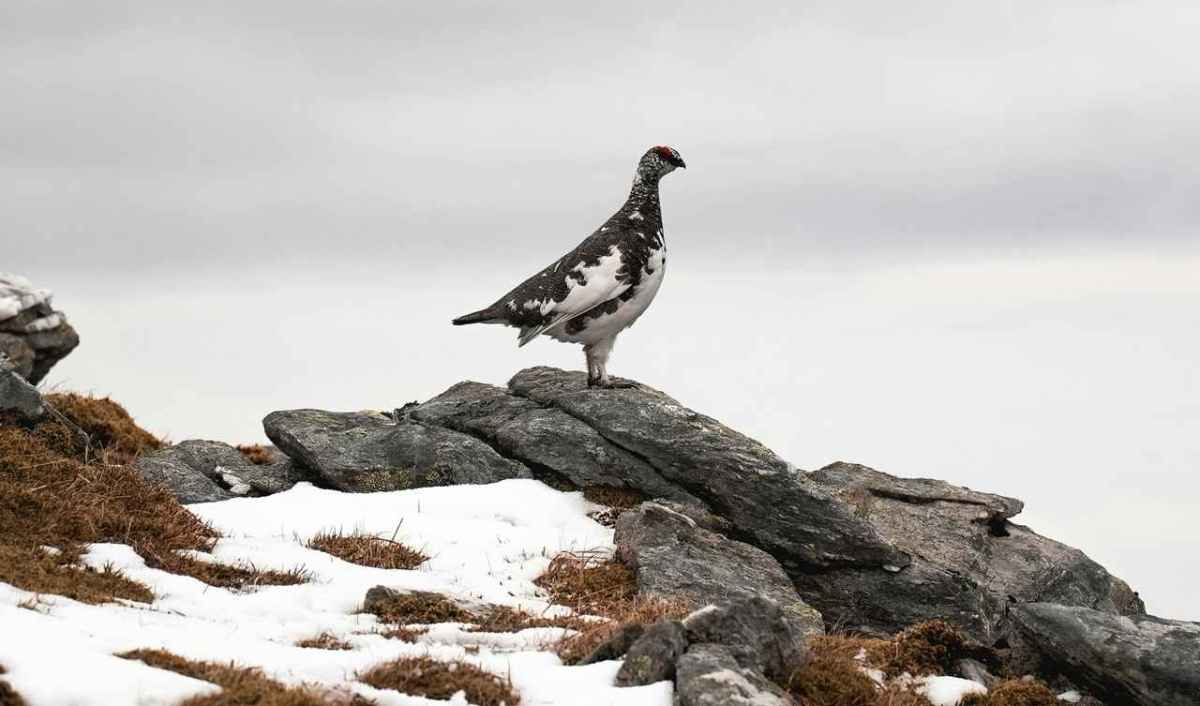
Rock ptarmigan. Photo: J M / Unsplash
“In White Clothing”
Since 16 October, rock ptarmigan have been open to hunting in Grisons and Valais. The species also remains huntable in the canton of Uri. France has simultaneously taken the opposite path and placed the rock ptarmigan and the capercaillie under strict protection.
What France has decided
On 8 September 2026, the French Official Journal published two decrees. One adds the rock ptarmigan (lagopède alpin) and the capercaillie (grand tétras) to the list of protected bird species; it is dated 12 August 2026. The other removes both species from the list of huntable species. This means more than a ban on shooting: nests and eggs are also protected, and deliberate disturbance is prohibited where it endangers the breeding cycle. According to France Nature Environnement, this is the first extension of this protection list since 2009.
The impetus came from a court. On 2 March 2026, the Conseil d’État, France's highest administrative court, ordered the government to suspend rock ptarmigan hunting nationwide for five years. For a species with steadily declining populations, hunting is incompatible with conservation efforts, the court held. For the capercaillie, it had already demanded a five-year hunting pause in 2022.
The government went beyond the ruling and turned the temporary moratorium into permanent protection. The National Council for the Protection of Nature endorsed this in June 2026. In the public consultations, more than 10,000 responses were received for the rock ptarmigan and around 16,800 for the capercaillie. According to reports on the ruling the rock ptarmigan has disappeared since 1950 from a third of the Alpine municipalities where it once occurred, and from a good fifth in the Pyrenees.
The protection was won by nature conservation organisations. The Comité Écologique Ariégeois had been challenging the kill permits in the Pyrenees since 2008, and the bird protection organisation LPO and One Voice later joined in. The prefectures nevertheless issued new kill quotas year after year, and the courts overturned them year after year. In 2022, the Toulouse administrative court therefore convicted the state for culpable conduct. The recreational hunting associations argued to the end that hunting was not the main cause of the decline. The government did not accept this argument: in its grounds for the decision it points to the species' conservation status and its shrinking range.
Switzerland: shooting season since 16 October
In Switzerland, the rock ptarmigan remains a huntable species. It is still hunted in the Grisons, Valais and Uri; in Ticino, according to the Swiss Ornithological Institute, none has been shot since 2019. This season, a recreational hunter may shoot up to ten ptarmigan in the Grisons and six in Valais. The details can be found in the article Low-ground hunt 2026: What Grisons, Ticino and Valais are releasing for the kill. According to Federal Hunting Statistics 223 ptarmigan were killed in the three cantons in 2025, 153 of them in the Grisons. From 2016 to 2025 the figure was 3’346.
The Swiss Ornithological Institute lists the rock ptarmigan on the Red List as near threatened. Around 40 per cent of the Central European population breeds in Switzerland, which gives the country a high international responsibility. The Swiss Ornithological Institute puts the decline in territorial males since 1995 at 13 per cent, and says the population has remained at a markedly lower level than in the 1990s since around 2008. In a statement from January 2023, it spoke of the overall population being roughly a third smaller since the mid-1990s. The Institute names climate warming as the most likely cause and expects the range to shrink further. A study involving the WSL and the Swiss Ornithological Institute forecasts a loss of 24 to 59 per cent of suitable habitat by the middle of the century. In the event of more strongly negative trends, the Institute demands that hunting pressure be reduced or hunting stopped altogether.
In Uri, voters narrowly rejected the initiative 'Let the ptarmigan and mountain hare live!' in May 2025, with 52.9 per cent voting no. In June 2026, the cantonal government wrote in its Response to an interpellation, there are no numerical hunting targets for the rock ptarmigan and the mountain hare. The aim, he says, is to be able to «use the species for hunting» without negatively affecting populations. He considers additional scientific monitoring disproportionate. In Uri, three test areas of roughly one square kilometre each are counted. Everything else about the species' situation can be found in the Rock Ptarmigan Dossier.
Same species, opposite conclusions
France and the Swiss hunting cantons interpret similar findings in completely different ways. In France, a shrinking range is enough to ban hunting. In Switzerland, a population that has settled at a lower level is treated as justification for continuing to shoot.
That the effect of hunting on the rock ptarmigan is «controversial» was also stated in 2022 by Wildtier Schweiz in a study. The client was JagdSchweiz, the umbrella organisation of recreational hunters. How closely Wildtier Schweiz is intertwined with recreational hunting is shown by the article Wildtier Schweiz: research label, recreational hunting core.
With the capercaillie, Switzerland is further ahead than France: the bird has been protected here for decades. Protection alone has not saved it, however. A nationwide count in 2001 still found 450 to 500 males, half as many as in 1971. In the canton of Fribourg the species is now considered practically extinct, as the article The capercaillie is practically extinct in Fribourg shows. Anyone who waits until a species collapses arrives too late with protection.
Commentary: A climate victim as recreational prey
No canton can do anything about climate change on its own. Against the kill, however, it can, and with a single change to the hunting regulations. The federal hunting act expressly allows the cantons to remove species from the list of huntable animals. Grisons, Valais and Uri decline to do so.
Every kill takes another animal from a species whose habitat is melting away anyway. Not even the authorities claim that this hunt is necessary: Uri openly speaks of «use», Grisons of sustainable use. Robert Brunold, then president of the Grisons licence hunters' association, told SRF in 2015 that for most of them, hunting ptarmigan is about having such an animal stuffed at home. For a mounted specimen on the wall, Switzerland is gambling with a species for which it bears responsibility across Europe.
France has shown that it can be done. There it took the courts, because the administration listened to recreational hunters for years. In Switzerland, the cantonal parliaments can act on their own. Anyone who wants to write to their elected representatives in the Grisons, Valais or Uri will find templates on the website template texts for hunting-critical motions in cantonal parliaments.
Sources: Arrêté du 12 août 2026 modifiant l’arrêté du 29 octobre 2009 fixant la liste des oiseaux protégés, published in the Journal officiel of 8 September 2026; Conseil d’État, decision no. 497460 of 2 March 2026; Conseil national de la protection de la nature, deliberation no. 2026-19 of 17 June 2026; Ministère de la Transition écologique, statement of reasons and summary of the consultation, 2026; France Nature Environnement Occitanie Pyrénées, 9 September 2026; FOEN, Swiss Federal Hunting Statistics, accessed on 24 October 2026; Swiss Ornithological Institute, «Bird hunting in Switzerland» and press release of 24 January 2023; Global Change Biology, April 2022; Cantonal Government of Uri, reply to the interpellation by Loa Wild, 16 June 2026; Canton of Uri, voting result of 18 May 2025; Wildtier Schweiz, «Effects of huntability on black grouse, rock ptarmigan, woodcock, brown hare and mountain hare», 2022; FOEN, Capercaillie Action Plan Switzerland, 2008; SRF, Regionaljournal Graubünden, 6 October 2015.
More on the subject of recreational hunting: In our dossiers on recreational hunting gather fact-checks, analyses and background reports. The scientific evidence is presented in the overview Studies on the Effects of Recreational Hunting.
The position of IG Wild beim Wild: IG Wild beim Wild rejects recreational hunting. Our model is the canton of Geneva, which has managed without recreational hunting since 1974: without hunting seasons, without hunting dogs, without driven hunts, without high seats, without the animal cruelty and crime that go hand in hand with hunting season elsewhere. What has worked there for over fifty years disproves every position paper by JagdSchweiz. An association that bases its policy on claims it refutes in its own documents is not a professional organisation, but a factory for misinformation.
Wild animals need a voice
Once a week: research, petitions and background information on recreational hunting. Free of charge and can be unsubscribed from at any time.

All articles are written by IG Wild beim Wild as well as by external co-authors. Research, structuring and editorial processes may be supported by AI-assisted tools.
Support our work
With your donation you help protect animals and give their voice a hearing.
Donate now →