Wild animals as scapegoats: what is making France's forests sick
A new French state report calls for a "regulatory shock" against red deer, roe deer and wild boars, yet a counter-analysis shows that the real causes of forest decline lie in industrial forestry, habitat fragmentation and the disturbance regime of recreational hunting.
The joint report by the state and the ONF covering the period 2026 to 2030 explains the crisis of French forests primarily through climate change and an alleged overpopulation of wild ungulates.
The analysis by the "Collectif pour un Equilibre Forestier Naturel" disagrees: it is not wild animals that are making the forests sick, but monocultures, clear-cuts, heavy interventions in soils and a hunting practice that itself generates new damage.
The report and its bias
At first glance, CGAAER report n° 24100 and IGEDD report n° 015934-01 read like a sober administrative document, but their political thrust is clear. They bet on a "choc de régulation des ongulés sauvages", that is, on massively intensified kills up to local eradication. At the same time, the national technical committee appointed to address "sylvo-cynegetic balance" operates with a striking one-sidedness, since conservation associations and independent science are not represented there.
The counter-analysis turns this into a systemic critique: anyone who views the forest solely as a production space and wild animals solely as a disturbance factor produces precisely the mismanagement that they later present as a natural crisis. This point is central for wildbeimwild.com because it makes hunting visible not as a solution but as part of the problem. The text therefore does not stop at morality, but moves on to the question of power, interpretive authority and false causes.
The myth of overpopulation
According to the counter-analysis, official reasoning relies above all on kill figures: more takings are supposed to automatically mean more animals. The analysis describes this as a self-referential model, because high kill quotas are first based on questionable population assumptions, and the subsequent fulfilment of those quotas is then used as evidence for those very assumptions. Such a procedure does not prove overpopulation, but rather the political and hunting bias of the system.
This is particularly evident in the example of the Forêt de Compiègne. There, the Indice Nocturne d'Abondance fell by 50.9 per cent between 2006 and 2019, while the kill quota for 2020/21 was never fully met despite being reduced. The age structure also argues against a stable or growing population: when 90 per cent of the red deer killed are younger than six years old, this is not a sign of robust stocks, but rather an indication of demographic impoverishment. The hunting lobby therefore cannot score points here with its usual narrative of "exploding game density".
What really weakens the forest
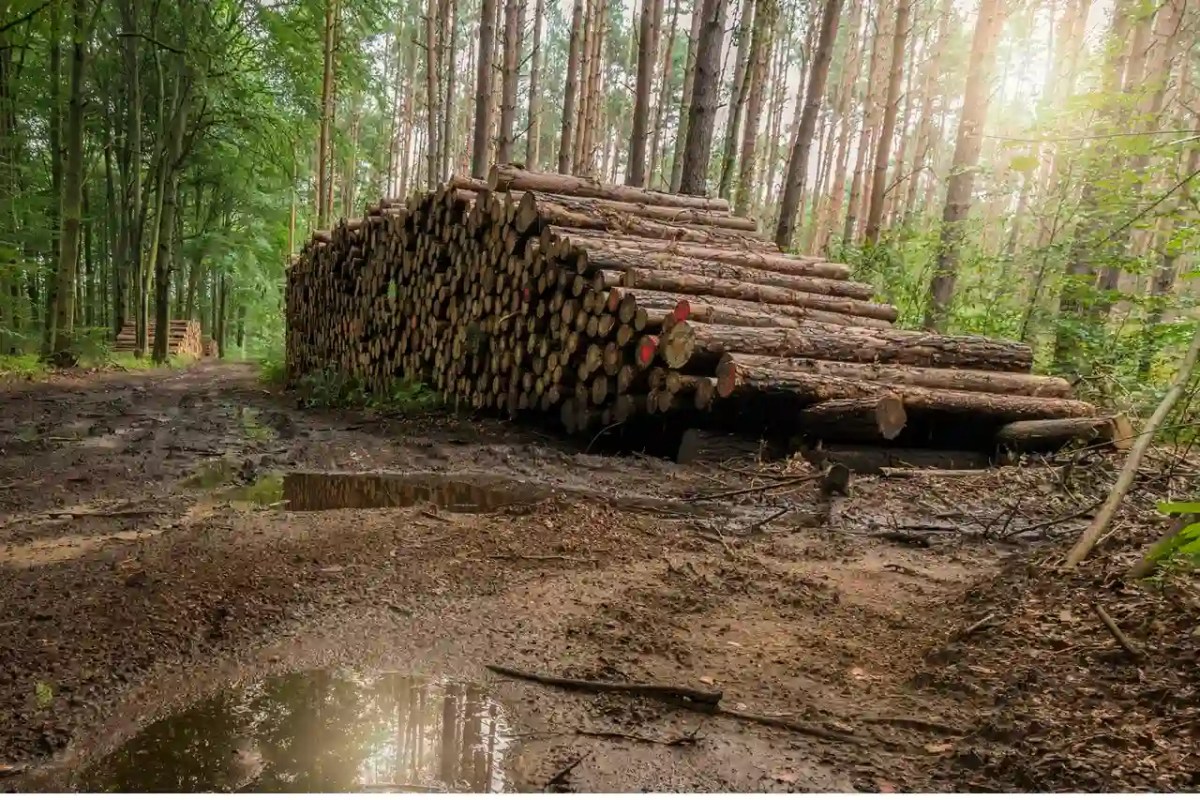
The analysis locates the real causes in the transformation of the forest into an industrial space. Instead of diverse mixed forests, monocultures dominate — above all Douglas fir, spruce and pine — together with clear-cutting, shortened rotation periods and heavy machinery that compacts soils and destroys mycorrhizal networks. This is not merely a question of forest management, but an intervention in the ecological foundation of the system.
On top of this comes a second industrialisation through recreational hunting itself. High seats, shooting lanes, baiting sites, driven hunt infrastructures and, in some regions, even fences further fragment the landscape. The result is a forest that no longer functions as a complex ecosystem, but as a division between timber production and wildlife management. It is precisely this logic that aggravates the problems it claims to solve.
Recreational hunting as a disturbance
The counter-analysis here draws on several behavioural-ecology studies. Hunting pressure alters activity patterns, spatial choices and physiology of animals — through increased stress, nocturnal activity and retreat into denser, poorer habitats. This is the "landscape of fear": the animals are not reacting to natural predation, but to human persecution.
The distinction matters, because recreational hunting does not replace any predator. Predators select weak or sick animals and thus stabilise populations in the long term, whereas recreational hunters often remove dominant, visible or trophy-grade individuals. It is precisely this that produces selective and evolutionary effects which have little to do with "regulation". And when browsing damage is then used as the justification for yet more hunting, the argument finally collapses into a circular one.
Geneva as a counter-example
Particularly powerful is the reference to the Geneva model. Since the popular vote of 1974, there has been no recreational hunting there; wildlife management is in the hands of professional game wardens employed by the canton. Geneva thus demonstrates that wildlife management works perfectly well without recreational killing. This refutes the claim that the absence of recreational hunting would automatically lead to ecological chaos.
International examples also speak against such dramatisation. In the Abruzzo, in Białowieża, or in regions without fox hunting, stable or robust ecological dynamics are evident, even though large herbivores or predators are present. What matters, then, is not blanket shooting, but the integrity of the habitat.
Sources:
- La chasse réguler ou dérégler?
- Les ongulés sauvages n'y sont pour rien : pour une remise à plat des causes réelles du dépérissement des forêts
More on the subject of recreational hunting: The scientific evidence is presented in the overview Studies on the Effects of Recreational Hunting.
The position of IG Wild beim Wild: IG Wild beim Wild rejects recreational hunting. Our model is the canton of Geneva, which has managed without recreational hunting since 1974: without hunting seasons, without hunting dogs, without driven hunts, without high seats, without the animal cruelty and crime that go hand in hand with hunting season elsewhere. What has worked there for over fifty years disproves every position paper by JagdSchweiz. An association that bases its policy on claims it refutes in its own documents is not a professional organisation, but a factory for misinformation.