Sumvitg: CHF 1.5 million for a fence around 25 hectares of protection forest
A wildlife fence more than 2.5 kilometres long is meant to save the Puzzastg protection forest near Sumvitg from browsing damage, paid for largely by the canton. At the same time, Grisons is decimating the region's wolf packs.
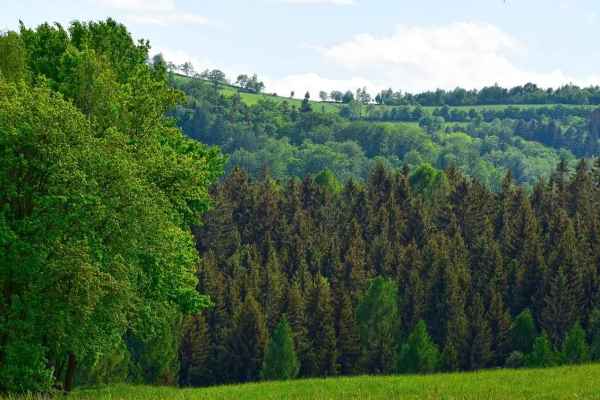
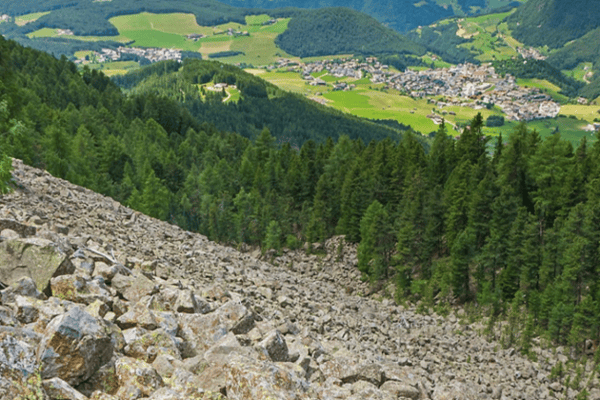
Above Surrein in the municipality of Sumvitg, there has been a structure since this summer that Switzerland has never seen before: a wildlife fence more than two and a half kilometres long and 2.5 metres high, enclosing 25 hectares of protection forest. According to SRF, construction cost around CHF 1.5 million, most of it borne by the canton of Grisons. The fence has been closed since the end of July. It is meant to keep red deer, chamois and roe deer out of the Uaul Puzzastg, which protects Surrein from avalanches, rockfall and debris flows.
That is not the end of it. Over the coming years, more than 20,000 young trees are to be planted inside the fence, some of them by volunteers from the Bergwaldprojekt. Whether the measure works will only become clear over decades; ETH Zurich is providing scientific monitoring of the project. The fence cost just under CHF 600 per running metre and around CHF 60,000 per hectare of protected area.
The planner does not want a precedent
What the experts themselves say about their structure is remarkable. Forester Beat Cadruvi told SRF that this forest will no longer recover on its own. The fence was planned by forestry engineer Nora Zürcher-Gasser. For her, it was the only realistic way to secure its protective function. At the same time, she stresses that the fence should not become a 'showcase project' for other regions, because it intrudes heavily on the landscape: 'I hope it will not have to come to such solutions elsewhere.'
Zürcher-Gasser knows the case like hardly anyone else: she is a co-author of the cost study by the Office for Forests and Natural Hazards of 2017 on this very forest. The fence is therefore a local emergency measure for a single slope, not a transferable solution for the Grisons protection forest.
Three decades of recreational hunting, and the forest still does not regenerate
The problem is an old one. As early as at meetings of the mountain forest management group in 1988 and 1997, a high urgency for regeneration and excessive browsing damage were identified in the Uaul Puzzastg. In the early 1990s, a focused hunting effort on chamois and red deer was therefore introduced. Since then, avalanche barriers worth several million francs have been built, and some of these temporary structures have already had to be replaced because no regeneration took hold.
In its reply to the Kreiliger inquiry of February 2025, the Grisons government itself stated what the cause is: the damage occurs mainly in winter, when chamois migrate in from their summer ranges. The number of chamois, it said, plays only a minor role; even a single chamois can jeopardise the silvicultural objectives.
This is a remarkable statement. It calls into question a policy that measures its success chiefly by population figures and kill quotas. If a few non-human animals are enough to prevent regeneration, recreational hunting reaches its limits as an instrument, and with the fence the canton has conceded exactly that. Wolves can influence not only numbers but also the behaviour and use of space of ungulates. How much this relieves pressure on forest regeneration depends on the site. What became visible at the Calanda and what predators mean for the Swiss forest has been documented in detail by Wild beim Wild. That the canton has failed to bring its red deer populations under control through recreational hunting since the reduction decision of 1989 is shown by the analysis “What does recreational hunting cost us?”.
Wolves are being killed in the same region
While fencing and planting go on in Sumvitg, Grisons reported in its wolf regulation summary for 2025/26 a total of 35 wolves killed: 18 as part of the pup regulation, 14 in pack removals and three lone wolves whose killing was ordered because of problematic behaviour. The regulated packs also included Stagias and Frisal in the Surselva. In early January 2026, a recreational hunter on a wait hunt in the Surselva also shot a young wolf by mistake. The canton subsequently halted the regulation of the possibly affected Frisal pack ahead of schedule. Wild beim Wild tracks the kills of the current season in the Wolf kill counter Switzerland 2026/27.
Ironically, the Bergwaldprojekt, which is now planting inside the fence, sees things differently from the canton. In its response to the hunting ordinance of 2024, it states that the wolf is a beneficial species in protection forests, and demands that proactive wolf regulation there be permitted only if forest regeneration is secured.
Official cost estimates are too low
Puzzastg itself shows how expensive browsing damage in protection forests actually becomes. The 2017 study modelled the additional browsing-related costs over 50 years for the 33-hectare forest area examined at the time, discounted at 2 per cent: 3.2 million francs without a fence, 1.85 million francs with a 2.7-kilometre wildlife fence. This model calculation is not equivalent to construction costs. Yet today the construction of the fence alone has cost 1.5 million francs, and the planting of more than 20,000 young trees and decades of maintenance are still to come.
Similar model calculations by the canton for other protection forests arrive at 1.5 million francs for the Gruobenwald-Tschägibach in the Prättigau and, for the Schwarzwald Chur, depending on the scenario, 1.6 to 3.3 million francs over 50 years. Judging by Puzzastg, these figures are more likely to underestimate reality.
122,000 hectares cannot be fenced in
Around 60 per cent of Grisons forest, a good 122,000 hectares, is protection forest. The fence in Sumvitg secures 25 hectares of it, or roughly 0.02 per cent. The government has already stated that further large-scale fencing of entire protection forests is not currently planned. The costs of browsing damage nevertheless continue to mount. Who ultimately bears them is something Wild beim Wild has set out in its calculation on recreational hunting and the taxpayer.
Commentary: A fence as an admission of failure
The Sumvitg fence is a monument to the failure of Grisons forest-wildlife policy. For over 30 years the authorities relied on recreational hunting to save this protection forest. The result is millions spent on avalanche barriers that had to be replaced, and now 1.5 million francs of taxpayers' money for a fence that even its own planner does not want to see anywhere else.
Consider the chain of events for a moment. Taxpayers pay for the wildlife wardens who shoot wolves on behalf of the canton. Since 2012 they have paid more than 17 million francs for fences, netting and plastic tubes against browsing damage. They pay for avalanche barriers that have to be replaced because the forest is not regrowing. And now they are paying 1.5 million francs for a fence behind which volunteers plant trees free of charge. Recreational hunting, meanwhile, which has failed to solve the problem in over 30 years, carries on as before as if nothing had happened. This is not forest-wildlife policy; it is a cycle in which the public foots the bill every time round, and the most absurd part is that nobody stops it.
At the same time, the same canton is having wolves shot in the region, wolves that the Bergwaldprojekt describes as beneficial to the protection forest. Nobody claims that wolves would have prevented the fence in Puzzastg; the problem is older than their return. But a policy that fulfils kill quotas and then fences off the consequences is measuring the wrong thing. Anyone who takes the protection forest seriously measures success by the forest that regrows, not by the number of dead wolves and chamois. As long as Grisons fights predators while pouring millions into fences, the canton is voluntarily giving up an ally of the forest, and taxpayers pay for it.
More on the subject of recreational hunting: What the research says about this is shown by Hunting fact-checked: the state of research.
The position of IG Wild beim Wild: IG Wild beim Wild rejects recreational hunting. Our model is the canton of Geneva, which has managed without recreational hunting since 1974: without hunting seasons, without hunting dogs, without driven hunts, without high seats, without the animal cruelty and crime that go hand in hand with hunting season elsewhere. What has worked there for over fifty years disproves every position paper by JagdSchweiz. An association that bases its policy on claims it refutes in its own documents is not a professional organisation, but a factory for misinformation.
Wild animals need a voice
Once a week: research, petitions and background information on recreational hunting. Free of charge and can be unsubscribed from at any time.

All articles are written by IG Wild beim Wild as well as by external co-authors. Research, structuring and editorial processes may be supported by AI-assisted tools.
Support our work
With your donation you help protect animals and give their voice a hearing.
Donate now →