Wildlife wardens can already deter wolves today: what the wolf motion wants
The Council of States committee wants to send out herd protection staff armed with weapons and non-lethal ammunition against wolves. Wildlife wardens can already carry out deterrence today. What would be new are armed laypeople in wolf territory, and the ban on night hunting in forests is to be dropped.
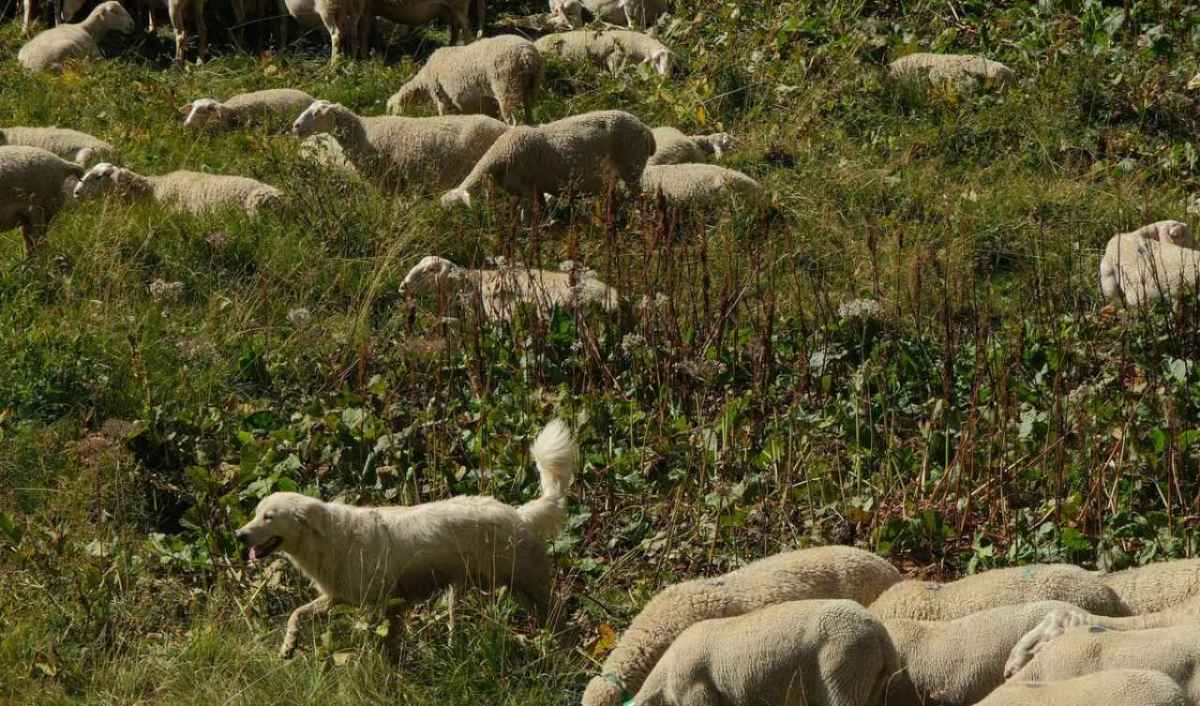
Herd protection works without weapons: a livestock guardian dog with a flock of sheep on the alp. Photo: Rosalie Gdy / Unsplash
«The Stolen Night»
At its meeting on 26 and 27 October 2026, the environment committee of the Council of States (UREK-S) adopted motion 23.3828 by Fabio Regazzi (Centre, Ticino) by 6 votes to 4, as the Parliamentary Services announced on 28 October. It calls for a legal basis for «driven hunts by herd patrols» against wolves, «including the use of weapons with non-lethal ammunition for herd protection staff», and for federal funding. That sounds like a gentle instrument. In reality, deterrence with rubber shot has long been practised. What the motion adds is something else: firearms in the hands of herd protection staff and volunteers.
What the motion demands
The text of the motion is short. The Federal Council is to «create the necessary legal basis in the hunting act for carrying out deterrence measures against wolves on alps or pastures» and regulate «the corresponding funding», «in particular the possibility of driven hunts by herd patrols, including the use of weapons with non-lethal ammunition for herd protection staff».
In his justification, Regazzi is more explicit. Fences and livestock guardian dogs worked «only to a limited extent» and had «a rather unfavourable cost-benefit ratio». The aim is «to reawaken the wolf's fear of humans». This requires «regular operations to drive off wolves», which «require exemptions from existing laws and many volunteers who have to be selected, trained and compensated».
Regazzi submitted the motion on 15 June 2023, while still a member of the National Council. The National Council adopted it on 19 June 2025 by 95 votes to 87, with 4 abstentions. Now the preliminary advisory committee of the Council of States has given its approval. The committee majority considers such measures "necessary to better protect livestock from wolf attacks and to strengthen alpine farming".
Deterrence already exists, just not by laypeople
The decisive sentence appears in the Federal Council's statement of 30 August 2023: "The cantonal hunting police bodies already hold a permit to carry weapons." And further: "Experience in the cantons with the use of rubber shot against wolves shows that this ammunition is only effective at a distance of less than 25 metres. Such close wolf encounters, however, occur so rarely that this deterrence method hardly appears to serve its purpose."
In other words: wildlife wardens already deter wolves today with non-lethal ammunition. Ticino recently confirmed this itself. In its reply of 7 October 2026 to interrogazione 48.26 on wolves in residential areas, the Council of State states that, in the case of repeated sightings, the wildlife wardens use camera traps and patrols and may fire deterrent shots with non-lethal ammunition (see Ticino ticker of 16 October).
So the motion does not invent deterrence. It relocates it. Away from the state wildlife wardens, towards "herd protection personnel" and "volunteers". This is precisely the point on which the Federal Council says no. Rubber shot is fired from weapons "from which lethal ammunition can be fired at any time". The federal Weapons Act prohibits, "with exceptions (e.g. military, police)", the carrying and use of such weapons in public space. For a herd patrol, this barrier would have to fall.
Who patrols, and who supervises?
The motion leaves open who is to provide the "herd protection personnel". Shepherds? Alpine farming families? Or recreational hunters, who are armed anyway and are already deployed for wolf regulation in the Grisons, Valais and Ticino? Ticino pays them for this 500 francs per wolf killed.
Nobody can check in the field whether a shotgun is loaded with rubber shot or lead shot. In his own justification, Regazzi writes that his measure requires «exemptions from existing laws». For the wolf, that would mean more armed people in its habitat, at night, on alpine pastures where follow-up searches are difficult and witnesses are absent. That deterrence can turn into poaching under such conditions is no theoretical risk. Of 128 wolves found dead between 1998 and August 2023, 19 had been illegally killed or previously shot at illegally, according to SRF's 'Rundschau', more than one in seven; the FOEN confirmed the figures.
Then there is the question of effectiveness. If rubber shot only works at under 25 metres, as the Federal Council notes, a patrol on an extensive alpine pasture achieves little. What it does achieve is disturbance for all the wild animals living there, and for the herd itself.
The Confederation supplies the argument against the kills itself
What the Confederation itself states is remarkable. According to an interim FOEN assessment from the end of May 2025, which Keystone-SDA supplies as context for the debate, the number of livestock kills has fallen back to the 2021 level after the peak of 2022, which the federal office attributes, among other things, to greater financial resources for herd protection. In the National Council debate of June 2025, Federal Councillor Albert Rösti said that the provisions on preventing wolf damage had been tightened since the motion was submitted, and that environmental organisations had also accepted them.
The Gruppe Wolf Schweiz reported around 180 livestock killed for the 2026 alpine season, compared with more than 400 the previous year (SRF, 17 October 2026). At the same time, according to its overview of 4 October 2026, the FOEN has already granted 39 approvals for preventive regulation affecting 37 packs in seven cantons; in 2025 it was 22 packs, according to SRF. If herd protection works and kills are falling, the justification for precautionary pack culls disappears. Wildlife ecologist Raphaël Arlettaz recently set out that wolf kills actually boost reproduction. The current state of the killings can be found in the wolf kill counter 2026/27.
The same session: threshold reaffirmed, night hunting ban set to fall
The deterrence motion was not the only wolf and hunting item on the Senate Environment Committee's (UREK-S) agenda at this meeting. By 8 votes to 2, the committee also adopted Motion 25.4472 by Alex Farinelli (FDP, TI), which calls for an upper threshold for the wolf population. It is worded identically to the already approved Motion 25.4464 by Regazzi. The committee rejected the Ticino cantonal initiative 26.307, which pursues the same aim, by 5 votes to 4 with 1 abstention, arguing that the matter is already covered. By 9 votes to 0 with 2 abstentions, it also recommends adopting Motion 25.4541 by Marianne Maret (Mitte, VS), under which livestock guardian dogs are in future to be tested directly on their own alp rather than in unfamiliar surroundings. Herd protection is thus not being rejected but restructured, while at the same time more weapons are to be brought into the field.
A third decision passed largely unnoticed. By 10 votes to 1, the committee submitted a motion of its own, entitled «Night hunting rules remain a matter for the cantons» (26.4710). It demands that «the setting of night hunting bans and the definition of exceptions continue to fall within the competence of the cantons», and that Article 3ter of the Hunting Ordinance be «amended accordingly or repealed». The night hunting ban in forests has been in force since 1 February 2025 and, according to the press release, was introduced at the request of several cantons and the Conference for Forests, Wildlife and Landscape. The committee does «not fundamentally reject» a ban, but wants to leave the decision to the cantons.
The night hunting ban was full of gaps anyway: according to the FOEN (BAFU) explanatory notes and the cantonal implementations, night only counts as the period from one hour after sunset to one hour before sunrise, the ban does not apply outside forests, and nocturnal wait hunting of fox, badger and marten remains permitted in winter even in forests. Now even this minimal protection is to be handed back to the cantons, that is, to the very bodies in which recreational hunters traditionally call the shots. For cantonal parliaments that wish to go in the opposite direction, a template text against recreational hunting at dusk and night is available.
Context
The three decisions follow a pattern. Instruments that already exist are sold as new (deterrence). Decisions that have already been taken are taken a second time (threshold value). And protective provisions that have only just come into force are put back up for debate (night hunting). What all three have in common: they bring more weapons, more hunting pressure and more decision-making power for those who are already doing the shooting.
Next, the plenary of the Council of States will decide. Whether Motion 23.3828 will be placed on the agenda of the winter session from 30 November to 18 December 2026 has not yet been settled; the session programme had not yet been published on 30 October. If the Council of States adopts the motion, it is referred on, and the Federal Council must draw up an amendment to the law.
Sources
- Parlament.ch, press release of the ENVI-S committee of 28 October 2026 on the meeting of 26 and 27 October 2026: Approval of two supplementary credits for reserve power plants (sections “Strengthening wolf regulation” and “Night hunting: cantons to decide”)
- Curia Vista, Motion 23.3828 Regazzi: Creation of the legal basis for active measures to prevent wolf attacks in alpine and pasture areas (text of the motion, justification, Federal Council opinion of 30 August 2023)
- Keystone-SDA via Bluewin, 28 October 2026: Council of States committee wants to deter wolves
- Parlament.ch / SDA, 19 June 2025: National Council wants to deter wolves with non-lethal ammunition
- SRF, 17 October 2026: Schwyz wolves under fire, politically too (GWS figure: 180 livestock animals, 22 packs in 2025)
- FOEN, overview of 4 October 2026 (39 approvals, 37 packs), cited from the WBW counter of wolf kills 2026/27
- Parlament.ch: Session dates, winter session 30 November to 18 December 2026
- Curia Vista, Motion 26.4710 of the ENVI-S (submitted 27 October 2026): night hunting rules remain a matter for the cantons
- Curia Vista, Motion 25.4541 Maret: Adjustment of the testing and recognition of livestock guardian dogs
- SRF “Rundschau”, 2023: One in seven dead wolves was poached (128 dead wolves from 1998 to August 2023, 11 killed illegally, 8 previously shot at illegally)
- Hunting Ordinance (JSV), SR 922.01, Art. 3ter; definition of night according to FOEN explanatory notes and cantonal implementations, e.g. Hunting calendar of the canton of Lucerne
More on the subject of recreational hunting: In our dossiers on recreational hunting gather fact-checks, analyses and background reports. What the research says about this is shown by Hunting fact-checked: the state of research.
The position of IG Wild beim Wild: IG Wild beim Wild rejects recreational hunting. Our model is the canton of Geneva, which has managed without recreational hunting since 1974: without hunting seasons, without hunting dogs, without driven hunts, without high seats, without the animal cruelty and crime that go hand in hand with hunting season elsewhere. What has worked there for over fifty years disproves every position paper by JagdSchweiz. An association that bases its policy on claims it refutes in its own documents is not a professional organisation, but a factory for misinformation.
Wild animals need a voice
Once a week: research, petitions and background information on recreational hunting. Free of charge and can be unsubscribed from at any time.

All articles are written by IG Wild beim Wild as well as by external co-authors. Research, structuring and editorial processes may be supported by AI-assisted tools.
Support our work
With your donation you help protect animals and give their voice a hearing.
Donate now →