Poland: 204,000 signatures against recreational hunting, parliament must debate reform
A citizens' initiative is forcing the Sejm to debate a law intended to put an end to hunting for pleasure, hunting tourism and the lack of transparency of the hunting association.
In Poland, a citizens' initiative has achieved what no movement in Switzerland has yet managed: it has forced the national parliament to address a fundamental reform of recreational hunting.
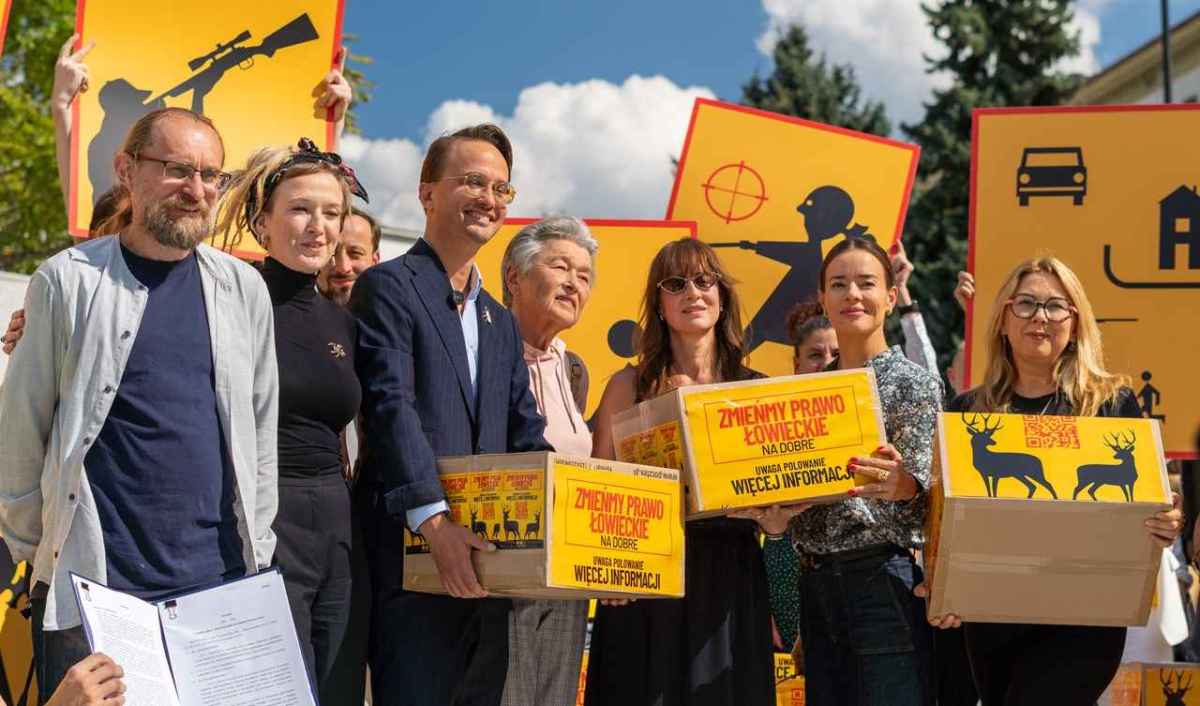
According to the initiative committee, the initiative «UWAGA! Polowanie. Zmieńmy prawo łowieckie. Na dobre» («Watch out: hunting! Let's change the hunting law. For good.») collected exactly 204,238 signatures. Only 100,000 would have been required. On 3 September 2026, the committee handed over the draft law and the signatures to Sejm Speaker Włodzimierz Czarzasty in front of the Sejm; he personally attended the press conference and, on behalf of the parliamentarians, assured the initiative of «wisdom in this matter». This opens the parliamentary process: the bill will first go to the Sejm's Committee on Environment, Natural Resources and Forestry.
Not an online petition, but paper
The result carries all the more weight given that Polish law requires physical signatures for popular legislative initiatives. Citizens had to print out forms, collect signatures and send the originals by post to the initiative committee. According to the organisers of the Centre for Environmental Activities «Źródła», this happened exactly that way across the whole country: from big cities, small towns and villages, in envelopes containing dozens or hundreds of signatures, collected by individuals, neighbourhoods and local groups.
And this happened under considerable counter-pressure. The online campaign was accompanied by a sustained wave of hostile comments from recreational hunting circles, while the Polish Hunting Association PZŁ ran its own public campaign against the reform. The forms came in nonetheless.
One detail shows how tough the path through parliament will be: the responsible Environment Committee is chaired by Urszula Pasławska (PSL), an active recreational hunter and honorary member of the Polish Hunting Association, who has publicly spoken out against the core points of the bill. A petition by Akcja Demokracja therefore demands that she step down from chairing the deliberations.
What the population really thinks
The initiative does not operate at the margins of society, but at its centre. The initiative committee points to a representative survey by More in Common Poland from May 2026 among 1,500 adults, which paints a nuanced picture: while 55 percent consider recreational hunters useful for protecting crops and ecological balance, at the same time 78 percent support a ban on hunting for pleasure, 76 percent support a minimum distance of 500 metres between hunting grounds and residential buildings, and 89 percent support mandatory, regular medical examinations for recreational hunters.
In other words: even those who fundamentally accept wildlife management want considerably stricter rules for recreational hunting, for public safety and for the accountability of those involved. A finding that matches the experience in canton of Geneva, where in 2005 the population upheld its ban on recreational hunting with 90 percent support.
What the draft law demands
The initiative does not call for an immediate blanket hunting ban, but for a systemic reform on three levels. The full text of the law, along with its rationale, is publicly available on the campaign website; the following points are based on this and on the statement of the initiative committee.
Animal welfare and the end of hunting tourism. Companies that organise, sell, broker or advertise paid hunting access are to be phased out. Existing providers receive a transition period; new ones may no longer be established once the law takes effect. The classification of species as huntable is to be based on scientific criteria and monitoring and reviewed regularly. Baiting, feeding to concentrate non-human animals, driven hunts, night hunting, hunting from vehicles and hunting during the breeding season are to be restricted. In future, population reductions must demonstrate a real threat, the absence of non-lethal alternatives and the proportionality of the killing.
Public safety. The shooting distance to residential buildings is to be increased from the current 150 to 700 metres, including public gathering places. Landowners may explicitly consent to recreational hunting closer to their buildings; the rule thus gives residents a say rather than imposing a rigid ban. Communal hunts must be announced more precisely, with an exact description of the hunting area rather than merely naming an entire hunting ground. Landowners are given a clearer objection procedure against planned hunts on their land.
Public hunting register and financial transparency. Probably the most important structural reform is a central, publicly accessible register: dates of communal and individual hunts, hunting ground boundaries, annual and multi-year kill quotas, planned and actually killed non-human animals, wounded and unrecovered non-human animals, locations of hunting infrastructure, as well as the financial and activity reports of the hunting association and hunting clubs. In addition, there are clearer alcohol rules with inspection powers for the state hunting authority, and the reintroduction of mandatory medical and psychological examinations for holders of hunting weapon licences.
The transparency point is particularly explosive in the Polish context: the PZł holds a special legal status, since only its members are permitted to hunt. It thus performs quasi-state functions but has so far been subject to no public oversight.
Why this concerns Switzerland
The Polish questions are European questions. Should the killing of wild animals be sold as a tourism product? How much does the public need to know about when and where shooting takes place in shared landscapes? What say do landowners and residents have? And what transparency obligations apply to organisations to which the state delegates wildlife management?
In Switzerland, exactly these points remain unresolved. Kill quotas, missed shots and wounded non-human animals are published incompletely or not at all by the cantons, high hunts take place without precise advance notice, and the hunting associations operate as private clubs with a public mandate but without public accountability. The argumentation guide for professional game wardens and the template texts for hunting-critical motions in cantonal parliaments formulate the very same demands for the Swiss cantons. Anyone wanting to know how wildlife management works without recreational hunting can find the answers in the dossier Hunting Ban Switzerland.
Poland shows that a movement dismissed as a fringe issue can mobilise more than 200,000 people within months. The parliamentary process has begun. Wild beim Wild will continue to follow it.
Sources: statement by the Centre for Environmental Activities «Źródła» (Krzysztof Wychowałek); draft law at uwagapolowanie.pl; OKO.press and Akcja Demokracja on the number of signatures and their handover; SmogLab on the press conference; English-language materials at zakazpolowania.pl. Photos: Daniel Ciura.
More on the subject of recreational hunting: In our dossiers on the criticism of recreational hunting gather fact-checks, analyses and background reports. What the research says about this is shown by Hunting fact-checked: the state of research.
The position of IG Wild beim Wild: IG Wild beim Wild rejects recreational hunting. Our model is the canton of Geneva, which has managed without recreational hunting since 1974: without hunting seasons, without hunting dogs, without driven hunts, without high seats, without the animal cruelty and crime that go hand in hand with hunting season elsewhere. What has worked there for over fifty years disproves every position paper by JagdSchweiz. An association that bases its policy on claims it refutes in its own documents is not a professional organisation, but a factory for misinformation.

All articles are written by IG Wild beim Wild as well as by external co-authors. Research, structuring and editorial processes may be supported by AI-assisted tools.
Support our work
With your donation you help protect animals and give their voice a hearing.
Donate now →