Solothurner Zeitung with the recreational hunter: what the profile leaves out
Peter Wäfler, president of the Thal hunters, explains his hunting to the newspaper. His own sentences refute the justifications, and the editorial team does not ask follow-up questions.
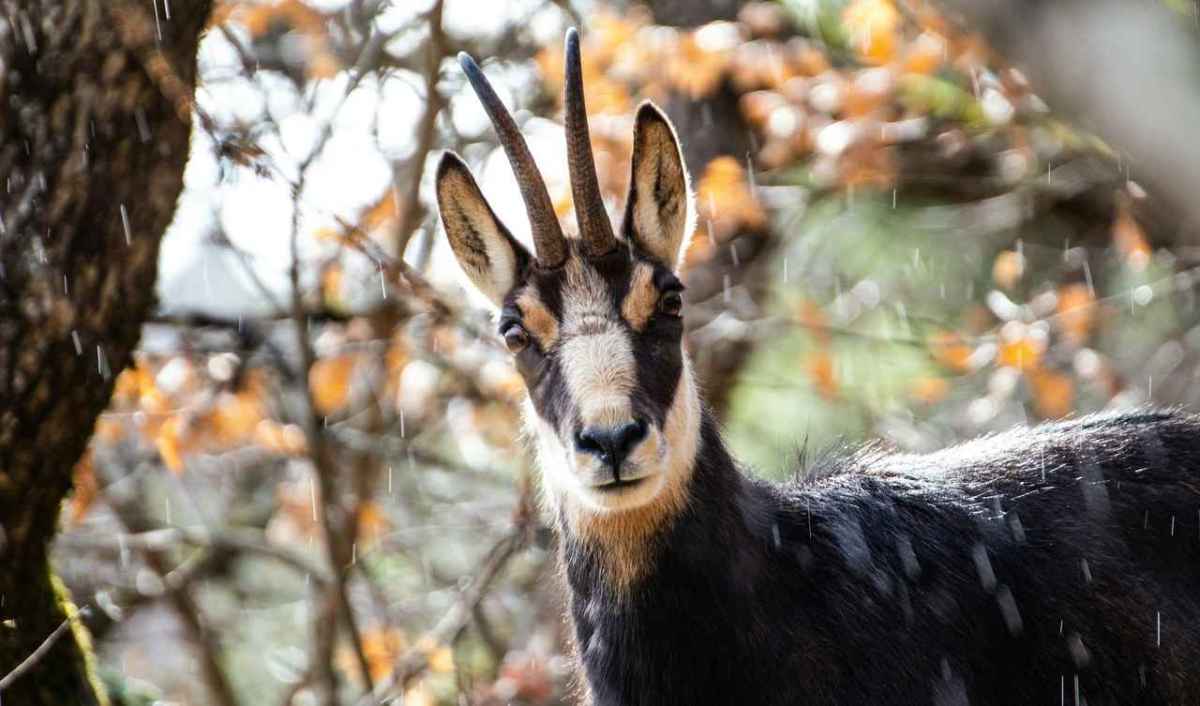
Chamois in the autumn forest. Photo: Gaëtan Othenin-Girard / Unsplash
Court Report
The Solothurner Zeitung published a portrait of Peter Wäfler on 29 October 2026, the president of the Vereinigung Thaler Jäger. Editor Patrick Gerber accompanied the farrier, who has been a recreational hunter for twenty years, on a mild October evening into a hunting ground of his Hegering: onto the Rislisberg above the Klus between Oensingen and Balsthal, in the Laupersdorf-Lebern hunting ground. The portrait aims to show that hunting is «far more than just shooting». Anyone who reads the text closely will find above all one thing: the arguments against recreational hunting, voiced by the recreational hunter himself. The editorial team let them stand without asking any follow-up questions.
The real motive comes at the end of the paragraph
Wäfler first lists the principles of the hunting act: forest regeneration, containment of wildlife damage. Then comes the sentence that carries the article: "Not least, though, I also like to have something delicious on my plate." The newspaper notes that he "admits" this. There is no further context. Yet this is precisely the sequence that IG Wild beim Wild has been describing for years: the statutory tasks are the outward justification, while the meat and the experience are the driving force. How this shift works is shown by the dossier on the psychology of hunting.
This fits with what Wäfler says about his evenings on the high seat. He often goes out "to wind down", "often waits for hours after finishing work", and has even fallen asleep there. During the conversation he smokes. That is the honest description of a hobby. A task that the canton urgently needs for forest and agriculture looks different.
"Often you don't even see the animals you would be allowed to shoot"
That is the title of the article, and in the text Wäfler says: «Often you don't even see the right ones.» He means that from the high seat he frequently sees non-human animals that he is not permitted to kill by species, sex and age. The newspaper reads this as proof of diligence. It can also be read differently: the recreational hunters sit in the hunting ground for hours and cannot find the animals they are supposed to shoot according to the kill quota. That is no argument for a system that justifies itself with the promise of regulating populations. The Stand hunting is above all waiting, and the waiting is decided by chance.
35 per cent of the damage: a vested interest, not a sacrifice
«We hunters have to pay for 35 per cent of the damage,» says Wäfler, looking at a meadow churned up by wild boars. That is correct, with one clarification: under Section 26 of the Solothurn Hunting Act the hunting association contributes 35 per cent of the wild boar damage in its ground, up to a maximum of the minimum annual lease fee. The newspaper cites the total wildlife damage for 2025 of around CHF 202,000. What is missing is the calculation behind it. The official wildlife damage statistics of the Office for Forests, Hunting and Fisheries show pure wildlife damage of CHF 179,326 for 2025, of which CHF 139,371 was caused by wild boars. The excess borne by all Solothurn hunting grounds together amounts to CHF 48,780. In the Hegering Thal, CHF 13,295 of wild boar damage occurred, and the recreational hunters killed 66 wild boars there. For the Laupersdorf-Lebern ground, where the report is set, the statistics show no wild boar damage at all for 2025, with 18 wild boars killed. The churned-up meadow therefore cost the association nothing there.
This contribution does not turn the recreational hunter into a service provider, but into a party with a vested interest. Anyone who helps pay for damage has a financial motive for high kill figures, and has an interest in the damage problem being seen as solvable by hunting. That it is not was shown by IG Wild beim Wild in July 2026 on the basis of a cantonal survey: Despite a higher hunting bag, wild boar damage remains high, in Solothurn too. After twenty years of recreational hunting in the Thal, the wild boars keep rooting up the land. Why recreational hunting worsens the problem rather than solving it is explained in the wild boar dossier.
«One hundred and one per cent» and the tracking bitch
Shots are only fired when one is "one hundred and one per cent" certain of hitting the animal properly, says Wäfler. In the same passage he explains what his blood-tracking dog Heika is trained for: tracking down wounded animals, which are then killed with a finishing shot. The two statements only make sense together if you take the second half seriously: the follow-up search is mandatory and blood-tracking dogs are trained because missed shots are factored into the system of recreational hunting from the outset. The talk of the safe shot is the narrative, the follow-up search is the practice. IG Wild beim Wild documented this in the article Why so many hunting dogs are needed. That the talk of the safe shot does not hold up in the canton of Solothurn either is shown by the case from November 2025: a Solothurn recreational hunter mistook a red deer hind for a roe deer, fired buckshot, and the animal lay seriously injured in the forest for two days. The 'identification of the target' that Wäfler describes as the core of the training had failed there.
Fox bolognese
As an anecdote from twenty years, Wäfler mentions that he once ate fox bolognese. The newspaper leaves the sentence in as a touch of colour. Yet it says something about fox hunting in the canton: the fox is not shot for its meat, nor is it shot because of any documented damage. In September 2026 the Solothurn cantonal government rejected the fox hunting petition, relying on a position paper from JagdSchweiz. The background, the figures on the 866 foxes killed in 2024 and the template letter to the cantonal parliament can be found on the page Stop Fox Hunting in Solothurn.
Who Controls Whom
Asked about the 'critical voices', Wäfler points out that the canton regulates hunting and that 'every hunting ground also has hunting supervision'. The newspaper does not ask who provides this hunting supervision. Section 15 of the Solothurn hunting act gives the answer: hunting supervision in the hunting ground is ensured by the hunting association itself, which appoints a hunting supervisor at its own expense, who must be licensed to hunt. According to the same section, the department deploys state hunting supervision officers mainly for the wildlife protection areas. In the hunting grounds, recreational hunters monitor recreational hunters. Why this self-supervision is not enough is explained in the dossier on hunting acts and oversight.
What the profile leaves out
The article announces a complex subject "between great responsibility, cantonal regulations and criticism". Criticism appears in it only as a keyword, which Wäfler himself introduces and promptly dismisses: he says he always tries to explain the hunters' point of view. There is no second voice, no wildlife biologist, no animal welfare organisation, no mention of the canton of Geneva, which has managed without recreational hunting since 1974 and deals with wildlife damage through professional game wardens. The pattern is a familiar one, and IG Wild beim Wild has described it in its dossier on the media and hunting topics described: hunting is narrated from the perspective of those who practise it, and their justifications are passed on as established fact. For this court report the Solothurner Zeitung demands a subscription; anyone expecting fact-checked figures and a second voice gets neither for their money.
At the end of the evening two chamois appear on the slope. Wäfler watches them through his binoculars; he does not reach for his rifle. It is the most beautiful image in the article. It shows that nobody has to shoot for an evening in the Jura to be a good one.
More on the subject of recreational hunting: In our dossiers on the criticism of recreational hunting gather fact-checks, analyses and background reports. The scientific evidence is presented in the overview Studies on the Effects of Recreational Hunting.
The position of IG Wild beim Wild: IG Wild beim Wild rejects recreational hunting. Our model is the canton of Geneva, which has managed without recreational hunting since 1974: without hunting seasons, without hunting dogs, without driven hunts, without high seats, without the animal cruelty and crime that go hand in hand with hunting season elsewhere. What has worked there for over fifty years disproves every position paper by JagdSchweiz. An association that bases its policy on claims it refutes in its own documents is not a professional organisation, but a factory for misinformation.
Wild animals need a voice
Once a week: research, petitions and background information on recreational hunting. Free of charge and can be unsubscribed from at any time.

All articles are written by IG Wild beim Wild as well as by external co-authors. Research, structuring and editorial processes may be supported by AI-assisted tools.
Support our work
With your donation you help protect animals and give their voice a hearing.
Donate now →