Solothurn woman wants to ban driven hunts
«The sight broke my heart»: this is why a Solothurn woman wants to ban the driven hunt.
Brigitte Ehrbar is convinced that the driven hunt harms the animals. She has submitted a petition to abolish this hunting method, even though recreational hunters take a different view.
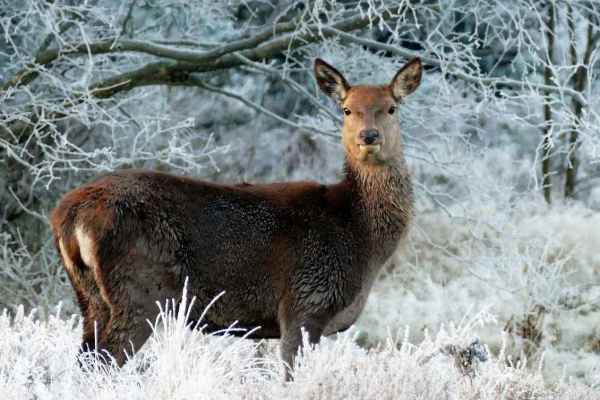
When Brigitte Ehrbar left her flat not long ago, she saw a group of roe deer running back and forth in panic. Some of the animals even ran into residential areas. «The animals didn't know where to flee to and ran in sheer terror», says the 66-year-old. What she witnessed was a driven hunt, in which animals are often startled by dogs and then shot, so as to kill as many as possible.
She is also worried about the danger of stray shots, which she says contravenes the Animal Welfare Act. In the canton of Solothurn, driven hunts are permitted from October to December. Wild boars may be hunted all year round.
On her own, Brigitte has collected more than 100 signatures for her petition. Although she received no political backing, she refused to be discouraged and spoke with neighbours and acquaintances. More and more people joined her initiative. The State Chancellery has since confirmed 105 signatures, and the petition is currently being examined.
Brigitte is also not afraid to speak to recreational hunters directly. In December she spoke to some of them as they were preparing for a driven hunt. She asked them whether it was fun to send the animals into a panic, and was told that she could call the police.
Recreational hunters argue that the driven hunt helps regulate animal numbers. Cyril Bardet, the president of the hunters' association in Solothurn, says that the driven hunt is necessary in order to meet the kill quota. He explains that the hunt is well planned and that not too many animals are hunted at once.
Brigitte agrees that hunting is necessary to regulate animal numbers. But she does not understand why people should decide which animal is to live or die.
Whether her motion will succeed, she does not know. She hopes that animal welfare matters more today than it did 20 years ago, when voters wanted to keep the driven hunt, writes the Solothurner Zeitung.
Perhaps her concern can bring about something big.
In the view of IG Wild beim Wild, recreational hunters require annual medical-psychological fitness assessments modelled on the Netherlands, as well as a binding upper age limit. Today, the largest age group among recreational hunters is 65+. Within this group, age-related limitations such as declining eyesight, slower reaction times, reduced concentration and cognitive deficits increase significantly, statistically speaking. At the same time, accident analyses show that the number of serious hunting accidents involving injuries and fatalities rises significantly from middle age onwards.
The regular reports of hunting accidents, fatal mistakes and the misuse of hunting weapons highlight a structural problem. Private ownership and use of lethal firearms for leisure purposes largely escapes continuous oversight. In the view of IG Wild beim Wild, this is no longer justifiable. A practice based on voluntary killing, which at the same time poses considerable risks to people and animals, loses its societal legitimacy.
Hobby Hunting is also based on speciesism. Speciesism describes the systematic devaluation of non-human animals purely on the basis of their species. It is comparable to racism or sexism and cannot be justified either culturally or ethically. Tradition is no substitute for moral scrutiny.
Critical scrutiny is particularly essential in the field of recreational hunting. Hardly any other area is so shaped by sugar-coated narratives, half-truths and targeted disinformation. Where violence is normalised, narratives often serve to justify it. Transparency, verifiable facts and an open societal debate are therefore indispensable.
Do you have a tip, a source or a correction for this article? Write to us.
Seen something yourself?
A driven hunt next to a hiking trail, a shot fired near houses, a trap in the forest or an injured wild animal: report it to the Recreational Hunter Radar. We check every tip-off and treat your details confidentially.
More on the subject of recreational hunting: In the dossier The Role and Criticism of Recreational Hunters we shed light on the training, power and self-image of recreational hunters. The scientific evidence is presented in the overview Studies on the Effects of Recreational Hunting.
The position of IG Wild beim Wild: IG Wild beim Wild rejects recreational hunting. Our model is the canton of Geneva, which has managed without recreational hunting since 1974: without hunting seasons, without hunting dogs, without driven hunts, without high seats, without the animal cruelty and crime that go hand in hand with hunting season elsewhere. What has worked there for over fifty years disproves every position paper by JagdSchweiz. An association that bases its policy on claims it refutes in its own documents is not a professional organisation, but a factory for misinformation.
Wild animals need a voice
Investigations, petitions and background on recreational hunting. As a thank-you, you will immediately receive our free guide «Recreational hunting on your doorstep: what you can do».
Support our work
With your donation you help protect animals and give their voice a hearing.
Donate now →