Imperial eagle Karoline-Anna flies 12,000 kilometres to Cameroon
For the first time, an imperial eagle radio-collared in Austria has migrated all the way to Africa, yet back home illegal persecution remains one of the main threats to the species.
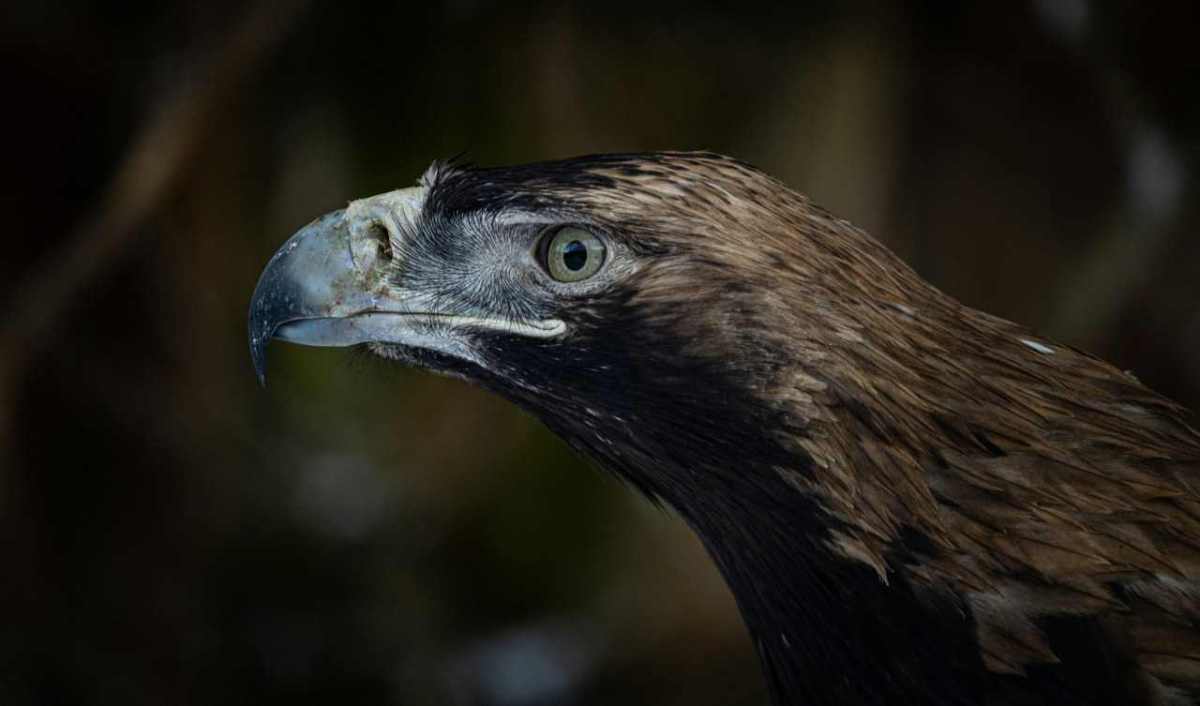
Photo: Jevgeni Fil / Unsplash
Homecoming
The young imperial eagle Karoline-Anna has arrived in West Africa. BirdLife Austria fitted the young bird with a GPS transmitter on 1 July 2026 in the Donau-Auen National Park east of Vienna. Since then she has flown over eleven countries and covered almost 12,000 kilometres. She is currently in Cameroon.
Across the Mediterranean to Cameroon
Her route took her across the Balkans and Greece, over the Mediterranean to Libya, then through Chad and Nigeria to Cameroon. More than 230,000 location points document the flight, as science.ORF.at reports, citing BirdLife. According to the bird protection organisation, it is the first documented record of such a long migration by an imperial eagle hatched and radio-collared in Austria.
Why the flight surprised the experts
Central European imperial eagles are not actually regarded as migratory birds. In their first few years, young birds usually roam about without any fixed direction. Karoline-Anna, by contrast, headed purposefully south, behaviour more commonly known from eastern populations in Central Asia. For Matthias Schmidt, a birds of prey expert at BirdLife Austria, what makes the case remarkable is therefore less the distance than «the nature of her journey». Why the young eagle took this route, and whether it will remain an isolated case, cannot be clarified with the data available so far.
Just how different siblings can be is shown by her brother Franz-Josef, who was also radio-collared. He sticks to the usual pattern and has so far roamed through Hungary, the Czech Republic and Slovakia. He was most recently travelling east of Budapest.
Back in Austria after around 200 years
The fact that imperial eagles are hatching in the Danube Floodplains at all is a success for species conservation. The species was wiped out in Austria for more than 200 years and, according to BirdLife has been breeding in the country again since 1999, and in the Danube Floodplains since 2011. In the 2025 breeding season, 50 breeding pairs fledged 81 young birds. Austria lies at the westernmost edge of the global range; on the IUCN Red List the imperial eagle is classified as vulnerable.
The greatest danger often waits in the hunting ground
Schmidt points out that illegal persecution, habitat loss and scarcer food can become a threat along the entire route. A good part of that threat, however, lies in Austria itself. The Wildlife Crime Report 2026 by WWF and BirdLife counts a total of 310 confirmed cases of wildlife crime for the years 2017 to 2025. Fifteen imperial eagles are recorded in it as known victims of proven or probable wildlife crime. Some 41.9 per cent of the cases are attributable to shootings, 21.3 per cent to poisonings. For birds of prey such as imperial eagles and white-tailed eagles, illegal killing is, according to the report, one of the most frequent known causes of death.
The report names the Innviertel and Hausruckviertel, the Weinviertel and Northern Burgenland as the main hotspots. It identifies a clear geographical link with the shooting of small game: in many small-game hunting grounds, predators are intensively persecuted in order to achieve high bags, in some cases using illegal methods. In 2021, near Tulln, a breeding female imperial eagle was shot with nine pellets. With its 2025 breeding report BirdLife announced that the imperial eagle Norbert had been shot dead at Pamhagen in Burgenland. In the Lesach Valley in 2026, six griffon vultures died from the banned poison carbofuran.
The transmitters therefore supply not only data on migration routes. They also show where and when a bird disappears. In May 2025, in the district of St. Pölten, the signal of a radio-collared imperial eagle broke off; all that was found was the severed transmitter. During the search, investigators came across six dead marsh harriers and eggs laced with carbofuran. A recreational hunter claimed he had found the transmitter and thrown it away. He was charged and acquitted because it could not be proven beyond doubt who had laid out the poisoned bait. In the case of the lynx Sofia the collar data led investigators to a group of recreational hunters.
Comment: An eagle knows no borders — protection does
In the space of a few months, Karoline-Anna has flown over eleven countries, crossing a desert and a sea. Her journey makes visible what BirdLife is calling for: protection for migration routes and stopover sites across all borders. Yet an imperial eagle that survives the Sahara does little for the population if, on its return, it is shot or poisoned over a small-game hunting ground.
As long as birds of prey are regarded in parts of the recreational hunting world as competitors for hare and pheasant, every radio-collared bird also becomes a potential witness. WWF and BirdLife recommend external controls where hunting supervision fails, specialised public prosecutors and more forensic examinations of birds found dead. These are minimum demands. Anyone who wants Karoline-Anna one day to breed in the Danube floodplains must bring recreational hunting under control precisely where, until now, it has controlled itself.
Do you have a tip, a source or a correction for this article? Write to us.
Seen something yourself?
A driven hunt next to a hiking trail, a shot fired near houses, a trap in the forest or an injured wild animal: report it to the Recreational Hunter Radar. We check every tip-off and treat your details confidentially.
More on the subject of recreational hunting: In our dossiers on recreational hunting gather fact-checks, analyses and background reports. The scientific evidence is presented in the overview Studies on the Effects of Recreational Hunting.
The position of IG Wild beim Wild: IG Wild beim Wild rejects recreational hunting. Our model is the canton of Geneva, which has managed without recreational hunting since 1974: without hunting seasons, without hunting dogs, without driven hunts, without high seats, without the animal cruelty and crime that go hand in hand with hunting season elsewhere. What has worked there for over fifty years disproves every position paper by JagdSchweiz. An association that bases its policy on claims it refutes in its own documents is not a professional organisation, but a factory for misinformation.
Wild animals need a voice
Investigations, petitions and background on recreational hunting. As a thank-you, you will immediately receive our free guide «Recreational hunting on your doorstep: what you can do».
Support our work
With your donation you help protect animals and give their voice a hearing.
Donate now →