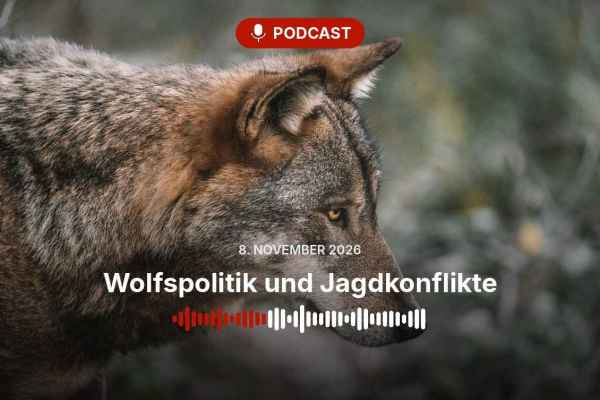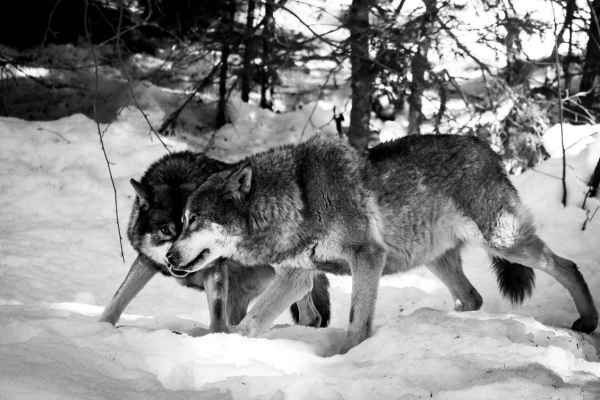
Podcast episode: Wolves, lynx and hunting conflicts
What was found in the stomach of the Schluchsee wolf, where the lynx of Oberegg died, how the SVP candidates voted on the wolf and why mother animals enjoy so little protection under recreational hunting.

Podcast episode: Wolves, lynx and hunting conflicts
This edition of “Wild beim Wild” is about a wolf with a euthanasia drug in its stomach, the wolf record of the two SVP candidates for the Federal Council, kill quotas in Austria and missing comparative figures in Switzerland, three shot lynx and a lynx in a fallow deer enclosure, an acquittal after the shooting of a red deer hind with milk in her udder, and pregnant vixens that are not protected in Aargau.
Wolf: poison in the stomach, kills on the agenda
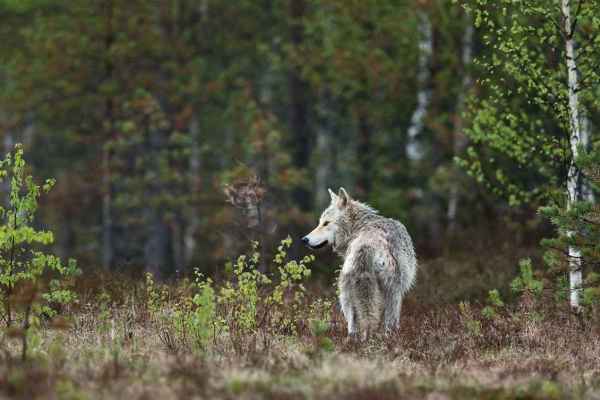
In the stomach contents of the Schluchsee wolf GW1129m, which was found seriously ill on the B500 at the end of September and euthanised, the euthanasia drug pentobarbital was detected. The Baden-Württemberg Ministry for Rural Affairs assumes secondary poisoning via a carcass. Police and the public prosecutor are investigating ex officio; so far there is no evidence of deliberate poisoning. It remains unclear which animal body the substance came from and whether regulations were breached in its disposal.
In Switzerland, the SVP parliamentary group has nominated Thomas Aeschi and Michael Graber to succeed Guy Parmelin. The voting data from the Parliamentary Services show a clear line for both: yes to the hunting act revision with preventive kills, to wolf-free zones and to the motion to terminate the Bern Convention. Graber called the wolf a “pest” in the National Council. Since 2021, Aeschi's voting behaviour on wolf proposals has matched Graber's; on a first threshold-value motion in April 2026 he did not take part. The Federal Assembly votes on 9 December.
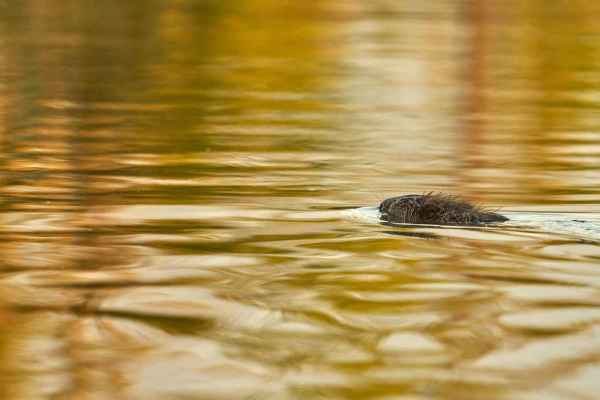
In Austria, according to a count by the WWF, there are currently kill quotas for 797 beavers and 186 otters in force, plus at least 88 kill orders for wolves this year. These are permits, not animals actually killed. The WWF criticises that blanket orders undermine the case-by-case assessment required by EU law. In Switzerland, meanwhile, an important point of comparison is missing: Identitas AG no longer updates its public animal statistics. In 2025, 52,504 sheep deaths were reported; for November 2024 to October 2025, the cantons applied to the Federal Office for the Environment (FOEN) for reimbursement for 808 livestock of all kinds killed by predators. All kills of the current season are recorded by the wolf counter.
Lynx: scene of the crime unknown, fence open
The lynx mother and her two cubs, found dead in Oberegg on 7 November, were according to the Appenzell Inner Rhodes cantonal police not shot where they were found. The police place the offence between 4 and 7 November. All four days fell within the canton's regular small-game hunting season. This does not establish any link to the perpetrator; the presumption of innocence applies. Details on the weapon, ammunition or checks during recreational hunting are still lacking, and the police continue to seek witnesses. What the loss means for the small population is shown by the articles on the Hereditary disease in lynx and on the missing rescue plan.
In Krattigen above Lake Thun, a lynx killed eight fallow deer in an enclosure. It entered through a hole that a badger had dug under the fence. Protection against digging under had been proposed after an earlier incident, but was not in place. An association demanded that the animal be killed, but the Bern hunting inspectorate refused. Under the Swiss Lynx Concept, unprotected cervids in enclosures are not taken into account when a canton examines the criteria for a kill permit. Background is collected in the dossier “The lynx in Switzerland”.
Hunting law: when mother animals are not protected
The Affoltern district court has acquitted, who in August 2025 first shot a red deer calf on the Albis range and, two days later, its mother. The hind was still lactating. The Zurich regulation permits the shooting of a mother animal only 'immediately' after that of her calf, and the district governor's office had imposed a fine of 800 francs. The court sided with the defence: once the hind has lost her calf, she may be shot. The state treasury must now pay 25,410 francs in compensation; the ruling is not yet final. A comparison shows five cantons with five different rules for lactating hinds, extending to a Ticino late hunt, in which a lactating hind may be killed without the calf having been shot first.
The Aargau cantonal government responds just as bluntly to the open letter from IG Wild beim Wild: 'Pregnant animals are not protected.' Removing animals capable of reproduction is central if the aim is to keep the population low, it says. It names neither a target population nor a population estimate. In 2025, Aargau recreational hunters shot 1,837 foxes; hunting is permitted until the end of February, when many vixens are long since pregnant. Anyone who wants to change this can write directly to the Grand Council.
A wolf for which it can no longer be established where it ingested the poison, lynx whose place of death is unknown, statistics that are no longer kept up to date, and protection rules that end as soon as the calf is dead: this week's topics are connected. The question of the episode is: Who monitors what is done in the name of population management, and who supplies the figures for it?
Do you have a tip, a source or a correction for this article? Write to us.
More on the subject of recreational hunting: The scientific evidence is presented in the overview Studies on the Effects of Recreational Hunting.
The position of IG Wild beim Wild: IG Wild beim Wild rejects recreational hunting. Our model is the canton of Geneva, which has managed without recreational hunting since 1974: without hunting seasons, without hunting dogs, without driven hunts, without high seats, without the animal cruelty and crime that go hand in hand with hunting season elsewhere. What has worked there for over fifty years disproves every position paper by JagdSchweiz. An association that bases its policy on claims it refutes in its own documents is not a professional organisation, but a factory for misinformation.
Wild animals need a voice
Investigations, petitions and background on recreational hunting. As a thank-you, you will immediately receive our free guide «Recreational hunting on your doorstep: what you can do».
Support our work
With your donation you help protect animals and give their voice a hearing.
Donate now →