Aargau government: Pregnant vixens are not protected
In its reply to the fox hunting petition, the cantonal government justifies the shooting of pregnant vixens by the aim of keeping the population low.
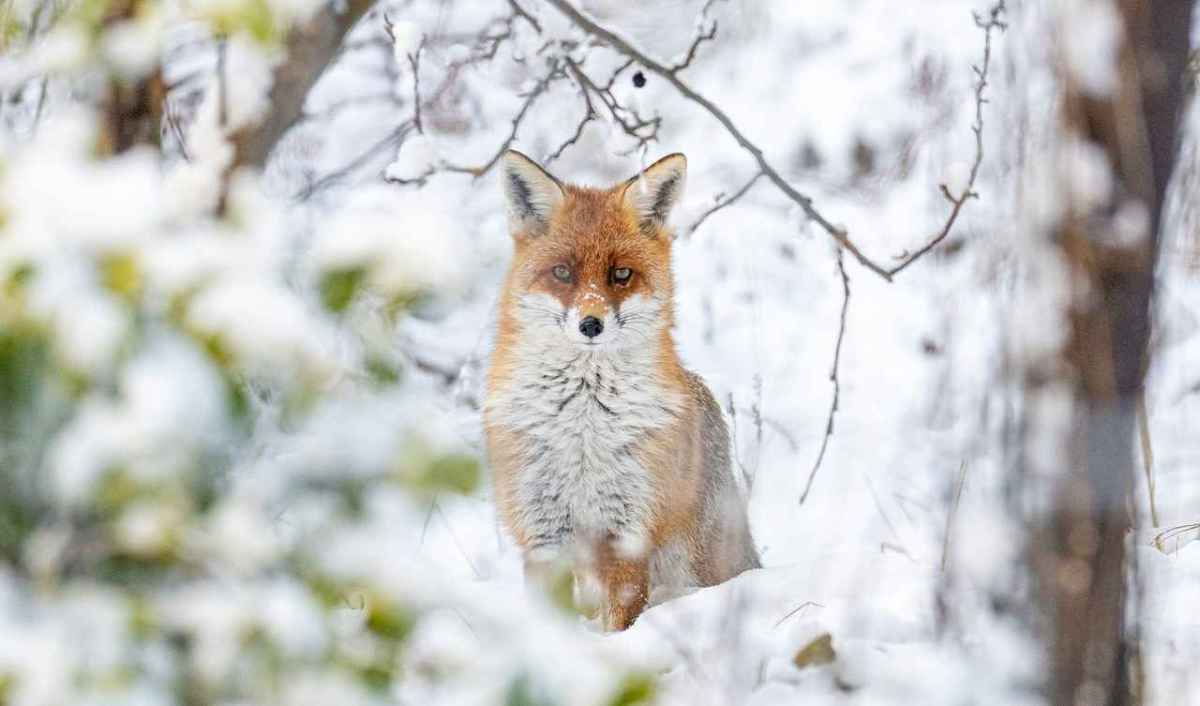
Illustrative image. Photo: Denis Dz. / Unsplash
Red Snow
Pregnant vixens may be shot in Aargau during the hunting season. In its reply of 18 November 2026 to the IG Wild beim Wild, the cantonal government states that pregnant animals are not protected, and explains that killing animals capable of reproduction is central if the fox population is to be kept low. It does not name a target population.
The letter is the reply to our open letter to Landammann Stephan Attiger on the rejected petition 'Ban on general fox hunting'. It was signed by Attiger and State Secretary Joana Filippi on behalf of the cantonal government (reply letter as PDF). We have published the remaining replies on the page Fox hunting in Aargau: Write to the Grand Council.
What the cantonal government writes
Under the heading 'Animal welfare in the final weeks of the hunting season', we had asked how the canton takes into account that pregnant vixens may be killed in February. The cantonal government's reply verbatim: 'Pregnant animals are not protected. If one wants to keep the population low, then the removal of animals capable of reproduction is of central importance.'
The closed seasons are set so that nursing animals and animals rearing young are protected, the cantonal government writes. Animal welfare concerns the young, which cannot survive without a parent animal. It does not address the unborn young of a pregnant vixen.
Hunting continues until the end of February
In the case of the fox, Aargau adopts the federal closed season from 1 March to 15 June. Hunting is therefore permitted until the end of February. The foxes' mating season falls in winter, gestation lasts 51 to 54 days, and most cubs are born in March and April. Vixens can therefore be pregnant long before the closed season begins on 1 March. We examined what recreational hunting between the mating and birthing seasons means for fox families in the article Swiss recreational hunters: animal cruelty in fox hunting.
In 2025, recreational hunters in Aargau shot, according to the cantonal hunting statistics, 1,837 foxes. The statistics do not show whether, or how many, of these were pregnant. According to the letter, the canton does not collect data on follow-up searches either, neither for recreational hunting nor after wildlife-vehicle collisions.
No target value, no demonstrated impact assessment
The cantonal government does not say what population would be 'low' enough. It names neither a population estimate nor a target value. It states that hunting use does not exceed the population increase, but presents no figures to support this. On the basis of the letter, it is impossible to judge whether, and to what extent, general fox hunting influences the population in Aargau.
The SWILD expert report commissioned by the canton of Zug concluded in May 2026 that the fox hunting practised, which is not spatially coordinated, does not regulate the population sustainably. Higher reproduction, higher survival rates and immigration can compensate for losses. The Aargau cantonal government questions the representativeness and transferability of the studies consulted, but names no study of its own from Aargau in the letter. Since then, the Zug hunting commission has no longer promoted fox hunting proactively.
Elsewhere, the cantonal government justifies fox hunting by arguing that shooting sick foxes 'reduces animal suffering'. In the same letter, it declares the killing of pregnant vixens to be permissible.
What happens next
The cantonal government could itself decide on a longer closed season for the fox by amending the cantonal hunting ordinance (AJSV). It states this in its letter. However, there is 'neither a justification nor a need' for this, it says.
The petition was initially assigned to the Department of Construction, Transport and Environment for a response. The letter of 18 November is signed in the name of the cantonal government, but it does not cite any formal decision by the full cantonal government on the petition. According to the letter, the matter will be put to the government if the IG Wild beim Wild insists. The IG Wild beim Wild is demanding a formal government decision and wants to know how the cantonal government reconciles the killing of pregnant vixens with Art. 4 para. 2 of the Animal Welfare Act, under which no one may unjustifiably inflict pain, suffering or harm on an animal or disregard its dignity.
Comment: A cantonal government that states in black and white that pregnant vixens are not protected so that the population stays low says more about its attitude than any statistic could. Anyone who justifies the killing of pregnant vixens by pointing to a low population should say how low the population is meant to be and how the effect of recreational hunting is to be measured. The cantonal government fails on both counts. What remains is the killing of mothers together with their unborn young, administered as routine. This has nothing to do with animal welfare, and just as little to do with respect for non-human animals.
What you can do: The cantonal government decides on the closed season, but the cantonal parliament (Grosser Rat) can exert political pressure. Write to the members of the Grosser Rat in your district, ideally in person and in your own words. You will find a template letter, figures and a list of members at Fox hunting in Aargau: Write to the Grand Council, and an overview of all cantons at End fox hunting.
Do you have a tip, a source or a correction for this article? Write to us.
More on the subject of recreational hunting: In the dossier Alternatives to recreational hunting we show political and practical alternatives to recreational hunting. The scientific evidence is presented in the overview Studies on the Effects of Recreational Hunting.
The position of IG Wild beim Wild: IG Wild beim Wild rejects recreational hunting. Our model is the canton of Geneva, which has managed without recreational hunting since 1974: without hunting seasons, without hunting dogs, without driven hunts, without high seats, without the animal cruelty and crime that go hand in hand with hunting season elsewhere. What has worked there for over fifty years disproves every position paper by JagdSchweiz. An association that bases its policy on claims it refutes in its own documents is not a professional organisation, but a factory for misinformation.
Wild animals need a voice
Investigations, petitions and background on recreational hunting. As a thank-you, you will immediately receive our free guide «Recreational hunting on your doorstep: what you can do».
Support our work
With your donation you help protect animals and give their voice a hearing.
Donate now →