
European Hare Switzerland: Endangered, hunted and ignored
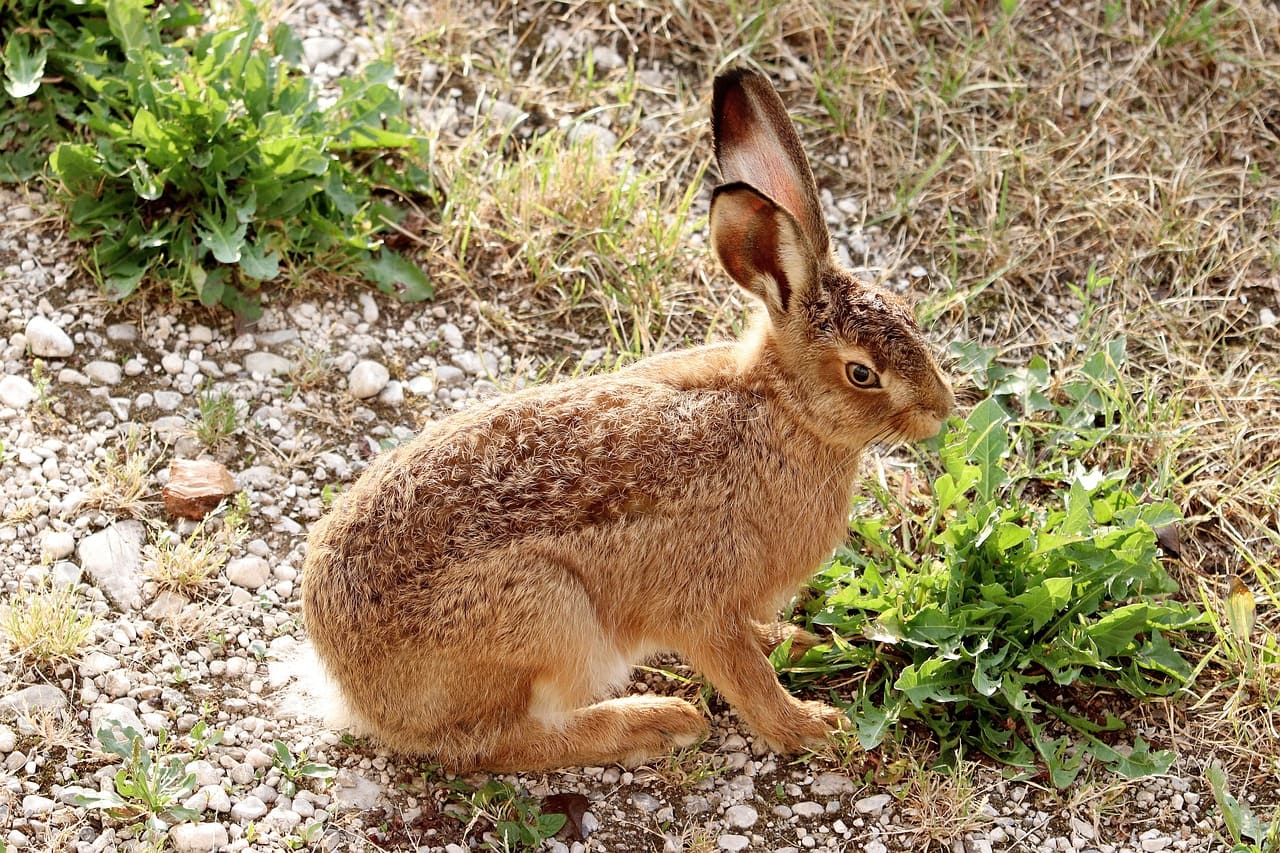
The European hare is on the Red List of threatened species. Its populations have been declining for decades. Nevertheless, it continues to be shot by hobby hunters in several cantons, around 1,600 animals per year. No other example demonstrates the inconsistency of the Swiss hunting system more clearly than the hunting of this threatened animal.
Profile
The European hare (Lepus europaeus) belongs to the family of hares (Leporidae) and is a typical inhabitant of open cultural landscapes. It inhabits fields, meadows, pastures and structurally diverse farmland, increasingly also higher elevations. Unlike rabbits, the European hare does not build burrows. It is a solitary animal that hides during the day in shallow depressions (forms) amidst vegetation and relies on its enormous sprinting ability when in danger, reaching speeds of up to 70 km/h with abrupt zigzag maneuvers.
Biology and reproduction
The European hare can theoretically reproduce three to four times per year. The female produces two to four young per litter, which unlike rabbits are born already furred and with eyes open (precocial). The young remain in the form for the first weeks and are nursed by the mother only once or twice daily, to avoid attracting predators to the nest.
Despite its high reproduction rate, the European hare is a vulnerable species. Mortality of young hares ranges from 60 to 80 percent, caused by mowing machines, predation (fox, birds of prey, crows), weather conditions and disturbances. Under natural conditions, this high juvenile mortality is balanced by the reproduction rate. But when habitat quality declines, this balance tips.
Red List status
The European hare is classified as 'vulnerable' (VU, Vulnerable) on the Red List of mammals in Switzerland (FOEN 2022). This means: There is an increased risk that the species will disappear from Switzerland in the medium term if the causes of endangerment are not eliminated.
The decline: From 70,000 to 1,600 kills
Historical decline
Hunting statistics document the decline of the European hare in Switzerland with alarming clarity. In 1947, in the post-war period, around 70,000 European hares were still shot nationwide. In the following decades, the population collapsed rapidly. Around the year 2000, there were only around 2,500 kills. Today, around 1,600 European hares are killed annually. Current population densities average only three animals per square kilometer. In the 1990s, it was still over four.
Causes of decline
The main cause of population decline is the intensification of agriculture. Land consolidation has destroyed hedges, fallow land and field margins that serve the brown hare as cover and food source. Fertilization and the use of pesticides impoverish plant diversity and reduce food supply. Mechanized farming with increasingly larger and faster machines directly kills young hares. Landscape fragmentation through roads and settlements fragments habitats and increases traffic mortality. In residential areas, free-roaming dogs and cats pose an additional threat.
The brown hare is a prey animal that depends on extensive, connected habitats. Individual unmanaged pastures surrounded by roads and settlements are of little use to it because it risks being hit by a car when fleeing. Today's Swiss cultural landscape has become a trap for the brown hare in many places.
Hunting: Tradition over species conservation
Legal situation
Under the current Federal Act on Hunting (JSG, Art. 5 Para. 1 lit. f), the brown hare remains huntable despite its Red List status. The hunting season extends from October 1 to December 31. Cantons may shorten the hunting season or protect the brown hare entirely, but are not obligated to do so.
Who shoots, who spares?
Of 26 cantons, 11 have protected the brown hare year-round at the cantonal level, including Canton Zug. Eight additional cantons have shortened the hunting season compared to federal law. In the remaining cantons, shooting is possible, with individual hunting associations voluntarily abstaining.
Particularly striking: Canton Graubünden consistently shows high brown hare kill numbers. The cantonal authorities justify this by stating that hunting is 'tradition' and represents 'sustainable use of a natural resource'. Income from license fees would be invested in wildlife management that actively creates habitats.
This argument illustrates the cynical logic of the hunting system: An endangered animal continues to be killed so that the income from its killing can be used for its protection.
The failed revision
As part of the revision of the Hunting Act (JSG), which was rejected by the people in 2020, environmental organizations wanted to stop hunting of endangered species like the brown hare, black grouse and woodcock. This demand failed due to political resistance from the hobby hunting lobby. Pro Natura stated at the time: There is no wildlife biology justification for folklore hunting of ptarmigan, black grouse, woodcock and brown hare. These animals cause no damage and do not need population control.
The FOEN argued that a federal hunting ban would only be appropriate if the brown hare were 'under pressure throughout Switzerland due to hunting'. The main cause of decline lies in habitat change. This argument is formally correct and simultaneously devastating: It protects the last remaining pressure factor, hobby hunting, because it is not the main factor. Ecologically speaking, exactly the opposite is correct: When a species is already under pressure from other factors, every additional mortality factor must be eliminated, not tolerated.
More on this: Dossier: Hunting and biodiversity
The brown hare as indicator species
What its disappearance means
The brown hare has a key function for science: it is an indicator species. Its population indicates the state of biodiversity in open agricultural landscapes. If the brown hare is doing poorly, one can conclude that field birds (lapwing, skylark), insects (wild bees, ground beetles), amphibians and numerous plant species in this landscape are also doing poorly.
Conversely, this means: If the brown hare recovers, the entire species community of the agricultural landscape benefits. Hedges and fallow areas at field and forest edges that benefit the brown hare are simultaneously habitats for dozens of other species. Promoting the brown hare is thus a lever for entire agricultural biodiversity.
Federal government fails its own goals
The federal government has set its own goals within the framework of Switzerland's Biodiversity Strategy. These include stabilizing and promoting endangered species. With the brown hare, the federal government blatantly fails these goals. The population continues to decline, hobby hunting is not restricted, and habitat enhancement progresses only slowly. The Fondation Franz Weber has warned that Switzerland could irreversibly lose the brown hare if decisive action is not taken.
More on this: Dossier: Hunting myths
The absurd simultaneity: hunting and promoting
Promotion projects alongside kills
The inconsistency of the Swiss system shows nowhere more clearly than with the brown hare. In individual cantons, promotion projects are running: farmers create fallow areas and hedges, biologists map populations, hunters participate in counts. At the same time, brown hares are being shot in the same or neighboring cantons. Public money is invested in habitat enhancement while hobby hunting continues to decimate the fragile population. This simultaneity of promoting and killing is not only ecologically absurd but also economically questionable.
Comparison with other countries
In several European countries, brown hare hunting has already been discontinued or severely restricted. In the Netherlands, the brown hare has not been huntable since 2004 after populations declined dramatically. In parts of Germany and Austria, strict closed seasons and hunting bans apply in areas with low population density. Switzerland lags behind in this regard.
What would need to change
- Immediate and nationwide hunting ban on the brown hare: An endangered species that causes no damage and does not need regulation must not be hunted. Hunting the brown hare is neither ecologically nor ethically justified. What 11 cantons have long implemented must be enshrined in federal law.
- Massive habitat enhancement in agricultural landscapes: Hedges, fallow areas, field margin strips and extensive pastures must be promoted on a large scale and bindingly. Current ecological compensation areas are insufficient in both scope and quality to halt the decline of the brown hare and entire agricultural biodiversity.
- Reduction of landscape fragmentation: Roads and settlements fragment the brown hare's habitats. Wildlife corridors and green bridges must be increasingly planned and implemented to ensure population connectivity.
- National brown hare monitoring: Current population data is based on cantonal estimates that are methodologically inconsistent and incomplete. Nationwide monitoring using standardized methodology is a prerequisite for evidence-based conservation strategy.
- Extension of hunting ban to other endangered species: What applies to the brown hare also applies to black grouse, ptarmigan and woodcock. Folklore hunting of endangered species that cause no damage must be ended.
Arguments
'The brown hare is not endangered by hobby hunting – the main cause is agriculture.' The main cause is correctly identified. However, the argument is ecologically misapplied: When a species is already under pressure from habitat loss, every additional mortality factor must be eliminated. 1,600 kills per year of an endangered species are not 'sustainable' but counterproductive. Hobby hunting worsens an already critical situation.
'Hunting the brown hare is tradition and part of sustainable use.' 'Sustainable use' presupposes that the population is stable or growing. With the brown hare, the opposite is the case: the population has been declining for decades. What is defended as tradition is continued extraction from a shrinking population. Tradition is no argument against species conservation.
'Income from brown hare hunting flows into nature conservation.' Killing an endangered animal to finance its protection with the proceeds is circular reasoning. Nature conservation must be organized and financed independently of hunting rights. Those who want to protect nature do not need hunting licenses.
'In our canton, the brown hare is still common enough for hunting.' The Red List classification 'vulnerable' applies nationwide. Cantonal 'stability' is often a misinterpretation of incomplete data. As long as no national monitoring with reliable numbers exists, any cantonal declaration of safety is scientifically untenable.
Quicklinks
Articles on Wild beim Wild:
- Studies on the impact of hobby hunting on wildlife
- Why recreational hunting fails as population control
- Animal welfare problem: Wildlife dies agonizing deaths due to hobby hunters
Related dossiers
- The Alpine ptarmigan in Switzerland: Ice age relic between climate crisis, tourism and gunshot
- The ibex in Switzerland: Smuggled, saved and again reduced to a trophy
- The beaver in Switzerland: Exterminated, reintroduced and newly released for shooting
- The woodcock in Switzerland: Endangered, hunted and politically ignored
- Waterfowl in Switzerland: Winter guests in the line of fire
- Pigeons in Switzerland: Between peace symbol, mass shooting and official starvation
- Corvids in Switzerland: The most intelligent animals in the crosshairs
- The Eurasian jay in Switzerland: Forest gardener in the crosshairs of low hunting
- The marmot in Switzerland: Ice age relic under climate stress, tourist attraction and mass shooting
- The European rabbit in Switzerland: critically endangered, yet huntable
- The mountain hare in Switzerland: Ice age relic between climate crisis and gunshot
- The raccoon in Switzerland: Released for shooting because it has the wrong origin
- The stone marten in Switzerland: Cultural follower between attic and gunshot
- The pine marten in Switzerland: Shy forest dweller under hunting pressure
- The badger in Switzerland: Ecosystem engineer in the crosshairs of low hunting
- The red deer in Switzerland: Exterminated, returned and reduced to a shooting object
- The roe deer in Switzerland: most shot wildlife and victim of misguided hunting policy
- The wild boar in Switzerland: Why recreational hunting worsens the problem instead of solving it
- The chamois in Switzerland: Between high hunting, climate stress and the myth of overpopulation
- The brown hare in Switzerland: Endangered, hunted and politically ignored
Our commitment
The brown hare is the symbolic animal of a lost cultural landscape. Its story is the story of Swiss species extinction in miniature: a slow, well-documented decline that everyone sees and no one stops. That it continues to be hunted despite its Red List status is not an expression of sustainable use, but the failure of a wildlife policy that puts the interests of recreational hunting above species protection. The consequence is clear: Brown hare hunting must be stopped immediately and throughout Switzerland. What 11 cantons have long since implemented must no longer be treated as a cantonal option under federal law. This dossier is continuously updated when new numbers, studies or political developments require it.
More on recreational hunting: In our hunting dossier we compile fact-checks, analyses and background reports.