Brown hare Switzerland: Endangered, hunted and ignored

The brown hare is on the Red List of endangered species. Its populations have been declining for decades. Even so, it continues to be shot by recreational hunters in eleven cantons: 1,343 animals in 2025, and 16,108 in total from 2016 to 2025 (Swiss Hunting Statistics 2025). No other example shows the inconsistency of the Swiss hunting system more clearly than the hunting of this threatened animal.
Profile
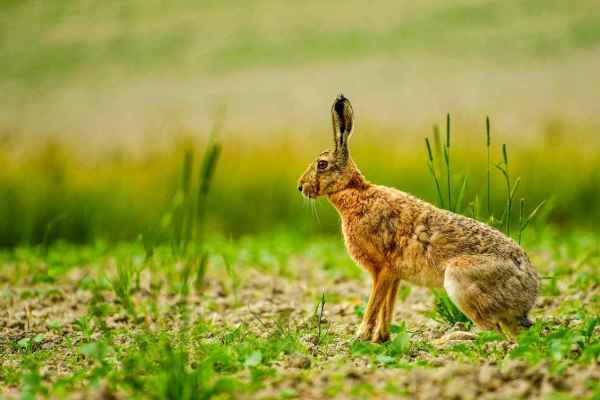
The brown hare (Lepus europaeus) belongs to the hare family (Leporidae) and is a typical inhabitant of open farmland. It occupies fields, meadows, pastures and structurally rich farmland, increasingly also at higher altitudes. Unlike the rabbit, the brown hare does not dig a burrow. It is a solitary animal that hides by day in shallow depressions (forms) amid vegetation and, when in danger, relies on its enormous sprinting ability, reaching speeds of up to 70 km/h with abrupt zigzag manoeuvres.
Biology and Reproduction
In theory, the brown hare can breed three to four times a year. The female gives birth to two to four leverets per litter, which, unlike rabbit kits, are born already furred and with their eyes open (precocial young). For the first few weeks the leverets stay in the form and are suckled by the mother only once or twice a day, so as not to draw the attention of predators to the nest.
Despite its high reproductive rate, the brown hare is a vulnerable species. Mortality among leverets is 60 to 80 per cent, caused by mowing machinery, predation (fox, birds of prey, crows), weather and disturbance. Under natural conditions, this high juvenile mortality is offset by the reproductive rate. But when habitat quality declines, this balance tips.
Red List status
In Switzerland, the brown hare is classed as «vulnerable» (VU) on the Red List of mammals (FOEN 2022). This means there is an increased risk that the species will disappear from Switzerland in the medium term if the causes of its endangerment are not eliminated.
The Decline: From 75,000 to 1,300 Kills
Historical Decline
The hunting statistics document the decline of the European brown hare in Switzerland with alarming clarity. In 1947, in the post-war period, 75,344 brown hares were shot nationwide. Over the following decades the population collapsed rapidly: by 1990 there were only 5,618 kills, by 2000 just 2,584, and by 2025 only 1,322 (Federal Hunting Statistics). Current population densities average only three animals per square kilometre. In the 1990s it was still over four.
Causes of the decline
The main cause of the population decline is the intensification of agriculture. Land consolidation has destroyed hedgerows, fallow land and field margins, which serve the brown hare as cover and a source of food. Fertilisation and the use of pesticides impoverish plant diversity and reduce the food supply. Mechanised farming with ever larger and faster machinery kills leverets directly. The fragmentation of the landscape by roads and settlements cuts up habitats and increases road mortality. Near residential areas, free-roaming dogs and cats are an additional threat.
The brown hare is a flight animal that depends on extensive, connected habitats. Isolated unfarmed pastures amid roads and settlements are of little use to it, because when fleeing it risks being struck by a car. In many places, today's Swiss cultural landscape has become a trap for the brown hare.
Hunting: tradition over species protection
Legal situation
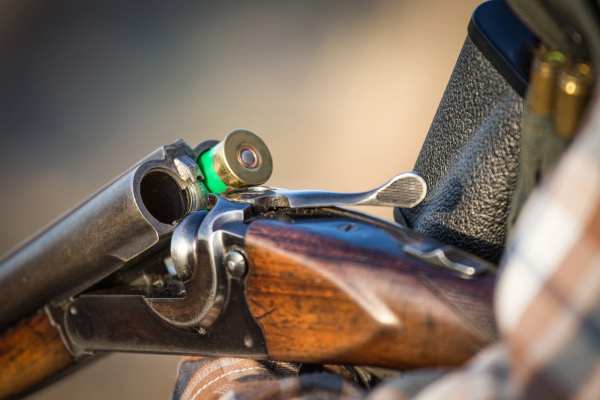
Under the current Federal Act on Hunting (JSG, Art. 5 para. 1 lit. f), the brown hare may be hunted despite its Red List status. The hunting season runs from 1 October to 31 December. The cantons may shorten the hunting season or protect the brown hare entirely, but are under no obligation to do so.
Who shoots, who spares?
Of the 26 cantons, 11 have protected the brown hare year-round at cantonal level, including the canton of Zug. Eight further cantons have shortened the hunting season compared with the federal law. In the remaining cantons, shooting is permitted, although some recreational hunters voluntarily refrain from it.
Particularly striking: the canton of Grisons consistently records high brown hare kill figures. In 2025, 947 brown hares were shot there, and 10,557 in total from 2016 to 2025, around two thirds of all kills in Switzerland. Valais follows (2025: 275), then Ticino (33) and Vaud (26) (Swiss Hunting Statistics 2025). The Grisons Office for Hunting and Fishing justifies small-game hunting not on grounds of population regulation, but with sustainable use, research data and the licence fees that fund the monitoring (small game hunting 2026).
This argument illustrates the cynical logic of the hunting system: an endangered animal continues to be killed so that the revenue from killing it can be used to protect it.
In July 2026, the Grisons government reported that 1,306 brown hares had been counted during the red deer surveys, “the highest number ever recorded” (Canton of Grisons, 1 July 2026). The record was followed not by protection but by small-game hunting: every recreational hunter may kill eight hares until 20 November, a maximum of two per day (Art. 87 Hunting Operations Regulations; Grisons Hunt 2026/27). In Valais, four brown hares per person are permitted, in Ticino one. Neuchatel opens the hunt on brown hares on two Saturdays in 2026; in 2025, 43 people bought a hare licence there and killed 14 brown hares (Neuchatel allows hunting of endangered brown hares).
The failed revision
As part of the revision of the Hunting Act (JSG), which was rejected by voters in 2020, environmental organisations wanted to stop the hunting of endangered species such as the brown hare, the black grouse and the woodcock. This demand failed owing to political resistance from the recreational hunting lobby. Pro Natura noted at the time: there is no wildlife-biological reason for the folklore hunting of ptarmigan, black grouse, woodcock and brown hare. These animals cause no damage and do not need to be controlled in number.
The FOEN argued that a federal hunting ban would only be warranted if the brown hare were “under pressure nationwide because of hunting”. The main cause of the decline, it said, lay in habitat change. This argument is formally correct and at the same time devastating: it shields the last remaining pressure factor, recreational hunting, because it is not the main factor. From an ecological perspective, the opposite is true: when a species is already under pressure from other factors, every additional mortality factor must be eliminated, not tolerated.
More on this: Dossier: Recreational hunting and biodiversity
The brown hare as an indicator species
What its disappearance means
The brown hare plays a key role for science: it is an indicator species. Its population shows the state of biodiversity in open farmland. If the brown hare is doing badly, one can conclude that field birds (lapwing, skylark), insects (wild bees, ground beetles), amphibians and numerous plant species in this landscape are also doing badly.
Conversely, this means that if the brown hare recovers, the entire community of species in the farmland benefits. Hedgerows and fallow land at the edges of fields and woodland, which benefit the brown hare, are at the same time habitats for dozens of other species. Promoting the brown hare is therefore a lever for agricultural biodiversity as a whole.
The Confederation is missing its own targets
As part of the Swiss Biodiversity Strategy, the Confederation has set itself targets, including the stabilisation and promotion of endangered species. In the case of the brown hare, it is missing these targets by a wide margin. The population continues to decline, recreational hunting is not being restricted, and habitat enhancement is progressing only slowly. The Fondation Franz Weber has warned that Switzerland could lose the brown hare irretrievably unless decisive action is taken.
More on this: Dossier: Hunting Myths
The absurd coexistence of hunting and conservation
Support projects alongside kills
The inconsistency of the Swiss system is nowhere clearer than with the brown hare. In individual cantons, support projects are under way: farmers create fallow strips and hedgerows, biologists map populations, and recreational hunters take part in counts. At the same time, brown hares are shot in the same or neighbouring cantons. Public money is invested in habitat enhancement while recreational hunting continues to decimate the fragile population. This simultaneous promotion and killing is not only ecologically nonsensical but also economically questionable.
Comparison with other countries
In several European countries, hunting of the European hare has already been discontinued or severely restricted. In the Netherlands, the European hare is on the national Red List; because all five huntable species there do not have a favourable conservation status, the government, from the 2022/23 season onwards, no longer opened hare hunting in the provinces with a declining population trend (Groningen, Limburg, Utrecht) and did not open rabbit hunting nationwide (Ministerie van LNV, Kamerbrief 33 576, No. 267). In parts of Germany and Austria, closed seasons and hunting bans apply in areas with low population density. On this point, Switzerland lags behind.
What needs to change
- Immediate nationwide hunting ban on the European hare: An endangered species that causes no damage and does not need to be regulated must not be hunted. Hunting the European hare is justified neither ecologically nor ethically. What 11 cantons have long since implemented must be anchored in federal law.
- Large-scale habitat enhancement in the cultural landscape: Hedgerows, fallow land, arable field margins and extensive pastures must be promoted on a large scale and in a binding manner. Today's ecological compensation areas are insufficient, both in extent and in quality, to halt the decline of the European hare and of agricultural biodiversity as a whole.
- Reducing landscape fragmentation: Roads and settlements cut through the habitats of the European hare. Wildlife corridors and green bridges must be planned and built more extensively to ensure that populations remain connected.
- National European hare monitoring: The current population data are based on cantonal estimates that are methodologically inconsistent and incomplete. Nationwide monitoring using a standardised methodology is a prerequisite for an evidence-based protection strategy.
- Extending the hunting ban to other endangered species: What applies to the European hare also applies to the black grouse, the ptarmigan and the woodcock. Folklore hunting of endangered species that cause no damage must be ended.
Talking points
“The European hare is not endangered by recreational hunting; the main cause is agriculture.” The main cause is correctly identified. But the argument is applied wrongly in ecological terms: if a species is already under pressure from habitat loss, every additional mortality factor must be eliminated. Over 1,300 kills a year in an endangered species are not 'sustainable' but counterproductive. Recreational hunting worsens an already critical situation.
«Hunting the European hare is a tradition and part of sustainable use.» «Sustainable use» presupposes that the population is stable or growing. With the European hare, the opposite is true: the population has been declining for decades. What is being defended as tradition is the continued removal of animals from a shrinking population. Tradition is no argument against species protection.
«The revenue from hare hunting flows into nature conservation.» Killing an endangered animal in order to use the revenue to fund its protection is circular reasoning. Nature conservation must be organised and funded independently of hunting rights. Anyone who wants to protect nature does not need a hunting licence.
«In our canton, the European hare is still common enough to be hunted.» The Red List classification «vulnerable» applies across Switzerland as a whole. Cantonal «stability» is often a misreading of patchy data. As long as there is no national monitoring with reliable figures, any cantonal declaration of no concern is scientifically untenable.
Quick links
Posts on Wild beim Wild:
- Hunting Fact Check
- Why recreational hunting fails as population control
- Animal welfare problem: wild animals suffer agonising deaths because of recreational hunters
- Neuchatel permits hunting of endangered brown hares, Fribourg opens fauna fund to shooting ranges
- Low-ground hunt 2026: What Grisons, Ticino and Valais are releasing for the kill
- Hare: Prefers hopping through flower strips
- Swiss Hunting Statistics 2025: What the Federal Figures Show
Related dossiers
- The Rock Ptarmigan in Switzerland: An Ice Age Relic Caught Between Climate Crisis, Tourism and the Shotgun
- Ibex Switzerland: Smuggled, saved, trophy
- Beaver Switzerland: Reintroduced and released for culling
- Woodcock Switzerland: Endangered, hunted and ignored
- Waterfowl in Switzerland: Winter Guests in the Line of Fire
- Pigeons Switzerland: Symbol of peace and mass shooting
- Corvids in Switzerland: the most intelligent animals in the crosshairs
- Eurasian jay Switzerland: The forest's forester in the crosshairs
- Marmot Switzerland: Ice age relic and mass shooting
- European rabbit Switzerland: Severely endangered, yet still huntable
- Mountain hare Switzerland: Climate crisis and the shotgun blast
- Raccoon Switzerland: Culled for the wrong origin
- Stone marten Switzerland: Urban adapter under hunting pressure
- Pine marten Switzerland: Shy forest dweller under hunting pressure
- Badger Switzerland: Ecosystem engineer in the crosshairs
- Red deer Switzerland: Returned and demoted to a cull target
- Roe deer Switzerland: The most frequently shot wild animal in recreational hunting
- Wild boar Switzerland: Recreational hunting exacerbates the problem
- Chamois Switzerland: High hunt, climate stress and the overpopulation myth
- Brown hare Switzerland: Endangered, hunted and ignored
- Swiss Hunting Statistics 2025: What the Federal Figures Show
- Self-regulation of wildlife populations: Scientific evidence from Geneva, the National Park and international comparison
- Forest-Wildlife Conflict in Switzerland: Why the Browsing Narrative Does Not Justify Recreational Hunting
sources
- FOEN, Federal Hunting Statistics: European hare, kills and special kills 1933–2025, retrieved on 21.10.2026 (jagdstatistik.ch)
- FOEN/info fauna (2022): Red List of Mammals (excluding bats), European hare: vulnerable (VU)
- Federal Act on Hunting and the Protection of Wild Mammals and Birds (JSG, SR 922.0), Art. 5 para. 1 lit. f
- Canton of Grisons: Ordinance on Hunting Operations (BR 740.025), 2026 version, Art. 87; press release of the cantonal government of 1.7.2026 (gr.ch)
- Canton of Neuchatel, Office for Fauna, Forests and Nature: Annual Report 2025; Hunting Decree 2026/27
- Ministry of Agriculture, Nature and Food Quality (2022): Letter to Parliament on the status of the game list, Parliamentary Paper 33 576, No. 267
Our Standard
The brown hare is the emblem of a lost cultural landscape. Its story is the story of Swiss species loss in miniature: a slow, well-documented decline that everyone sees and nobody stops. That it continues to be hunted despite its Red List status is not an expression of sustainable use, but the failure of a wildlife policy that places the interests of recreational hunting above species protection. The conclusion is unambiguous: hare hunting must be stopped immediately and nationwide. What 11 cantons have long since implemented must no longer be treated under federal law as an optional extra left to the cantons. This dossier is updated continuously whenever new figures, studies or political developments require it.
More on the topic of recreational hunting: in our hunting dossier we bring together fact checks, analyses and background reports.