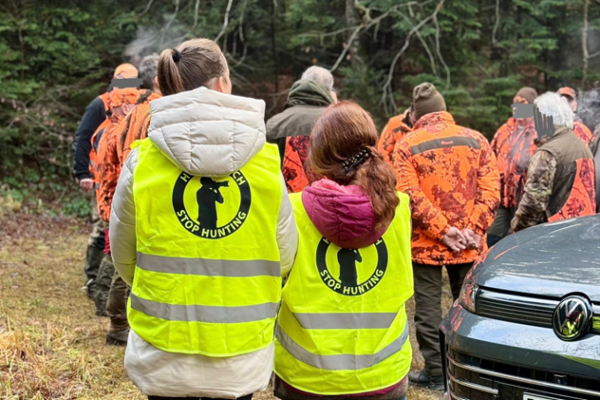
Driven-hunt dates: Zurich wants to wait until December to decide
The hunting administration wants to consult the hunting societies first. By then, the bulk of the regular driven-hunt period will have passed.
Illustrative image. Photo: Pascal Debrunner / Unsplash
The Others Should Watch Out
The dates of larger driven hunts must be reported to the Zurich administration before they take place. The Office for Landscape and Nature (ALN) is for now unwilling to release the information already reported. In response to a request by Ursula Alayan-Ricklin of Effretikon under the Information and Data Protection Act (IDG), Manuel Bünzli, head of the Legal & Services section of the Fisheries and Hunting Administration (FJV), stated on 6 November that the hunting societies would be consulted first. A decision would come "mid-December at the earliest". By then, roughly four fifths of the regular period for driven hunts will have elapsed.
What was requested
Alayan-Ricklin submitted her request on 8 October. She asked for the dates and the locations of all society and driven hunts for the autumn/winter 2026 season that have been reported to the administration. She did not ask for the names or addresses of recreational hunters. Her reasoning: at driven hunts, shots are fired in forests that, under Article 699 of the Swiss Civil Code, anyone may enter. Anyone who knows the dates can adjust their route.
The Zurich hunting ordinance permits driven and drive hunts from 1 October to 31 December, and on wild boars until the end of February. Driven hunts involving more than six shooters must be reported by the hunting society to the ALN before they take place (§ 30 of the cantonal hunting ordinance). For hunts already reported, the office therefore holds the information. It is not known which dates for the current season have already been received.
The response, shortly before the deadline expired
Manuel Bünzli got in touch shortly before the 30-day deadline expired. He said he had discussed the matter with the ALN's legal department. Because the interests of third parties were affected, namely “those of the Zurich hunting societies and their members”, the authority wanted to consult the hunting societies before deciding on disclosure.
The IDG (Zurich Information and Data Protection Act) provides that the authority must grant access or issue a ruling within 30 days of receiving the request. If it cannot meet the deadline, it must state its reasons and say when the decision will be available. Manuel Bünzli gives “mid-December at the earliest”, but this wording does not amount to a binding date. Third parties are to be heard when the authority intends to grant access and personal data or information classified as confidential are affected. The reply does not explain which protected details are supposed to be contained in hunting dates and hunting grounds. Nor does it explain why at least part of the data cannot be released immediately, for instance without the names of the hunting grounds.
Alayan-Ricklin sticks to her request
That same afternoon, Alayan-Ricklin objected. A decision in mid-December would defeat her right to information “merely through the passage of time” and amounted to an unjustified delay in proceedings. The data, she argued, were already held centrally and digitally by the administration. Asking private leaseholders whether official data should be made transparent was neither justified nor proportionate.
She demands the release of the data for the entire season. If the FJV (Fish and Hunting Administration) maintains the extension of the deadline, she is requesting an appealable ruling with information on legal remedies, so that she can challenge the delay before the competent authority.
One municipality shows it can be done
Geroldswil shows that dates need not be a secret. On 3 November the municipality announced two driven hunts by the Altberg Süd hunting society, giving date, time and area: on 13 November and 4 December, with up to 28 shooters and 18 beaters. Visits to the forest in the areas concerned are to be avoided during these periods. A canton-wide overview, as demanded by Alayan-Ricklin, does not exist.
In its November bulletin, the FJV itself points to dangers during driven hunts: because of the drought, unpredictable breakage of branches and treetops was a threat, and with so many people involved there was an “increased collective risk” (Zurich wants to amend hunting legislation). This notice is addressed to the organisers of the hunts. For forest visitors who are out the same day with their dog, their bike or their children, the canton provides no overview of when and where shooting takes place.
Hunt Watch in the background
Alayan-Ricklin suspects that the administration is withholding the data because she is active with Hunt Watch. For years, the group has accompanied driven hunts in Switzerland and documented what happens during them (Driven hunt under observation). How violently some recreational hunters react to such observation was shown in December 2025 by an assault on an activist in Basel-Landschaft (Violent assault on activist during driven hunt). By her observation, warning signs are also often missing at Zurich driven hunts.
This is not the first dispute over FJV data. In the summer, Manuel Bünzli first supplied Alayan-Ricklin with incorrect fox figures and had to admit a filtering error in September. The corrected data showed that only 7.7 per cent of the foxes shot carry a note of illness (The game register refutes the canton's disease justification).
Responsibility and oversight
The reply was signed by Manuel Bünzli, section head for Legal & Services at the FJV. The FJV is the responsibility of co-heads Lukas Bammatter and Reto Muggler. Oversight lies with the ALN under office head Marco Pezzatti and with the Building Department headed by cantonal minister Martin Neukom. The reply does not name which lawyers in the ALN legal service were involved.
Comment: Information with an expiry date
For all hunts taking place up to mid-December, the information would come too late to adjust one's own route. The practical value of access diminishes with every hunting date that passes. For timely route planning, a late answer can be just as useless as a refused one, even though no formal refusal has yet been issued. Anyone who hunts with firearms in publicly accessible recreational areas, lets dogs chase game and sends lines of beaters through the forest cannot expect the when and where to remain a private matter.
Geroldswil publishes; the FJV first consults those whose hunts would become public. The administration must explain which specific interests stand in the way of an earlier release and why at least the upcoming dates cannot be made public immediately. As long as the dates are not accessible, this hampers not only route planning but also independent observation of the hunts.
What you can do
Write directly to the members of the Zurich cantonal parliament and demand that the dates of driven hunts be published in good time before any shooting takes place. In the experience of IG Wild beim Wild, personal emails to politicians achieve more than petition lists. You will find addresses and a template letter on the page End fox hunting. IG Wild beim Wild will report on the FJV's decision as soon as it is available.
More on the subject of recreational hunting: In our dossiers on the criticism of recreational hunting gather fact-checks, analyses and background reports. What the research says about this is shown by Hunting fact-checked: the state of research.
The position of IG Wild beim Wild: IG Wild beim Wild rejects recreational hunting. Our model is the canton of Geneva, which has managed without recreational hunting since 1974: without hunting seasons, without hunting dogs, without driven hunts, without high seats, without the animal cruelty and crime that go hand in hand with hunting season elsewhere. What has worked there for over fifty years disproves every position paper by JagdSchweiz. An association that bases its policy on claims it refutes in its own documents is not a professional organisation, but a factory for misinformation.
Wild animals need a voice
Once a week: research, petitions and background information on recreational hunting. Free of charge and can be unsubscribed from at any time.

All articles are written by IG Wild beim Wild as well as by external co-authors. Research, structuring and editorial processes may be supported by AI-assisted tools.
Support our work
With your donation you help protect animals and give their voice a hearing.
Donate now →