Trophies in Bohemia, kills in Alsace, carcasses on Instagram: Dominik Feusi and recreational hunting as a worldview
The plagiarism scandal surrounding "Nebelspalter" deputy editor-in-chief Dominik Feusi has reached a wider public. But anyone who wants to understand what this man truly represents need not dwell on the stolen Middle East commentary. The real story is to be found on his public Instagram profile. There, Feusi has documented for years that recreational hunting is, for him, not a local tradition but an international lifestyle pursued at the expense of wildlife.

Photo: Instagram @Feusl
«Straight from the forest»
A post from 4 October 2023 shows a dead roebuck lying on the ground next to a rifle.
The animal's empty eyes stare into nothingness. Feusi writes: «I am always thankful when everything was right and I had the chance to shoot an animal. It is like becoming part of this huge cicle of nature.» Hashtags: #jagd #hunting #nature #chasse #switzerland.

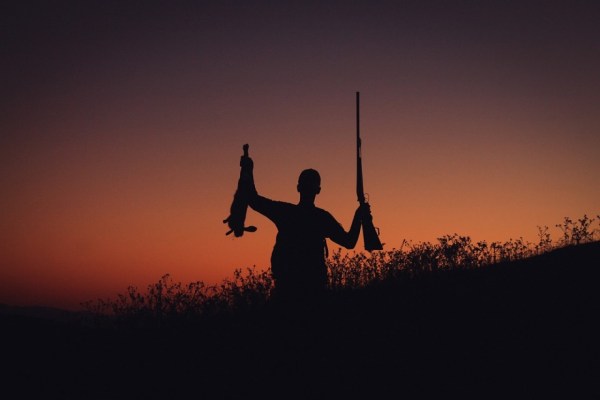
This is not modesty. This is the classic recreational hunting ideology in its purest form: glorifying one's own act of killing as a spiritual connection to nature, staging the death of an animal as personal fulfilment, and crowning the whole thing with the aura of the «cycle of nature». What is missing from this worldview is the animal itself. It exists as a projection screen for the shooter's needs, not as a sentient being.
Hunting Tourism as a Programme
Feusi does not only hunt at home. His profile reveals a geographic reach that makes the word "hunting tourist" simply accurate.
In May 2024 he posts from Mašovice in the western Bohemian Plzeň Region, Czech Republic. Feusi smiles next to a killed roebuck in a grain field. Caption: "My first roebuck in Bohemia, stalked across the open field." Hashtags: #jagd #bohemia #hunting #pirsch.

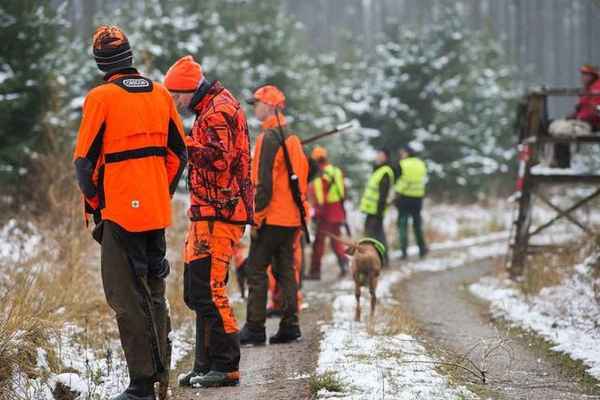
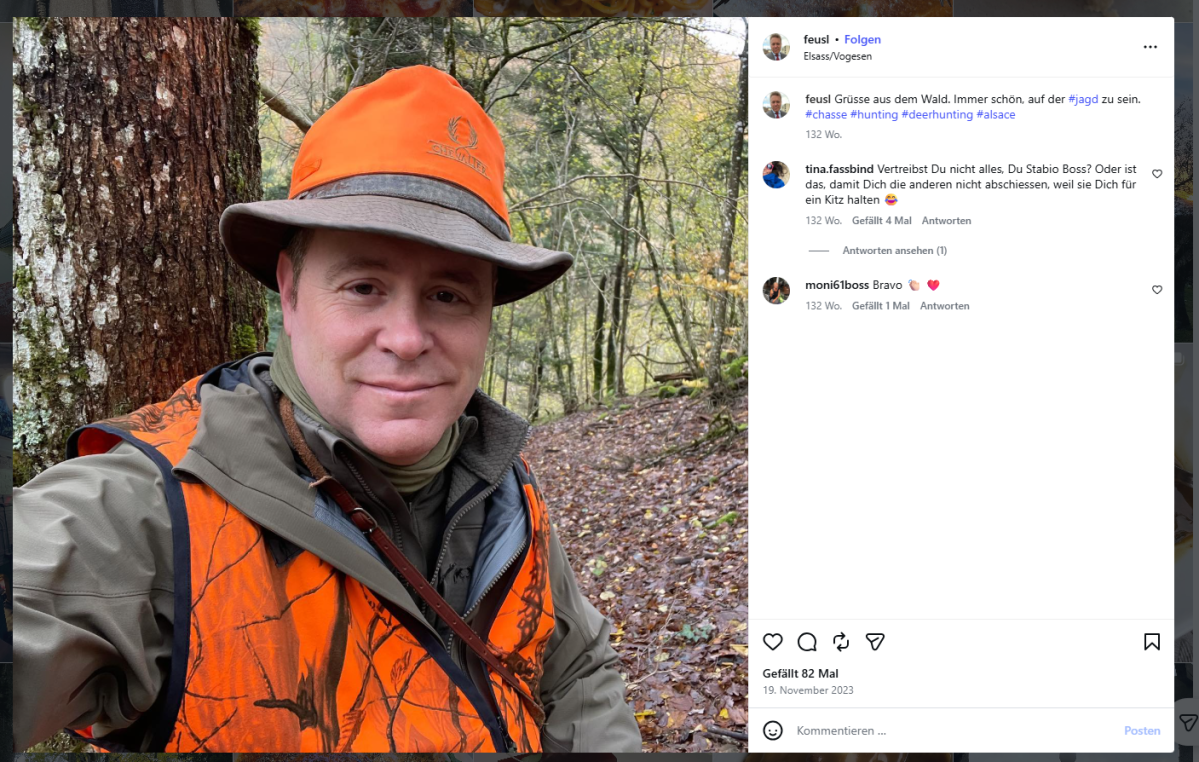
In November 2023, he checks in from Alsace and the Vosges in France. Orange hunting vest, hat, selfie in front of an autumn forest. "Greetings from the forest. Always nice to be out on the #jagd." #chasse #hunting #deerhunting #alsace.
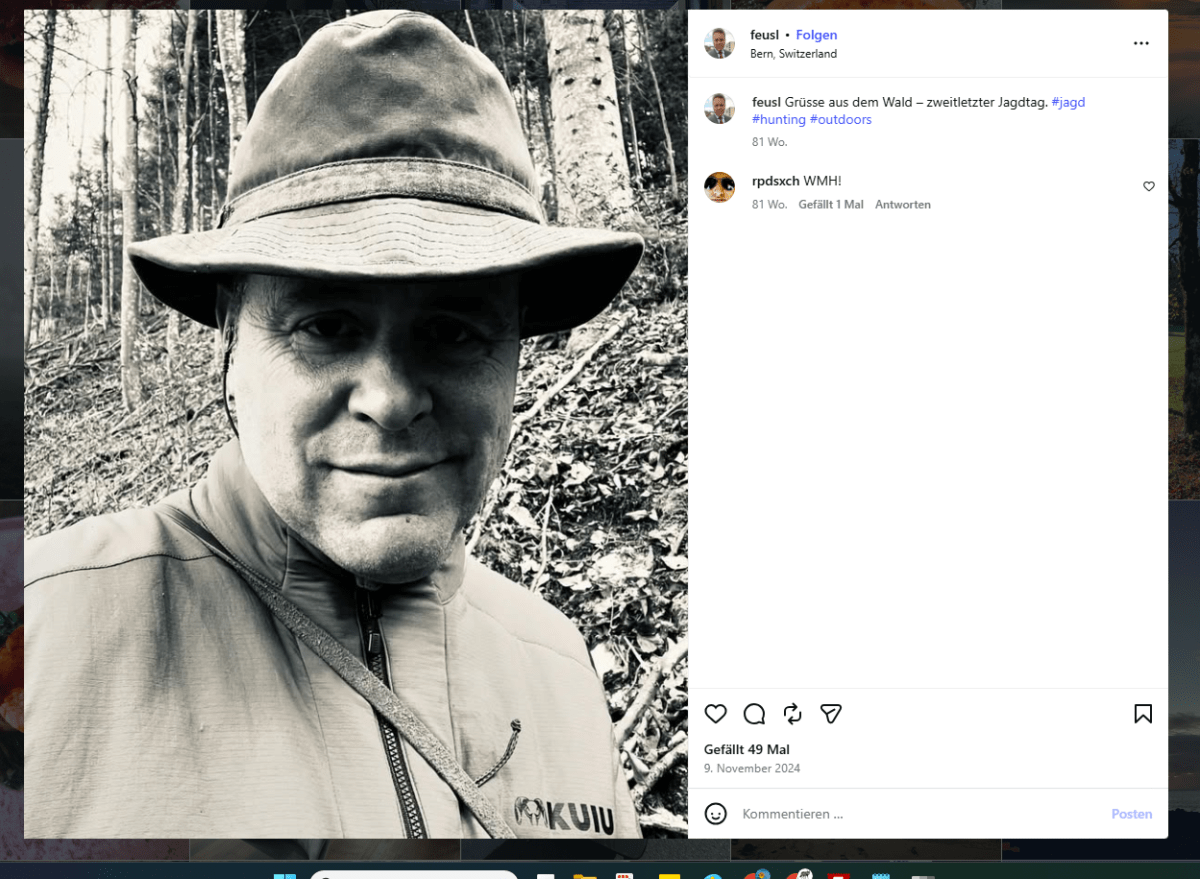
In Switzerland he hunts regularly, documenting it with close-ups of his rifle, first-person perspectives from the high seat, and trophy photos. In October 2024 he posts the opening of roe deer season with a view over the gun barrel into the undergrowth: "Roe deer hunt opened." #meateater. In November 2024 he captures, in black and white, his second-to-last day of hunting: "Greetings from the forest, second-to-last day of hunting."
This is not a local recreational hunter who knows and tends his own patch of forest. This is Hunting tourism across national borders, in which the hunting ground merely serves as a backdrop for the next kill.
“Ready for the next deer”: the weapon as a lifestyle object
A post from 6 November 2024 shows, in close-up, an opened, engraved double-barrelled shotgun with two cartridges inserted (RWS Rottweil 12/70), with autumnal forest floor in the background. Caption: “Ready for the next deer.” Hashtags: #hunting #stalking #outdoors #nature #arms.
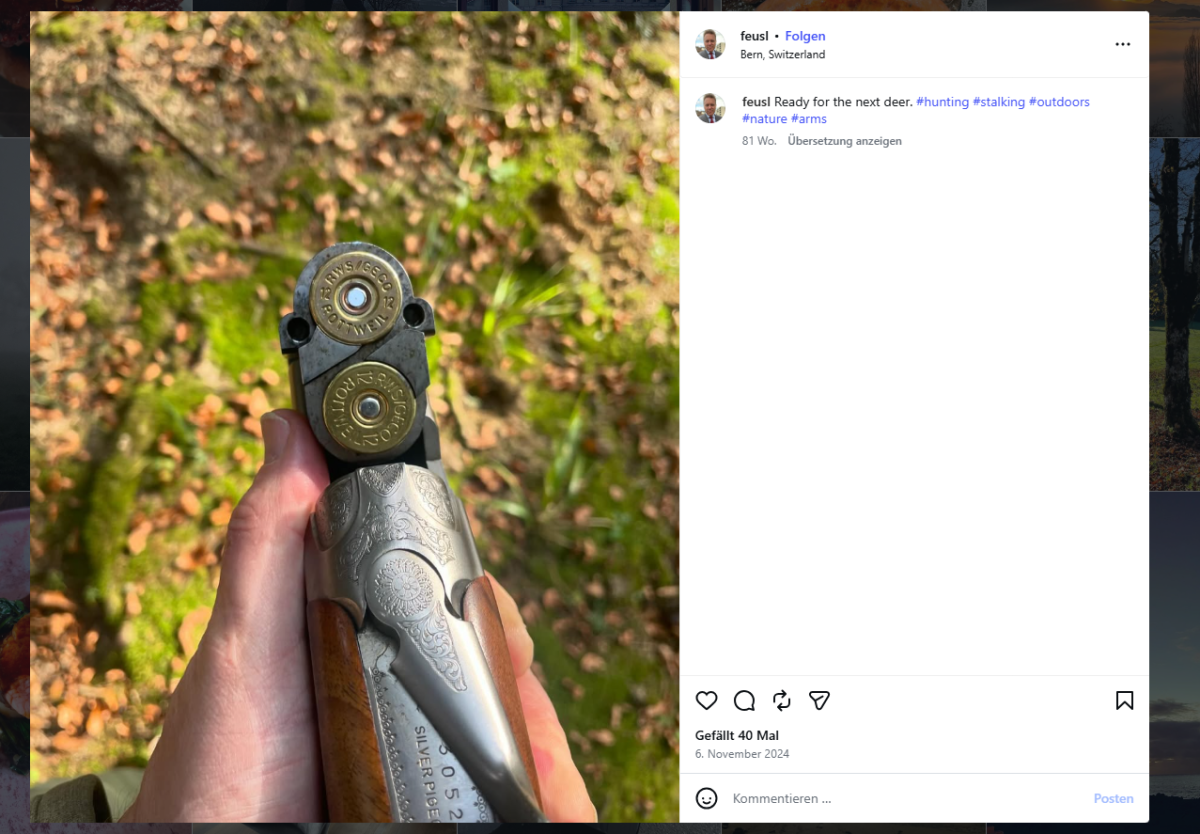
“The next deer.” Not “a roe deer”, not “wildlife” as part of an ecosystem. “The next deer” as if it were the next item on a list. The language gives away the attitude: the animal as the next target in a series, the weapon as a prop in a curated image. This is not hunting culture. This is hunting as a status symbol.
“Grateful for nature” – and what that actually means
In October 2024, Feusi posts a trophy photo from Switzerland. Hunting attire, a misty mountainside, beside him a freshly killed roe deer. He is smiling. Caption: “Grateful for nature.” #jagd #hunting #meat #nature. 93 likes.
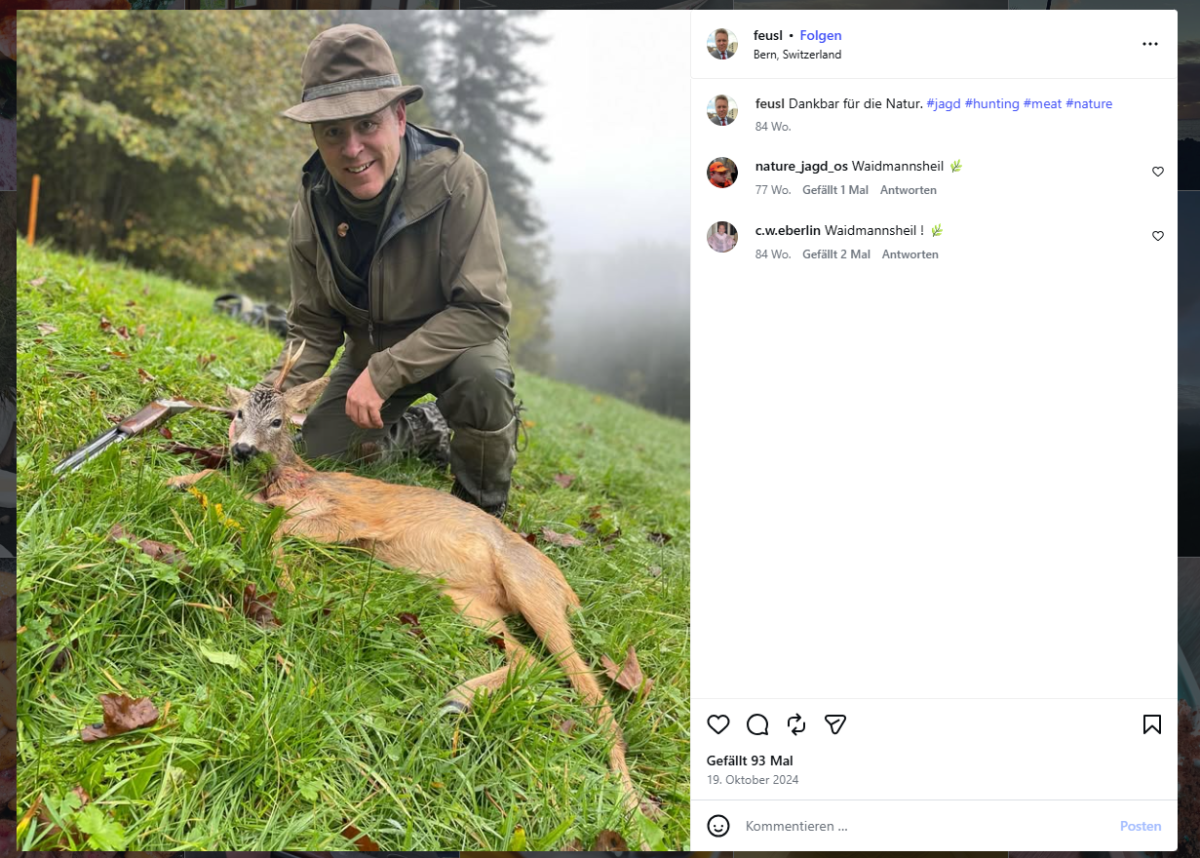
In recreational hunting parlance, “grateful for nature” is a fixed formula for moral self-absolution: whoever is grateful means well. Whoever says “nature” is protecting it. What the image shows contradicts the caption: a dead body, a smiling shooter, a weapon. Nature appears merely as a backdrop, not as a system worth protecting.
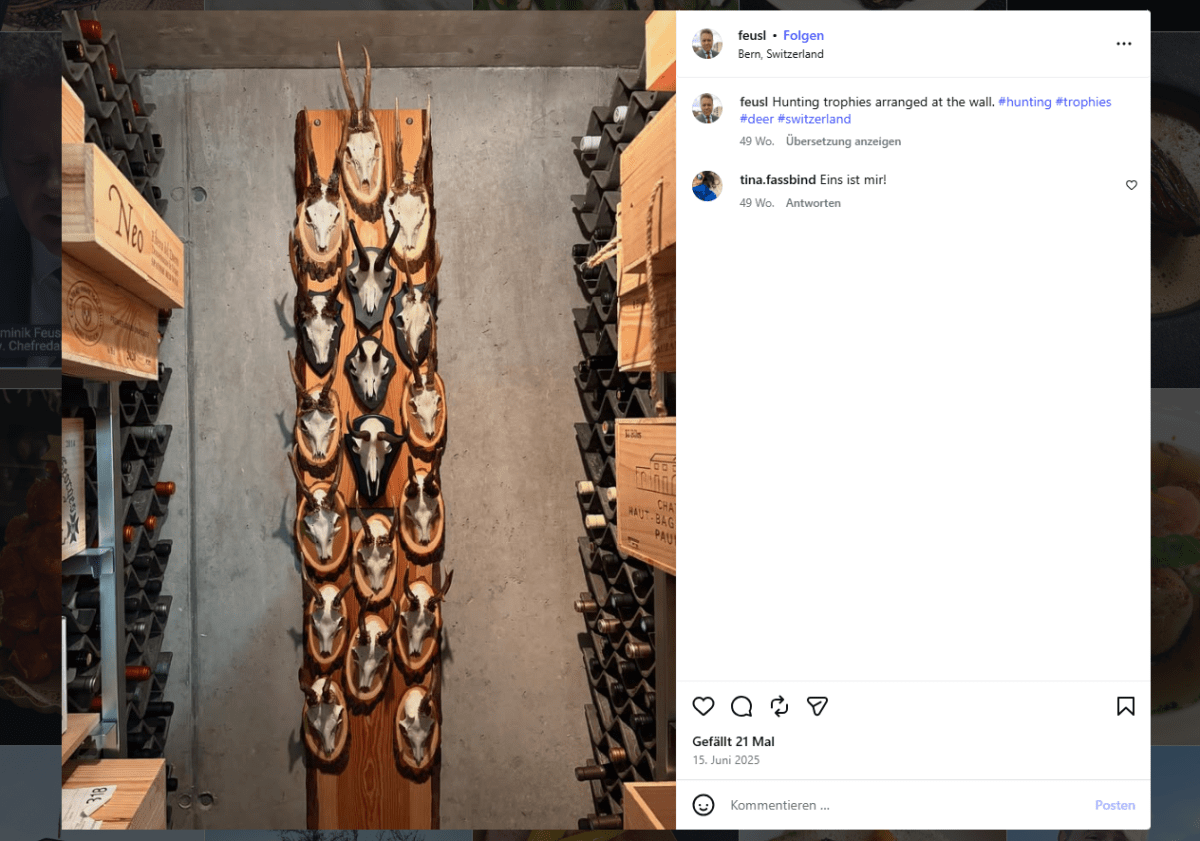
A post from 15 June 2025 makes this relationship to nature even more visible: a densely packed concrete wall, flanked by wine racks, row upon row of mounted red deer and roe deer skulls with antlers. Feusi's comment: “Hunting trophies arranged at the wall.” Hashtags: #hunting #trophies #deer #switzerland.
The day everything falls apart
There is one detail that inseparably links the hunting story and the plagiarism story, and which has never before been worked out so clearly.
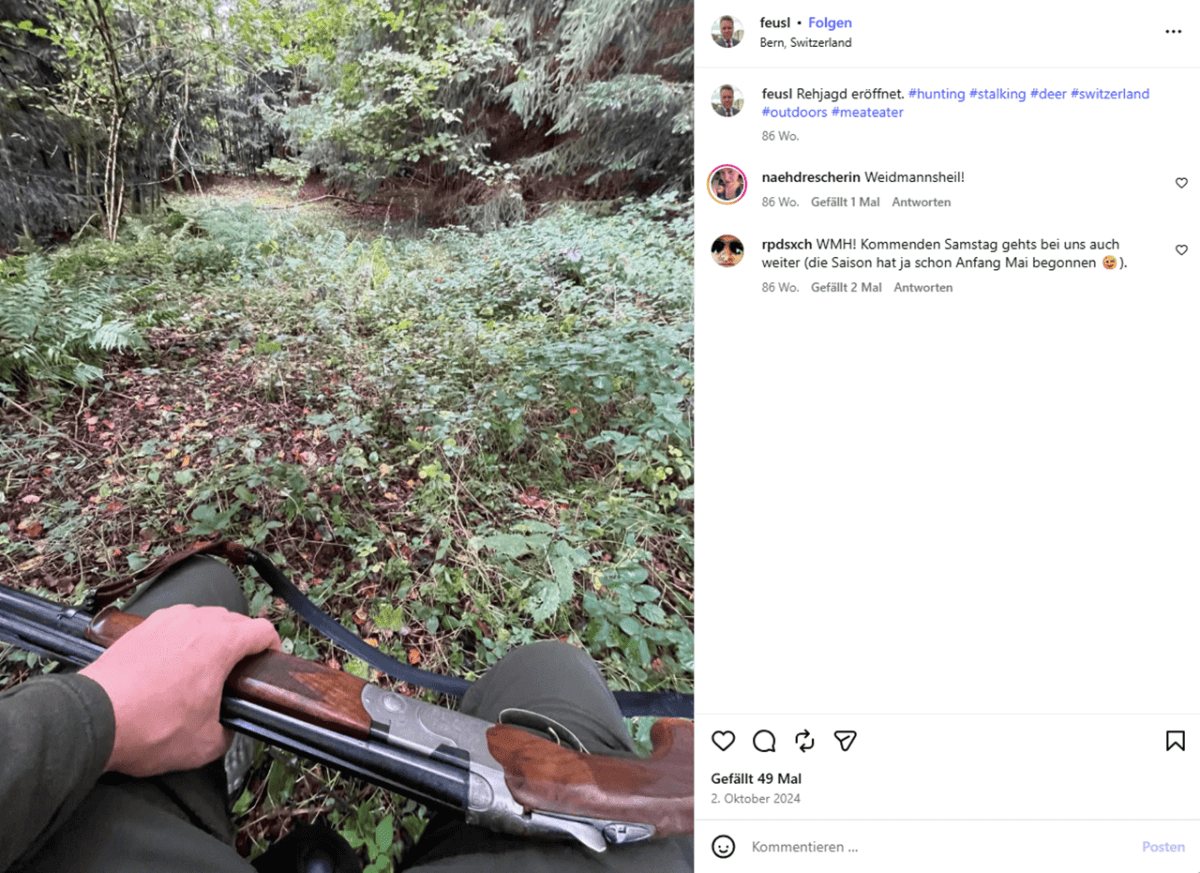
On 2 October 2024, Feusi posted a first-person perspective from the Swiss forest, rifle raised, gaze fixed on the undergrowth. Caption: «Roe deer hunting season opened.» On 3 October 2024, one day later, an article appeared in «Nebelspalter» that he had copied roughly 90 per cent from the British «Telegraph».
Feusi himself explained to «Blick» how this came about: on that day, «Nebelspalter» had urgently needed another story, and he had been solely responsible for the website. So he translated someone else's text, deleted the source references, and published it under his own name.
What Feusi did not say, but his Instagram shows: he was presumably out hunting. Not in the Federal Palace. Not at his desk. In the forest, rifle in hand.
That is the real punchline of this story. Not the plagiarism as an isolated lapse by an overworked journalist, but a recreational hunter who considers his day of hunting more important than his profession, who quickly inserts a stolen story to fill the gap, and in doing so commits a fundamental act of journalistic fraud. Recreational hunting has displaced journalism. Not just once, but structurally.
3,513 posts, one theme: the staging of killing and eating
Dominik Feusi's Instagram profile comprises more than 3,500 posts. One common thread runs through the years: the systematic documentation of killed animals and their subsequent consumption. Freshly shot roebucks, raw roe deer haunches on the chopping board, grilled roe deer ribs with the hashtag #eatyourmeat, trophy walls full of skulls, interspersed with head cheese, Käsekrainer sausage, Culatello di Zibello, cured ham, sausage products of every kind.
This is no occasional food account. It is a years-long, sustained self-portrayal in which the killing and eating of animals is made the centrepiece of a public identity. The hashtags are telling: #hunting #eatyourmeat #venison #jagd #meat #trophies. Not a word about sustainability, ecology, or animal welfare. Killing as a lifestyle, eating as a statement.
What Feusi consumes and documents in the process is medically unambiguous. The WHO/IARC classifies processed meat – that is, cured, smoked and fermented meat such as sausages and ham – as a Group 1 carcinogen: carcinogenic to humans. This is the same evidence category as tobacco smoke and asbestos.
The recreational hunting lobby has for years marketed game meat as a healthy, natural alternative to industrially produced meat. What Feusi's profile shows is the opposite of this narrative: massive consumption of processed meat and red game, combined with the killing of animals as a leisure pursuit, documented under the hashtag #eatyourmeat. Not a bond with nature. Consumption as identity.
Enhancing habitat? The opposite is true
The recreational hunting lobby repeats like a mantra that recreational hunting protects habitat and is necessary for the «balance» of wildlife populations. Feusi's Instagram profile shows what actually lies behind this claim.
A man who shoots his «first roebuck in Bohemia» in the Czech Republic, sits in wait for red deer in Alsace, and «opens» the roe deer hunt in Switzerland is not interested in habitat enhancement. He is interested in the next kill. The hunting ground is not a homeland that he knows and protects, but a resource that he harvests – across borders, no less.
Hunting tourism is the opposite of habitat protection. It brings shooters unfamiliar with an area into hunting grounds that they neither know nor bear long-term responsibility for. It does not reduce wildlife populations according to ecological criteria, but according to the criterion of the best shooting experience. More on the scientific classification of these myths can be found in our dossier on recreational hunting.
«Hunter of game»: The author profile as evidence
All of this would be a private matter, were it not stated on the official author page of his employer. The «Nebelspalter» publicly describes Feusi as a «historian, Schwyz native and hunter, of both game and good stories». His identity as a recreational hunter was no secret. It was part of his professional self-presentation as a federal parliamentary journalist, listed on equal footing alongside his academic training.

A federal parliamentary journalist whose publisher markets him as an active recreational hunter and international hunting tourist is not an independent observer of federal politics. He is a lobbyist with a press pass. The conflict of interest was not hidden. It was the programme.
A milieu that exposes itself
The Feusi case is no accident. It is the logical result of a milieu that places opinion above craft, ideology above integrity, and networking above independence. What his Instagram profile has documented for years is the ideology of the recreational hunting in its most unvarnished form: killing animals as spiritual fulfilment, carcasses as lifestyle content, international hunting grounds as a consumer good, and the WHO-classified cancer risk as a proudly staged menu.
Anyone who understands this also understands the «Nebelspalter». And anyone who understands the «Nebelspalter» understands why a serious federal parliamentary journalist like Fabian Schäfer left the publication before Feusi had worked even a single day.
More on the subject of recreational hunting: In the dossier The Role and Criticism of Recreational Hunters we shed light on the training, power and self-image of recreational hunters. The scientific evidence is presented in the overview Studies on the Effects of Recreational Hunting.
The position of IG Wild beim Wild: IG Wild beim Wild rejects recreational hunting. Our model is the canton of Geneva, which has managed without recreational hunting since 1974: without hunting seasons, without hunting dogs, without driven hunts, without high seats, without the animal cruelty and crime that go hand in hand with hunting season elsewhere. What has worked there for over fifty years disproves every position paper by JagdSchweiz. An association that bases its policy on claims it refutes in its own documents is not a professional organisation, but a factory for misinformation.

All articles are written by IG Wild beim Wild as well as by external co-authors. Research, structuring and editorial processes may be supported by AI-assisted tools.
Support our work
With your donation you help protect animals and give their voice a hearing.
Donate now →