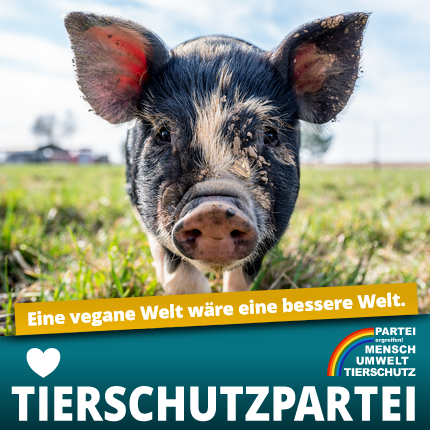
Study: a vegan world would be a better world
A response to a questionable article in the Süddeutsche Zeitung, which claims that "a world full of vegetarians would not be a good one" and "if you love animals, you should eat them".
Two very different articles recently appeared in the Süddeutsche Zeitung.
On 7 March, Kristina Kobl set out sensitively and with scientific precision that "the suffering of fish" is real. She explores the question of why fish are attributed less capacity for suffering than other animals. Biologically, there is little to suggest that a sharp moral line can be drawn between fish and other vertebrates, or between different animal species in general. She concludes, for instance, that the term "seafood" instead of "marine animals" represents a fatal degradation of marine life, and she condemns the common notion that pescetarianism is ethically justifiable. No, it is not. On top of that come the ecological effects of fishing on other animals and the entire planet.
And then, on 23 April, an article by Christina Berndt appeared. Unlike Kobl's piece, it triggered massive discussion. The sad lesson for the Süddeutsche Zeitung is likely to be: writing in a scientifically and ethically sound way generates neither clicks nor new subscriptions – but constructing untenable theses that predictably provoke complies with the rules of media economics.
What did Berndt write? Her lines are actually far too muddled and lacking in substance to deserve much attention. Other outlets, such as Utopia, Animals United, Aljoscha, and Robert Marc Lehman, have already responded to it at length. But the stage for such absurdities was set up by the Süddeutsche Zeitung – so now the microphone should be put to extensive use by others too!
Berndt's thesis is that vegetarianism would prevent the lives of so-called farm animals. "A world full of vegetarians would not be a good one“, she titles it, drawing a nonsensical parallel to abortion or contraception in humans. Berndt's central assumption, without which her thesis cannot hold up at all, is that one should only breed, slaughter and eat animals if they had a pleasant life beforehand. In doing so, she crudely wriggles her way out of the agro-industrial reality of animal suffering.
Yet every Aldi cheap-meat buyer, every Wiesenhof sausage consumer, will understand Berndt's thesis as legitimation. Will want to and be able to understand it that way. Because that is exactly what's depicted on the packaging: a pleasant life on the farm. The cruel reality in the barns, the dozens of barn fires every week, the deforestation of rainforest for animal feed, the zoonoses and the greenhouse gases – none of this is fundamentally an issue on the supermarket shelf. Not even with an animal welfare label. On the contrary, advertising with labels serves to soothe consumers' consciences or even acts as a recommendation to buy particularly cheap bargains.
Moreover, she completely ignores the fact that even the few animals on idyllic farms and alpine pastures all too often are also simply transported to an assembly-line slaughterhouse. And usually while still in childhood or adolescence, even though the “life” that Berndt waxes so lyrical about still lies ahead of them. During transport they face injuries, and before slaughter there are numerous botched stunnings. And in the end, a third of the meat isn't even consumed but simply thrown away.
Berndt's thesis, the central assumption it requires, the advertising lies, the consumption behaviour – it all forms a consistent pattern. And none of it has the effect of reducing animal suffering, but rather of sustaining and maximising it.
Instead of writing an article about the need for more education on the reality of the agricultural industry, in order to make her central assumption – the farmyard idyll – a reality, she prefers to shift the focus of consideration entirely. Out of nowhere, she constructs an alleged problem with a vegetarian/vegan way of life that has absolutely nothing to do with reality. Nor would it, even if the world were to eat a purely plant-based diet.
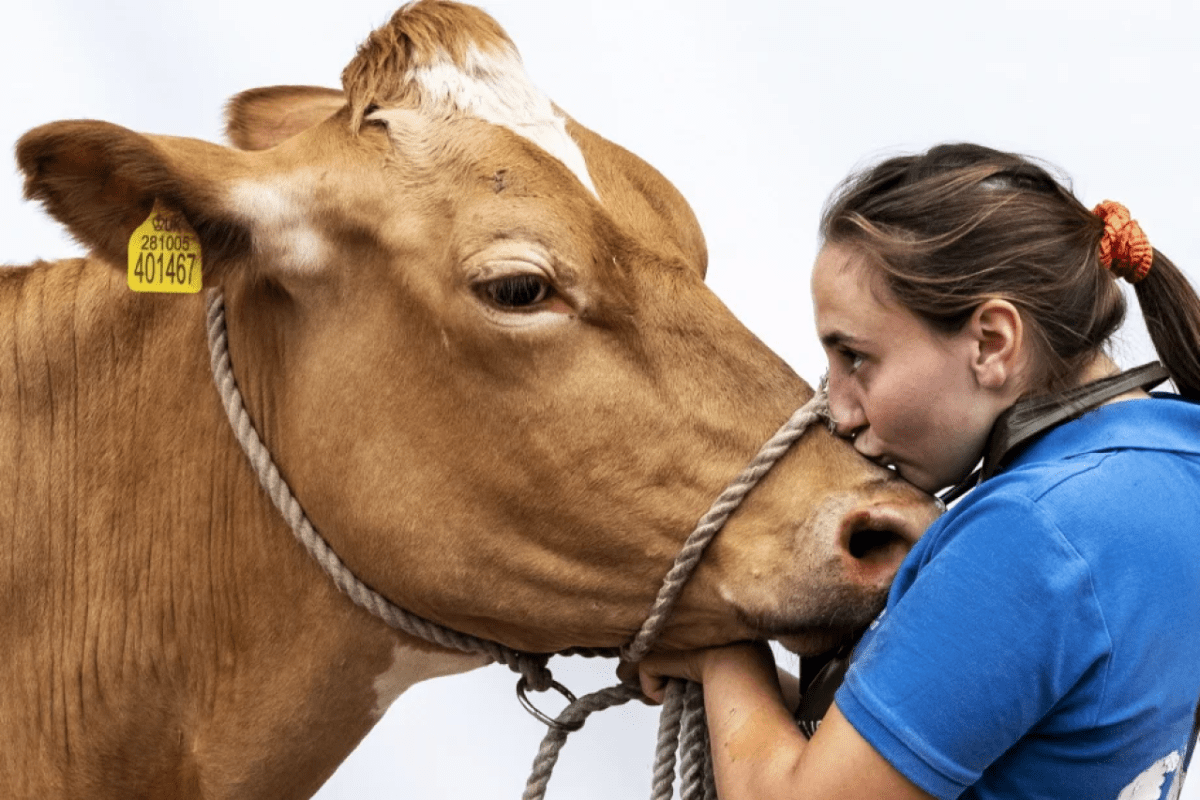
For even in a world without commercial animal farming, without exploitation and profit pressure, humans and animals could still come closer to each other with mutual respect. Every animal sanctuary shows that this is possible. We recommend that Christina Berndt, for example, visit the “Land der Tiere”“ to visit. There, she would gladly be shown how a sustainable human-animal relationship can be developed in our society – one that is truly, ultimately and fundamentally life-friendly.
Berndt constructs a further parallel in her text: so many animals suffer in nature anyway. What, then, does the additional suffering in animal farming matter, is her implicit suggestive question. Many profiteers of animal suffering resort to this sham argument. Hunting enthusiasts use it to downplay their killing orgies, agricultural businesses to justify their trade, trawl fishing to justify emptying the oceans. Yes, life itself is cruel. But according to some estimates, there are almost as many chickens in the world as all wild birds combined. According to other calculations, the land vertebrate biomass of all farm animals now even exceeds that of wild animals by a factor of 20!
Counted in individuals, which is more meaningful from an animal ethics standpoint, things unfortunately don't look much better: ever more so-called farm animals and ever fewer wild animals. We humans bear full responsibility for the suffering of farm animals; not always for the suffering of wild animals. But the latter can never be instrumentalised as an argument to skew the debate on animal farming in the way Berndt attempts.
The visible animal life on this planet now consists almost entirely of humans and farm animals – if all the animals in the agricultural industry were even visible at all – factory farming has erected high walls around them, and people would rather not show their children how bear-shaped sausages are made.
But are some people seriously worried that vegetarians would prevent life? Animal farming, whether cattle on pasture or pigs in barns, contributes significantly to climate change and to species extinction . This life that is actually prevented as a result – life that, unlike animal farming, is genuinely important for the continued existence of our planet's biosphere – interests Berndt very little.
And so this article in the Süddeutsche exposes itself. Anyone who writes so crudely past reality and the actual ethical challenges of our time serves nothing more than the most primitive desire to justify wrongful behaviour. Life-hostile behaviour, writes Robert Gabel of the Animal Welfare Party.
More on the subject of recreational hunting: In the dossier The Role and Criticism of Recreational Hunters we shed light on the training, power and self-image of recreational hunters. The scientific evidence is presented in the overview Studies on the Effects of Recreational Hunting.
The position of IG Wild beim Wild: IG Wild beim Wild rejects recreational hunting. Our model is the canton of Geneva, which has managed without recreational hunting since 1974: without hunting seasons, without hunting dogs, without driven hunts, without high seats, without the animal cruelty and crime that go hand in hand with hunting season elsewhere. What has worked there for over fifty years disproves every position paper by JagdSchweiz. An association that bases its policy on claims it refutes in its own documents is not a professional organisation, but a factory for misinformation.

All articles are written by IG Wild beim Wild as well as by external co-authors. Research, structuring and editorial processes may be supported by AI-assisted tools.
Support our work
With your donation you help protect animals and give their voice a hearing.
Donate now →