Genusswoche: When Baselland sells carrion as a delicacy
The 2026 Baselland Genusswoche, held under the motto «Forest & Game», presents recreational hunting as a culinary experience. A look at where the meat actually comes from shows that this picture does not add up.
The 14th Baselland Genusswoche runs from 10 to 20 September under the motto «Forest & Game».
More than 50 events spread across all five districts are intended to put «enjoyment» centre stage, with game dishes in restaurants, courses and an experience vehicle run by Jagd Baselland. Its president, Martin Thommen, sees this as a welcome platform for bringing the «many-faceted» world of recreational hunting closer to the public.
But since when has carrion been a delicacy? What is served up at the Genusswoche as a gourmet treat is not meat from a sterile abattoir handled by trained professionals, but the product of recreational hunters working in the forest without refrigeration, without hygiene standards and without proper slaughtering. As «Game meat from recreational hunters is carrion» points out, animals shot during driven hunts often lie around for hours before they are recovered, while rituals such as blowing the horn over the laid-out kill or the traditional post-hunt feast are celebrated. This is not food production, this is carrion on the plate.
Unquestioning hunting PR instead of journalism
The article by Simon Tschopp in the bz Basel adopts Jagd Baselland's self-portrayal virtually unchecked: «many-faceted», nature conservation, care of the cultural landscape, out working «when others are asleep». Not a single critical question about animal welfare, about scientific evidence or about the numerous documented incidents in the very same canton appears in the text. Exactly how this pattern works is shown in the dossier «The media and hunting topics: how language, images and ‹experts› shape the debate»: Terms such as «husbandry», «regulation» or «multi-faceted» sound caring and technical, yet they tacitly transport the world view of the hunting lobby the moment media adopt them without comment. Anyone who turns a press conference held by Jagd Baselland one-to-one into an article is not practising journalism, but issuing a communiqué.
The image of the press conference itself is equally telling: alongside Martin Thommen, Liestal's mayor Daniel Spinnler, Gastro Baselland president Fabienne Ballmer, Baselland Tourismus project manager Romona Walter, the president of the bakers' and confectioners' association Reto Ziegler and Baselland Tourismus managing director Michael Kumli all posed together for the camera. A municipal authority, the tourism association and the hospitality sector have thus allowed themselves to be harnessed to the hunting lobby's cart, providing it with an official, apolitical stage that it could hardly ever have arranged for itself.
This is not a one-off appearance, but structurally anchored: on the official website of Baselland Tourismus, Jagd Baselland figures among the «partners» of the Genusswoche culinary week, on an equal footing with the town of Laufen, the Baselbiet fruit growers' association and the energy utility ebl. An interest group that lives from the killing of wild animals is thus officially integrated into the canton's tourism marketing, with logo placement and legitimacy conferred by public and semi-public institutions. Anyone who allows themselves to be co-opted in this way should not be surprised when their own PR ends up in the newspaper unchecked.
How deep this integration goes is shown by the programme itself: the opening evening on 10 September is staged under the title «Weidmannsheil!» with hunting horn players and «information on hunting». No fewer than two «forest and game courses», organised directly by the hunting societies of Sissach and Therwil, were fully booked weeks in advance. At the Liestal truffle market, the Chutzenkopf hunting society also appears with its own stand. The Genusswoche thus not only provides the hunting lobby with a stage, but gives it direct, uncritical access to an audience that actually wanted to discover bakeries, fruit growing and regional products.
A driven hunt means mortal terror, not quality
A large share of the game meat promoted during Genusswoche comes from driven hunts, in which animals are chased for hours before being shot. In their death throes, the animals release stress hormones such as adrenaline and cortisol, which flood the entire organism and remain detectable in the muscle tissue. «Driven hunt in the Willbrigwald – fear, blood and the perpetrators» describes this process vividly. Technically, it has long been documented: «Game meat: risks, lead and hunting myths» notes that driven hunts and drive hunts in particular produce the lowest-quality meat of all, frequently contaminated with ammunition particles into the bargain.
Nor is lead contamination a mere footnote. The Federal Food Safety Office expressly advises pregnant women, children and women of childbearing age against eating game meat shot with lead, as summarised in the dossier «An introduction to hunting criticism». Anyone selling the carcass of an animal chased to death and riddled with lead fragments is not selling a quality product, but the result of animal cruelty, with a health risk on top; see also «Caution: warning about game meat from recreational hunters». Just how little control prevails at such driven hunts is shown by a case from Muttenz: «Recreational hunting in Basel-Landschaft: hunting dogs chase wild boar» documents how a wild boar youngster was chased and bitten by hunting dogs for more than eight minutes while the recreational hunters present looked on without intervening.
700 foxes a year: regulation without any basis
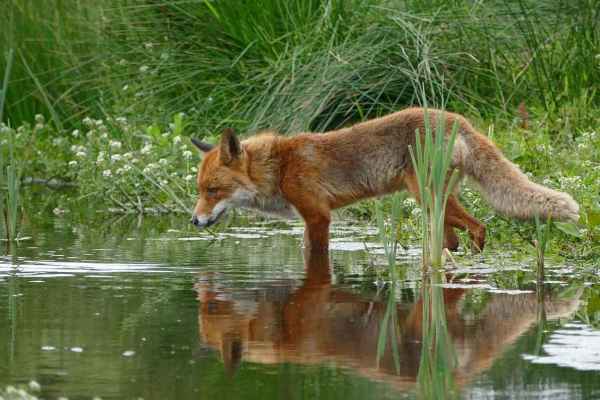
Each year around 1,200 roe deer, 1,000 wild boars and some 600 foxes are killed in the canton of Basel-Landschaft. The official justification is almost always the same: population regulation. For the red fox, this justification has been scientifically refuted. More than 30 years of wildlife biology research consistently show no lasting regulatory effect from fox hunting, because compensation effects such as higher birth rates and immigration quickly offset the kills. The canton of Lucerne, the only one to systematically record the health status of foxes killed, finds that over 98 per cent of the animals killed were healthy — an indication that disease control does not hold up as an argument either.
Baselland itself, of all places, has already exposed this contradiction: the authorities backtracked in a second statement on the cantonal fox-hunting petition, after an earlier reply had managed without a single piece of scientific evidence, «Basel-Landschaft backtracks: first regulation, now ‹no objective›». Anyone who can no longer formulate a clear objective themselves should not be celebrating a practice with a week of culinary indulgence.
The danger extends beyond the forest
The public is already exposed to additional risks in the forest during the hobby hunt, and the indulgence week aggravates this problem instead of addressing it. Time and again, uninvolved people are injured by recreational hunters. Such cases are not one-off slip-ups but a documented pattern: «The great hunting lie: how recreational hunters doctor Europe's accident figures and cover up their dead» shows how systematically injuries and fatalities in the context of recreational hunting are played down right across Europe.
Those at risk are not only people who happen to be present, but also people who observe recreational hunting critically. In Baselland itself, a Hunt Watch activist was subjected to physical violence by a beater while observing a driven hunt in Füllinsdorf and Arisdorf, as «Violent assault on activist during driven hunt» documents. The animal welfare activist Olivier Bieli has also already been the target of intimidation in Baselland: «Recreational hunters against animal welfare activists in Basel-Landschaft» describes how the tyres of his vehicle were slashed while he was observing a driven hunt. Anyone who, during the indulgence week, invites people to take a walk in the forest or go for a bike ride while shooting is taking place in the same area and observers are being intimidated is accepting a real danger to the public instead of addressing it.
Recreational hunters: a group with a striking potential for violence
Martin Thommen stresses that recreational hunters are out there «when others are asleep». That sounds like a unique selling point, but it is nothing of the kind: emergency services, nursing staff and many other occupational groups are also active at night, entirely without firearms. The real striking feature lies elsewhere. Access to firearms and an environment that normalises killing as a leisure activity repeatedly correlate with serious violence. Recent cases such as «Another femicide by a recreational hunter: 90-year-old kills his wife» or «Femicide in Faido, explosion in Leontica: not isolated cases but a pattern among recreational hunters» reveal a pattern that cannot be explained away as a series of isolated cases.
The fact that 20 to 25 new recreational hunters are trained in Baselland every year and that there is «no shortage of new recruits» is, from the point of view of wildlife protection, no cause for celebration but rather a reason for concern.
Nature conservation does not need firearms
Anyone who wants to practise genuine nature conservation can do so without a gun. Wildflower strips, hedges and near-natural gardens do more for biodiversity and ground-nesting birds than any driven hunt, and without a single animal dying. That of all things an event devoted to «pleasure» should stage recreational hunting as a many-sided, likeable pastime and sell its carrion as a delicacy ignores animal suffering, scientific evidence and a documented risk of violence in equal measure.
What a scientifically grounded alternative to current fox hunting practice could look like is demonstrated by the canton of Zug, the only canton to have commissioned an independent study (see the overview «An end to fox hunting»). Until Baselland takes this step as well, the «Genusswoche» remains a marketing label for a practice that does not withstand critical scrutiny.
Geneva shows that things can be done differently
The fact that a «Genusswoche» should advertise itself with recreational hunting of all things is all the more remarkable because Switzerland has long had a functioning counter-model. The canton of Geneva abolished recreational hunting by popular vote back in 1974 and has since relied on professional, state-run wildlife management with trained game wardens instead of leisure marksmen. There are no driven hunts there, no high seats disfiguring the landscape, and no „regulation» of species such as the fox or the badger simply because the hunting season happens to be open. Instead, Geneva relies on deterrence, targeted prevention and scientifically justified individual measures.
If Baselland wants to devote a «Genusswoche» to the subject of forest and wildlife, a look towards Geneva would have been more appropriate than providing a stage for Jagd Baselland. There it could be shown what wildlife management can look like without cruelty to animals, without endangering uninvolved people and without romanticising carrion as a delicacy.
As soon as a wild animal is shot, its body begins to change: the blood clots, there is initially no cooling, and any delay increases the hygiene risks. For Wild beim Wild it is clear: what is marketed as a regional delicacy after lying for a long time in the forest is carrion – not a culinary treat.
Instead of the animals being recovered, gralloched and chilled without delay, the ritual at social hunts often begins with the «blowing of the bag»: the killed animals are laid out side by side, hunting horn players sound the death calls for the respective species, and the hunters pay their own «final respects». Hunting tradition speaks of respect for the game. From an animal welfare perspective, however, it remains a sectarian staging around the killed animals, while the handling that is decisive for meat hygiene waits in the background.
What no professional butchery or abattoir could allow itself is sold in recreational hunting as nature romanticism. In a slaughterhouse, bleeding must take place as quickly as possible after stunning; regulated hygiene procedures, meat inspection and chilling then follow.
More on the subject of recreational hunting: In our dossiers on the criticism of recreational hunting gather fact-checks, analyses and background reports. The scientific evidence is presented in the overview Studies on the Effects of Recreational Hunting.
The position of IG Wild beim Wild: IG Wild beim Wild rejects recreational hunting. Our model is the canton of Geneva, which has managed without recreational hunting since 1974: without hunting seasons, without hunting dogs, without driven hunts, without high seats, without the animal cruelty and crime that go hand in hand with hunting season elsewhere. What has worked there for over fifty years disproves every position paper by JagdSchweiz. An association that bases its policy on claims it refutes in its own documents is not a professional organisation, but a factory for misinformation.

All articles are written by IG Wild beim Wild as well as by external co-authors. Research, structuring and editorial processes may be supported by AI-assisted tools.
Support our work
With your donation you help to protect animals and give their voice a hearing.
Donate now →