The great hunting lie: how recreational hunters doctor Europe's accident figures and conceal their dead
A European comparison is meant to make recreational hunting look harmless, but whatever doesn't fit simply isn't counted. And when a recreational hunter shoots his wife, the media conceal who the perpetrator was.
Once again recreational hunters are distorting figures, facts and telling untruths.
On 17 July 2026 the French portal «Le Chasseur Français» placed the hunting accident records of France, Germany, Italy, Spain and Finland side by side. The message sounds reassuring. France fares well with around 9.5 accidents per 100’000 recreational hunters, and Germany is said to have recorded «not a single death» in 2025. Yet the article's own closing sentence gives the deception away. A genuine European safety ranking is impossible, because every country counts something different.
That is the heart of the matter. The supposedly «astonishing differences» between the countries prove not differing levels of safety but differing counting rules. And these rules point in almost the same direction everywhere. They are constructed so that recreational hunting appears safer than it is. Every victim of recreational hunting is one too many. And the only honest conclusion to draw from these figures is not «better statistics» but the abolition of recreational hunting.
Germany: «zero deaths» is a brazen manipulation of figures
The most brazen claim concerns Germany. 460 accidents, but allegedly not a single fatality in 2025.
The figure comes from a press release by the SVLFG, the social insurance for agriculture, forestry and horticulture. It concedes itself that these accidents mostly occur on unpaved paths as well as on and around high seats and during their maintenance. For accidents involving hunting weapons it even reports a decline. The 460 «hunting accidents» are therefore largely not shooting accidents at all, but falls and workplace incidents. And only the insured collective of the gainfully employed is recorded.
What this statistic makes disappear is revealed by the media-documented chronicle of hunting accidents and crimes involving hunters' weapons for the same year. In November 2025 a recreational hunter shoots dead four family members and himself. In December a recreational hunter kills his neighbour with a targeted headshot. During a driven hunt a man is fatally struck. In addition there are several extended suicides in which wives and children are shot dead with the legal hunting weapon.
Why do these dead appear in no «hunting accident» statistic? Because homicides and extended suicides are filed under a different category in criminal law, and because the victims are not insured gainfully employed persons engaged in hunting. «No deaths in 2025» is not a safety record. It is a lie with method.
Italy: the same season, two counts, 50 per cent more dead
For Italy the French article cites 45 accidents and 8 deaths in the 2025/2026 season. This figure is supplied by the University of Urbino, whose analysis the hunting associations gratefully spread. The catch: Urbino deliberately filters and excludes cases of feeling unwell, falls, deliberate acts and poaching. What remains is 45 incidents, 8 deaths in the season period from 1 September 2025 to the end of January 2026.
This is countered by an independent survey. The «Associazione Vittime della caccia» (AVC), an observatory for hunting victims, documents 46 affected persons for practically the same period. Of these, 33 recreational hunters as victims with 10 dead and 23 injured, plus 13 uninvolved persons with 2 dead and 11 injured. That makes 12 dead compared with the 8 of the whitewashed association figure.
The same period, the same country, a difference of 50 per cent in the number of dead. The whole difference lies in the filter. Whoever excludes the inconvenient cases gets the lower figure, which is then passed around the press as supposed proof of safety.
France: the «success story» blanks out the victims
France plays the star pupil. For the 2025/2026 season, the biodiversity authority OFB recorded 92 accidents among around 963,000 recreational hunters, four of them fatal, and boasts of a 49 per cent decline over twenty years.
This record, too, has an ugly flip side. The animal welfare organisation ASPAS counters that in an earlier season more than one in four accidents struck an uninvolved person. Cyclists, hikers, mushroom pickers, walkers. The obvious demand for a hunting-free Sunday remains unmet to this day, because the recreational hunting lobby blocks it. A low number of dead recreational hunters says nothing about how dangerous the forest is for everyone else.
Spain: the absence of figures is no accident, but intent
For Spain the comparison cites «at least 9 dead and 27 injured» and no national reference figure. That is true, but it conceals the crucial point. Spain keeps no official national statistics on hunting accidents at all.
All the figures circulating for 2025, whether 9 dead and 27 injured or 8 dead and 29 injured, come exclusively from press analyses by animal welfare organisations. These name the true reason: the absence of official data is not a technical oversight but a political decision. Without public figures there is no risk assessment and no pressure to act. That is exactly how the industry wants it.
Just how easily the sparse data can be manipulated became clear in 2020. In response to a parliamentary inquiry, the government cited 605 victims, 51 of them fatal. This figure referred to ten years, but was reported in the media as an annual tally. Over the three-year period from 2022 to 2024, 32 people died while hunting in Spain, almost one per month. Here, too, many of the victims are bystanders whose cases disappear into general statistics.
Finland: low figures, but here too two yardsticks
Finland shows the lowest values. Among around 300,000 recreational hunters, of whom roughly 196,000 actually hunt, the wildlife authority Riistakeskus counts only 10 to 20 hunting accidents a year. Fatal cases are rare. In 2025 there was at least one. In Juva a recreational hunter died when the weapon of a member of the same hunting group accidentally discharged.
Yet here too a second method of counting reveals a different picture. The Finnish Institute for Health and Welfare (THL) records incidents involving large firearms such as rifles and shotguns, registering 15 to 30 per year, and 246 in total since 2010. Not all are hunting accidents, but the discrepancy once again proves the point: even in the supposedly safest country, the outcome depends on who is doing the measuring.
The real scandal: when the perpetrator is a recreational hunter, the media stay silent
So far this has been about doctored figures. But the greater scandal runs deeper. It lies in the fact that the public often does not even learn that a recreational hunter committed the crime.
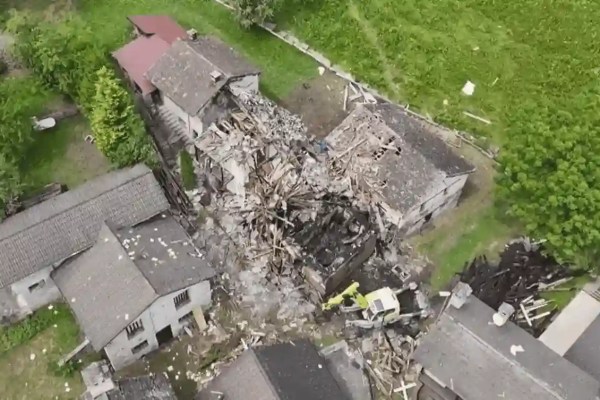
On 9 July 2026, a 56-year-old woman was found with a gunshot wound to the head on the grounds of a rehabilitation clinic in Faido, Ticino. She died shortly afterwards in hospital. The perpetrator was her 59-year-old ex-husband. A day later he blew up a house in the Blenio Valley, barricaded himself inside, and died in the process. Three police officers were injured in the explosion, one of them buried under the rubble. It was the 17th femicide in Switzerland in this year alone, the third in Ticino.
The perpetrator was a recreational hunter. This is not a supposition. In response to an enquiry from Wild beim Wild, the public broadcaster Radiotelevisione svizzera (RSI) expressly confirmed: «Fatto accertato e confermato è che era un cacciatore.» In other words, it is an established and confirmed fact that the man was a recreational hunter and legally owned several weapons. Because no one heard the fatal shot, investigators assume the weapon was fitted with a silencer. And silencers are in principle banned in Switzerland. The decisive exception applies, of all people, to holders of a hunting licence, to whom the canton may grant a special permit.
Now the crucial question: who learned from the major Swiss media that the perpetrator was a recreational hunter? Practically no one. The reporting spoke of the “ex-husband”, the “entrepreneur from Leontica”, the “59-year-old”. The circumstance that furnished this man with legal weapons and privileged access to silencers, his status as a recreational hunter, was almost entirely absent from mainstream reporting, even though the police mentioned it several times at the press conference.
This is not an isolated case but a pattern. In family tragedies, extended suicides and acts of violence committed with a hunting weapon, the fact that the perpetrator was a recreational hunter is regularly kept quiet. The man is then called a «family father», a «pensioner», a «neighbour», a «husband». Never a «hunter». As a result, the public perception never forms the picture that the facts paint: that recreational hunting gives men in personal crises legal access to lethal weapons, and that these very weapons are then turned against wives, children, neighbours and police officers.
Whoever defines it wins. Whoever conceals it protects the perpetrators
Five countries, five counting methods, one system. The official figures are everywhere below the reality, and the mechanism is always the same. Whoever defines what counts as a «hunting accident» determines the outcome. This power of definition lies almost everywhere with bodies close to hunting or the insurance industry, whose narrow categories sort out the inconvenient cases.
Extended suicides with a hunting weapon? A criminal matter, not an accident. Shot wives and neighbours? A family tragedy, not a hunting issue. Falls and sudden illness? Filtered out in Italy. National statistics? Not available at all in Spain. And when a case does make headlines, as in Faido, then at least the word «recreational hunter» disappears from the reporting.
The French contribution concludes that a European safety ranking is impossible. That is true, but the consequence is different from the harmless shoulder-shrugging variant. As long as those institutions determine the counting rules that have an interest in low figures, and as long as the media conceal the perpetrator role of recreational hunters, the pretty figures deserve no trust.
Only the independent documentations reveal the true extent. The German chronicle of hunting accidents, the Italian AVC dossier, the Spanish press analyses, the research by Wild beim Wild on Faido. Every single one of these victims is one too many. The «astonishing differences» across Europe are in truth astonishingly effective methods of making the victims of recreational hunting invisible. The only answer that does justice to this finding is the abolition of recreational hunting.
Further reading on wildbeimwild.com: Femicide in Faido, explosion in Leontica: not an isolated case, but a pattern among recreational hunters | Hunting victims in Europe: dead, injured and a continent without statistics | Switzerland: statistics on fatal hunting accidents | Hunting accidents and criminal offences by recreational hunters
More on the subject of recreational hunting: In the dossier Poaching and hunting crime in Switzerland we document cases, legal questions and recurring patterns. What the research says about this is shown by Hunting fact-checked: the state of research.
The position of IG Wild beim Wild: IG Wild beim Wild rejects recreational hunting. Our model is the canton of Geneva, which has managed without recreational hunting since 1974: without hunting seasons, without hunting dogs, without driven hunts, without high seats, without the animal cruelty and crime that go hand in hand with hunting season elsewhere. What has worked there for over fifty years disproves every position paper by JagdSchweiz. An association that bases its policy on claims it refutes in its own documents is not a professional organisation, but a factory for misinformation.