
Eurasian Jay Switzerland: Forest steward in the crosshairs
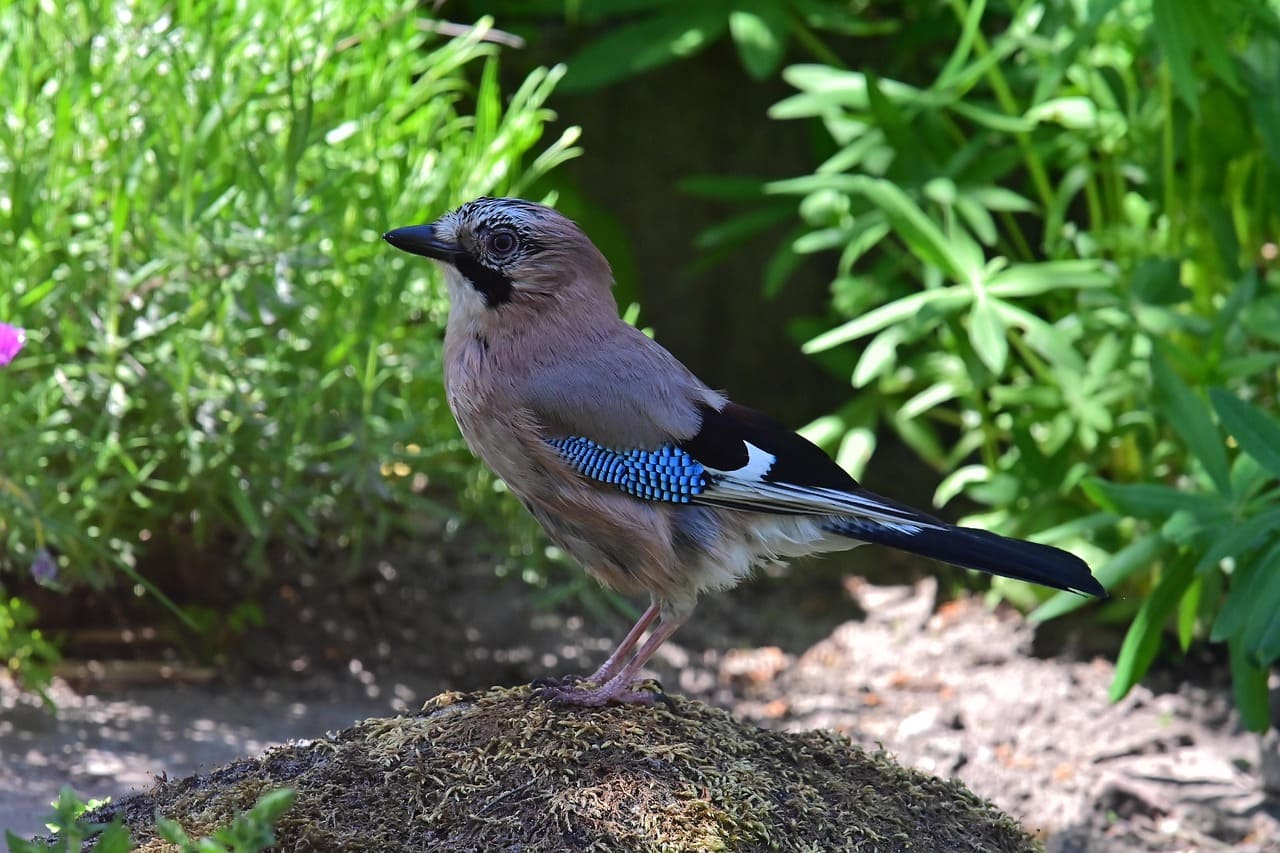
The Eurasian Jay is Switzerland's most important natural tree planter. A single bird hides up to 3,000 acorns in the forest floor in autumn, fails to find many of them again, and thus allows young oak trees to sprout. In forestry, there is a specific technical term for this: 'jay plantings'. In Brandenburg, the Eurasian Jay is officially recognized as an assistant in forest conversion. In Switzerland, it is shot. Hundreds to over a thousand Eurasian Jays fall victim to lowland hunting annually. BirdLife Switzerland comments: 'Why Eurasian Jays are shot is poorly understood.' The recreational hunting community treats the 'forest steward' like pest control.
Profile
The Eurasian Jay (Garrulus glandarius) belongs to the crow family (Corvidae) and is the most well-known representative of this family in Switzerland after the magpie and carrion crow. It is about the size of a magpie, with a body length of around 34 centimeters and a weight of 140 to 190 grams. Its plumage is unmistakable: The body is delicate pinkish-brown to beige, the crown pale beige with black streaking, the moustachial stripe black, the throat white. Its trademark features are the bright sky-blue, black-banded wing coverts that make it Europe's most colorful crow species. In flight, the white rump stands out, contrasting sharply with the black tail. Both sexes look identical.
Biology and lifestyle
The Eurasian jay is a resident bird that remains in its territory year-round. Only in years with poor acorn crops or due to population pressure from northeastern Europe do so-called invasion flights occur, during which large flocks migrate into Switzerland. In Canton Graubünden, 770 Eurasian jays were shot in such an invasion year, compared to only 192 in the previous year (Südostschweiz, 2018). The Eurasian jay lives in deciduous and mixed forests with dense undergrowth and prefers oak and oak-hornbeam stands. It also breeds in parks and large gardens with old tree stock (Waldwissen.net, Swiss Ornithological Institute Sempach).
The Eurasian jay lives in monogamous pair relationships that often last for several years. From April onwards, the pair builds a nest in dense undergrowth or in tree crowns. The clutch comprises 4 to 6, rarely up to 9 eggs. The incubation period is 16 to 19 days, after another 20 to 23 days the young leave the nest. Life expectancy in the wild is up to 17 years.
Intelligence and voice imitation
The Eurasian jay is among the most intelligent birds in Europe. Its scientific name Garrulus means 'chatterer' and refers to its diverse vocal repertoire. It can imitate the voices of other bird species with deceptive accuracy, including the call of the common buzzard, and uses this ability both to warn its fellow species and to confuse other animals. Its penetrating alarm call 'rätsch' warns all forest inhabitants, from roe deer to squirrels, of approaching dangers. It is thus the acoustic alarm system of the forest.
The 'forester of the forest': A key ecological service
Jay plantings: planting trees without human hands
The most ecologically significant characteristic of the Eurasian jay is its hoarding behavior. In autumn it collects large quantities of acorns, beechnuts and hazelnuts and buries them in hundreds of hiding places in the forest floor. A single bird can store up to 3’000 acorns per autumn and transports them in its gular pouch and beak over distances of several hundred meters to several kilometers from the find location to the hiding place (Waldwissen.net, avi-fauna.info). The cognitive performance is remarkable: the birds precisely remember the location, quantity and type of their stores and can find them even under snow cover.
However, not all hiding places are rediscovered in winter. From every forgotten acorn, a young tree can sprout. This natural forest regeneration by the Eurasian jay is known in forestry under the technical term 'jay seeding' (Waldwissen.net, Brandenburg). Foresters in Germany and Austria use this mechanism deliberately: they set up so-called 'jay tables' on which they offer the Eurasian jay acorns and beechnuts so that it buries them in the surrounding forest. In Brandenburg, the Eurasian jay is officially recognized as a helper in forest transformation and has been chosen as the heraldic bird of the forest transformation campaign (Waldwissen.net, AG Wildtiere Position Paper, 2021).
Why the oak needs the Eurasian jay
Acorns are heavy seeds that fall only a few meters from the mother tree on their own. Without an animal disperser, the oak cannot conquer new locations. The Eurasian jay is the most important long-distance disperser of acorns in Central Europe. It transports them over distances that no other animal achieves and buries them at precisely the depth (2 to 5 centimeters) that is optimal for germination. Without the Eurasian jay, there would be significantly fewer oaks in Swiss forests.
Climate change makes the Eurasian jay more important than ever
The oak tree is gaining massive importance for Swiss forestry in the course of climate change. As a drought-resistant and heat-loving tree species, it is promoted as a 'future tree species' in many silvicultural programs. The Forest Report 2025 by FOEN and WSL emphasizes that more climate-resistant tree species such as oak and maple are crucial for forest adaptation to climate change. The silvicultural work of the jay, which plants oaks free of charge, efficiently and without subsidies, is thus becoming more important than ever (Waldwissen.net, Markwart the outspoken oak planter). It is an unparalleled paradox that Switzerland simultaneously releases this natural forest regenerator for shooting.
More on this: Dossier: Hunting and Biodiversity
The hunting: 19th-century pest control
Legal situation
The jay is a huntable bird species under the Federal Act on Hunting (JSG, Art. 5 Para. 3). Together with carrion crow, magpie and raven, it is classified under small game hunting. The closed season varies by canton. In the canton of Bern, the jay belongs to the species that may be shot during the closed season as part of 'special culls', along with carrion crows, magpies, foxes and badgers (IG Wild beim Wild, Fox massacre in Switzerland).
The scale of the shooting
Exact nationwide shooting figures for the jay alone are difficult to isolate in the publicly available summaries of hunting statistics, as it is often reported together with other corvids. BUWAL determined in 1998 that half of all shot birds were carrion crows and jays (BUWAL press release, 1998). BirdLife Schweiz criticized the shooting of jays as 'poorly comprehensible' (BirdLife Schweiz, hunting statistics). In the canton of Graubünden, 770 jays were shot in 2017 during an invasion year (Südostschweiz, 2018). Watson.ch noted: 'Even birds atypical for hunting laypeople such as magpies and jays may be hunted and are not protected bird species' (Watson, 2023).
The 'vermin' narrative
The historical justification for hunting the jay stems from the 19th century. Hobby hunters regarded it as 'vermin', as an animal harmful to managed game that should not be hunted but combated as a pest (AG Wildtiere, Position paper jay, 2021). In Germany, the term 'vermin' was removed from the Federal Hunting Act in 1976 as a 'vilifying and unnecessary expression'. In Austria, it is still used for the jay. In Switzerland, the narrative lives on: The jay is defamed as a 'nest robber' and 'egg thief' that harms populations of songbirds and small game and must therefore be 'regulated'.
What the narrative conceals
The jay does indeed eat eggs and young birds of other species in spring and summer. This behavior is real, but it is a natural component of the forest ecosystem and has not driven any bird species to extinction in millennia of coevolution. The main threats to songbirds are habitat loss through agricultural intensification, pesticide use that destroys insect food, glass facades, domestic cats and road traffic, not the jay. Criminalizing a bird as a 'nest robber' because it feeds naturally is pseudobiological nonsense that serves to legitimize small game hunting of corvids.
More on this: Why recreational hunting fails as population control
Diet and ecological function: Far more than acorns
Omnivore with seasonal variation
The Eurasian Jay is a versatile omnivore. In spring and summer, animal food dominates: caterpillars, beetles, grasshoppers and other insects make up the main portion. Additionally, it preys on mice, lizards and occasionally eggs and young birds. In autumn and winter, it switches to plant-based food: acorns make up to 70 percent of its diet, supplemented by beechnuts, hazelnuts, chestnuts, berries and grain (avi-fauna.info, Waldwissen.net).
Insect regulation
Through the high proportion of insects in its summer diet, the Eurasian Jay acts as a natural pest regulator in the forest. The predation of caterpillars, particularly oak processionary moths and winter moth caterpillars, benefits forestry. This benefit is not considered in any hunting planning.
The warning function
The loud alarm call of the Eurasian Jay warns not only its own species, but the entire forest ecosystem of dangers. Deer, hares, squirrels and other songbirds benefit from its vigilance. Recreational hunters find precisely this warning function disturbing: the Eurasian Jay 'betrays' the hobby hunter who is stalking through the forest. That a wild animal is shot because it warns other wild animals is a perversion of the hunting concept that requires no further commentary.
What would need to change
- Nationwide Swiss protection of the Eurasian Jay: A bird that promotes forest regeneration as a natural tree planter, regulates insect populations and protects the entire ecosystem as an alarm caller must not be hunted. The Eurasian Jay belongs removed from the catalogue of huntable species. What is celebrated in Brandenburg as the heraldic bird of forest transformation must not be treated as 'vermin' in Switzerland.
- Recognition of forestry services: Forestry must officially recognize the Eurasian Jay's services in spreading oak and beech trees and integrate them into forest management programs. 'Jay tables' following the German model should also be used in Switzerland to specifically promote natural forest regeneration.
- Abolition of small game hunting of corvids: The hunting of Eurasian Jay, magpie and carrion crow is not justified by wildlife biology and serves the recreational pleasure of recreational hunters. The Swiss Animal Protection STS rightly demands that the purpose and meaning of hunting these species be critically questioned.
- Stop 'special culls' during closed season: In the canton of Bern, the Eurasian Jay is killed as part of special culls even during closed season. This practice undermines the purpose of closed season and must be ended immediately.
- Research on the role of the Eurasian Jay in Swiss forests: There are no specific Swiss studies on the quantitative significance of jay seed dispersal for oak regeneration. Given climate change and the growing importance of oak as a future tree species, this research gap urgently needs to be closed.
Argumentarium
'The Eurasian Jay is a nest robber and harms songbird populations.' The Eurasian Jay occasionally eats eggs and young birds in spring and summer. This behavior is natural and part of the forest ecosystem that has functioned for millennia. No songbird species is threatened by the Eurasian Jay. The actual threats to songbirds are habitat loss, pesticides, glass facades and cats, not a corvid that feeds naturally. Defaming the Eurasian Jay as a 'nest robber' to justify shooting it is the 'vermin' narrative of the 19th century, which was abolished in Germany in 1976 and continues to live on in Switzerland.
'The Eurasian Jay warns game animals of the hobby hunter and therefore disrupts hunting.' That a wild animal is shot because it warns other wild animals of humans is an admission that recreational hunting is incompatible with the ecosystem, but works against it. The warning function of the Eurasian jay is an ecological service that applies equally to predators and hobby hunters. It is not a reason for its shooting, but an argument for its protection.
«The Eurasian jay is common and not endangered, therefore it can be hunted.» That a species is not endangered does not mean that hunting it is sensible or necessary. The Eurasian jay causes no damage that would justify shooting it. Its ecological benefit as a tree planter, insect regulator and alarm caller exceeds any conceivable 'damage' many times over. Hunting a species merely because it is common has no reasonable justification in terms of animal welfare law.
«Hunting the Eurasian jay has no impact on the population.» If shooting has no impact on the population, it also has no purpose. Shooting without effect and without benefit is senseless killing. The reasonable justification that animal welfare law requires for killing an animal must exist before the shooting, not in the determination that it had no consequences.
«In invasion years, Eurasian jays must be shot because too many immigrate.» Invasion flights are a natural phenomenon triggered by poor food availability in the regions of origin. The immigrating birds distribute thousands of acorns in Switzerland and thus contribute to forest regeneration. Misusing invasion years as an argument for increased shooting turns biology upside down: nature sends free tree planters, and the recreational hunters shoot them down.
Quicklinks
Articles on Wild beim Wild:
- Studies on the impact of recreational hunting on wildlife
- Why recreational hunting fails as population control
- Animal welfare problem: Wild animals die agonizing deaths because of hobby hunters
- Animal cruelty: Fox massacre in Switzerland
Related dossiers
- The rock ptarmigan in Switzerland: Ice age relic between climate crisis, tourism and gunshot
- The ibex in Switzerland: Smuggled, rescued and again degraded to trophy
- The beaver in Switzerland: Exterminated, reintroduced and newly approved for shooting
- The woodcock in Switzerland: Endangered, hunted and politically ignored
- Waterfowl in Switzerland: Winter guests in the firing line
- Pigeons in Switzerland: Between peace symbol, mass shooting and official starvation
- Corvids in Switzerland: The most intelligent animals in the crosshairs
- The Eurasian jay in Switzerland: Forest forester in the crosshairs of low hunting
- The marmot in Switzerland: Ice age relic under climate stress, tourist attraction and mass shooting
- The European rabbit in Switzerland: severely endangered, yet huntable
- The mountain hare in Switzerland: Ice age relic between climate crisis and gunshot
- The raccoon in Switzerland: Approved for shooting because it has the wrong origin
- The stone marten in Switzerland: Cultural follower between attic and gunshot
- The pine marten in Switzerland: Shy forest dweller under hunting pressure
- The badger in Switzerland: Ecosystem engineer in the crosshairs of low hunting
- The red deer in Switzerland: Exterminated, returned and degraded to shooting object
- The roe deer in Switzerland: most shot wild animal and victim of misguided hunting policy
- The wild boar in Switzerland: Why recreational hunting exacerbates the problem instead of solving it
- The chamois in Switzerland: Between high hunting, climate stress and the myth of overpopulation
- The brown hare in Switzerland: Endangered, hunted and politically ignored
References
- Federal hunting statistics, FOEN/Wildtier Schweiz: http://www.jagdstatistik.ch
- BUWAL Press Release (1998): Federal Hunting Statistics 1997 (Half of the birds shot were hooded crows and Eurasian jays)
- BirdLife Schweiz: Current hunting statistics and the revised hunting law (birdlife.ch)
- Waldwissen.net/WSL: Native forest birds, The Eurasian jay (Garrulus glandarius)
- Waldwissen.net: Markwart, the vocal oak planter (Jay sowing and jay tables in NRW)
- Swiss Ornithological Institute Sempach: Distribution of the Eurasian jay 2013–2016
- Südostschweiz (2018): Hunters set a new record (770 Eurasian jays in Graubünden)
- AG Wildtiere (2021): Position paper Eurasian jay (ag-wildtiere.com)
- Watson.ch (2023): Hunting, So many animals are shot in Switzerland for wild meat consumption
- IG Wild beim Wild (2020/2025): Fox massacre in Switzerland, Hunting statistics 2022 (wildbeimwild.com)
- State of Brandenburg: Leaflet Eurasian jay (forst.brandenburg.de)
- avi-fauna.info: The Eurasian jay (Garrulus glandarius) in Germany
- Federal Act on Hunting and the Protection of Wild Mammals and Birds (JSG, SR 922.0)
- Animal Welfare Act (TSchG, SR 455)
Our Mission
The Eurasian jay is the unsung hero of Swiss forests. It plants oaks where humans do not. It warns the forest of dangers. It regulates insect populations. It is intelligent, colorful and a master of voice imitation. Forestry owes it more than it realizes: Without jay sowing, many oak stands in Europe would never have emerged. At a time when climate change is making the oak a tree species of the future, the free work of the Eurasian jay becomes more valuable than ever. And yet it is shot in Switzerland as part of small game hunting. Because it occasionally eats a bird's egg. Because it 'betrays' the hobby hunter. Because it has been considered 'vermin' since the 19th century. This classification is a relic of an outdated view of nature that divides animals into 'useful' and 'harmful' and releases the latter for shooting. The Eurasian jay deserves no shot, it deserves protection. This dossier is continuously updated when new figures, studies or political developments require it.
More on the topic of recreational hunting: In our Hunting Dossier we bundle fact checks, analyses and background reports.