
Wild boar in Switzerland: Hobby hunting exacerbates the problem
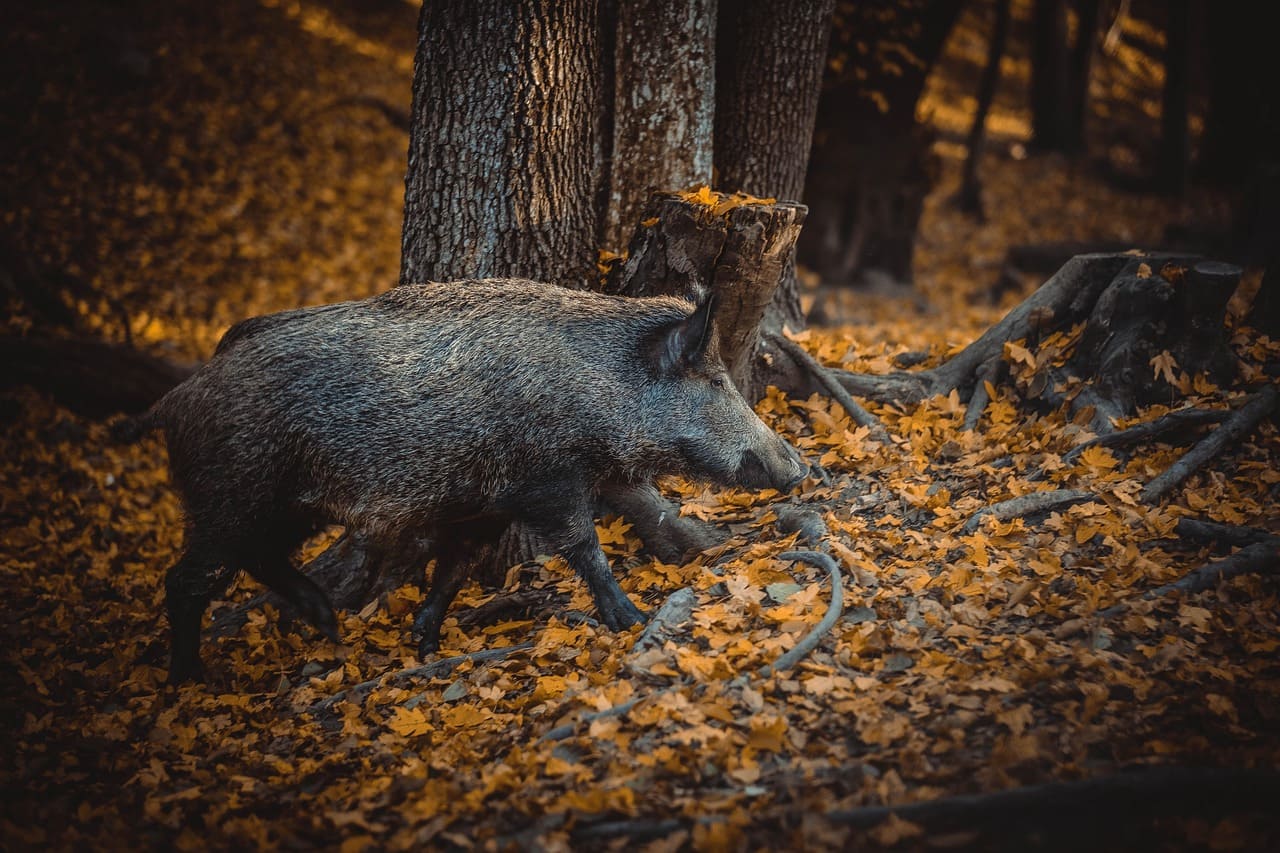
Wild boar populations have been increasing across Europe for decades, and recreational hunting has intensified in parallel. Despite this, efforts to reduce the population have proven unsuccessful. This report shows why hunting practices for wild boar lead to a dead end and why recreational hunting itself is one of the main causes of the population explosion.
Profile
The wild boar ( Sus scrofa ) belongs to the family Suidae (true pigs) and is the ancestor of the domestic pig. It is a highly social, intelligent, and adaptable animal that lives in family groups. In Switzerland, the wild boar was almost extinct in the 19th century and only began to spread again in the 20th century. Today, it primarily inhabits northwestern Switzerland, Zurich, Ticino, and increasingly other parts of the country.
Biology and social behavior
Wild boars live in matriarchal family groups led by an experienced sow. The sow knows the best feeding and resting places, avoids danger, and coordinates the behavior of the entire group. Male boars are driven out of the group as yearlings and usually live solitary lives thereafter. Only during the mating season do older boars temporarily rejoin a group.
The wild boar is an omnivore with a pronounced preference for acorns, beechnuts, insect larvae, roots, and agricultural crops such as corn. It is predominantly nocturnal, a behavioral adaptation largely attributable to disturbance by recreational hunting.
Reproductive biology
Wild boars are so-called r-strategists: they respond to favorable living conditions with a rapid increase in their reproductive rate. In mast years (abundant acorn and beech mast), reproduction increases dramatically. A sow can reach sexual maturity at less than one year of age and give birth to four to eight piglets per litter, in exceptional cases up to twelve. Under natural conditions, that is, without the disruption of the social structure through recreational hunting, usually only the dominant sow of a sounder reproduces.
The population explosion: causes and misinterpretations
The numbers
The number of wild boar shot in Switzerland has increased almost two hundredfold in the last 50 years. According to the Federal Statistical Office, more wild boar were killed nationwide in 2024 than ever before. Annual damage caused by wild boar amounts to hundreds of thousands of Swiss francs, depending on the canton, primarily to corn, grassland, and vineyards.
The standard declaration
The hobby hunting lobby explains the increasing populations with climate change and mild winters, more frequent mast years due to more beech and oak trees, the abundant food supply from agriculture, and the natural adaptability of the wild boar.
All of this is true. But the crucial factor is missing: the role of recreational hunting itself.
The lead sow question: How recreational hunting stimulates reproduction
Perhaps the most significant scientific finding regarding wild boar dynamics concerns the role of the lead sow. In healthy sounders, the lead sow regulates the reproduction of lower-ranking sows through pheromones and social hierarchy. If the lead sow is killed by recreational hunting, the sounder disintegrates, and all sows, including yearlings, immediately become estrus and capable of reproduction.
This mechanism has now been confirmed by numerous studies. Italian pheromone researcher Professor Andrea Mazzatenta has shown that in the Abruzzo and Tuscany regions, doubling wild boar hunting led to a doubling of the population. A long-term French study by Sabrina Servanty and colleagues (Journal of Animal Ecology) compared reproduction over 22 years in a heavily hunted forest area in the Haute-Marne department with a less heavily hunted area in the Pyrenees. The result: Heavy hunting leads to significantly higher reproduction rates and stimulates fertility. Sows in intensively hunted areas reach sexual maturity earlier, are lighter in their first pregnancy, and increasingly give birth to piglets even outside the natural farrowing season.
After extensive literature research, Bavarian wildlife expert Hohmann concludes that the theory of social reproductive suppression by dominant sows is not tenable in the sweeping form propagated by some hunters. At the same time, he makes it clear that shooting a dominant sow destabilizes the sounder in any case and leads to uncontrolled reproduction of the young sows—precisely the effect that recreational hunters lament.
More on this topic: Science: Hunting increases the species' population and contraceptives for wild boars
The problem of baiting
In many cantons and neighboring countries, luring wild boar with food (baiting) is a common hunting practice. While baiting allows for targeted shooting, it is counterproductive: mostly individual boars and yearlings are killed, not the reproductively important sows. The additional food supply eliminates natural winter mortality, stimulates reproduction, and also affects other wildlife species such as deer and badgers. Baiting is thus a prime example of how recreational hunting exacerbates the problem it ostensibly solves.
The logic of damages: Who benefits, who pays?
Damage caused by wild animals
Damage caused by wild boars to agriculture is real and burdensome for affected farmers. Annual damage figures per canton often reach six figures. The damage primarily affects cornfields, grassland, and vineyards. The question is not whether damage occurs, but whether recreational hunting is the right answer.
What really works
The most effective measure against wild boar damage is an electric fence, erected early and maintained regularly. This method is tried and tested and recommended by the authorities. A disadvantage is the large-scale fencing required, which impairs the connectivity of wildlife habitats. In the long term, a stable, intact sounder system would be more helpful than constant hunting pressure: A sounder with an experienced lead sow avoids farmland more effectively than a destabilized, leaderless group of young sows.
More information: Dossier: Hunting and animal welfare and Dossier: Wildlife corridors and habitat connectivity
Ethical dimension
Driven hunts: Stressful terror in the forest
Wild boar in Switzerland are frequently hunted using driven hunts with dogs. These hunts disrupt entire forest areas for hours. Beaters and dogs flush the animals from their lairs, whereupon they are driven past lines of hunters. The accuracy of shots when hunting fleeing wild boar is high, as are the tracking rates for wounded animals. Driven hunts are extremely stressful for the animals, not only wild boar, but all forest inhabitants.
Wild boar hunting
In some cantons, piglets may be hunted with shotguns. Shooting animals only a few months old is declared as population control, but is ethically highly questionable. Piglets that lose their mother often die.
Night hunting and constant disturbance
Since wild boars are predominantly nocturnal, a large part of the hunting takes place at night, using night vision devices, spotlights, and thermal imaging cameras. This constant disturbance drives the animals into increasingly remote areas and increases the pressure on remaining refuges.
The vicious cycle of hobby hunting
The dynamics of wild boar populations can be summarized as a vicious cycle: recreational hunters shoot lead sows and boars. The sounder structure breaks down, young sows become pregnant immediately. The reproduction rate increases, the population grows. Damage to crops and property increases, and the call for more recreational hunting grows louder. More recreational hunting further destabilizes the sounders. And so on.
This mechanism, compensatory reproduction under hunting pressure, is particularly pronounced in wild boar because, as r-strategists, they are evolutionarily programmed to respond to increased mortality with maximum reproduction. The more they are shot, the more wild boar there are. The hunting statistics of the last 50 years are proof of this.
More on this topic: Studies on the impact of recreational hunting on wildlife
What would need to change
- Protection of lead sows: The lead sow is the central regulatory element of a wild boar sounder. Shooting her destabilizes the social structure and leads to all sows in the sounder, including yearlings, becoming pregnant immediately. A ban on shooting lead sows would be the single most effective measure for reducing the reproduction rate.
- Ban on baiting: Baiting eliminates natural winter mortality, stimulates reproduction, and leads to the killing of primarily non-reproductive animals (boars, yearlings). Baiting is counterproductive and must be banned.
- Prioritizing preventative measures : Electric fences, adapted crop rotations, and spatial separation of agricultural land and wildlife habitats are more effective than intensifying recreational hunting. The cost analysis favors prevention, not culling.
- Large undisturbed quiet zones: In undisturbed areas, stable sounder structures develop, in which the lead sow naturally regulates reproduction. The constant disturbance caused by recreational hunting prevents precisely this stabilization.
- Professional wildlife management : Wild boar regulation must be transferred to professional game wardens who intervene in a targeted, planned and expert manner, without further fueling the cycle of disturbance, group breakup and compensatory reproduction.
Argumentation
"Without intensive hunting, wild boar populations would explode." The number of animals shot has increased almost two hundredfold in 50 years, yet the population continues to grow. Population ecology shows that intensive hunting destroys sounder structures, triggers compensatory reproduction, and rejuvenates the population. Recreational hunting creates the very problem it claims to solve.
"The damage caused by wildlife proves that more hunting is necessary." The damage is real, but recreational hunting is not the answer. Electric fences are demonstrably more effective than shooting. Healthy sounders with an experienced lead sow avoid farmland more deliberately than destabilized groups of young sows. More recreational hunting leads to more damage, not less.
"The culling of the lead sow is a myth – the social reproductive suppression is not scientifically proven." The long-term study by Servanty et al. (Journal of Animal Ecology) over 22 years clearly shows: Heavy hunting leads to higher fertility and earlier sexual maturity. Mazzatenta has demonstrated in Italy that doubling recreational hunting led to a doubling of the population. Even Hohmann, who criticizes the blanket theory of the lead sow, confirms: Culling the lead sow destabilizes the sounder and leads to uncontrolled reproduction.
"Wild boars are nocturnal – night hunting is therefore necessary." The nocturnal activity of wild boars is largely an adaptation to the disturbance caused by recreational hunting. Studies show that wild boars in undisturbed areas are also active during the day. Night hunting combats a symptom that recreational hunting itself causes.
Quick links
Posts on Wild beim Wild:
- Hunting allows the species to increase in number.
- Contraceptives for wild boars
- Studies on the impact of hunting on wildlife
- Why recreational hunting fails as a means of population control
- African swine fever: What the disease means for wild boars and recreational hunting
Related dossiers
- The rock ptarmigan in Switzerland: Ice Age relic caught between climate crisis, tourism and shotgun fire
- The ibex in Switzerland: Smuggled, rescued, and once again reduced to a trophy.
- The beaver in Switzerland: Extinct, reintroduced, and now open to hunting again
- The woodcock in Switzerland: Endangered, hunted, and politically ignored
- Waterfowl in Switzerland: Winter visitors in the firing line
- Pigeons in Switzerland: Between symbol of peace, mass shooting and official starvation
- Corvids in Switzerland: The most intelligent animals in the crosshairs
- The Eurasian jay in Switzerland: Foresters of the forest in the crosshairs of small game hunting
- The marmot in Switzerland: Ice Age relic under climate stress, tourist attraction and mass shooting
- The wild rabbit in Switzerland: highly endangered, yet still huntable.
- The snow hare in Switzerland: Ice Age relic between climate crisis and shotgun blast
- The raccoon in Switzerland: Cleared for shooting because it has the wrong origin
- The stone marten in Switzerland: a synanthropic species between attic and shotgun blast
- The pine marten in Switzerland: Shy forest dweller under hunting pressure
- The badger in Switzerland: Ecosystem engineer in the crosshairs of small game hunting
- The red deer in Switzerland: Extinct, returned, and degraded to a hunting target.
- The roe deer in Switzerland: the most shot wild animal and a victim of a misguided hunting policy
- The wild boar in Switzerland: Why recreational hunting exacerbates the problem instead of solving it.
- Chamois in Switzerland: Between high-level hunting, climate stress and the myth of overpopulation
- The European hare in Switzerland: Endangered, hunted, and politically ignored
Our claim
The wild boar is not a pest. It is a highly intelligent, social wild animal that has been part of Europe's forests for millennia. The fact that populations are increasing despite massive hunting is not an argument for more recreational hunting, but rather compelling proof that recreational hunting is the wrong approach. Population ecology shows that intensive hunting destroys sounder structures, triggers compensatory reproduction, and rejuvenates the population. Anyone who wants to reduce damage caused by wildlife must protect lead sows, prohibit baiting, and prioritize prevention. A systemic shift towards professional wildlife management is not radical, but rather an adaptation to the current state of scientific knowledge. This dossier is continuously updated as new figures, studies, or political developments necessitate it.
More on the topic of hobby hunting: In our dossier on hunting, we compile fact checks, analyses and background reports.