African swine fever and recreational hunting
African swine fever is a highly contagious viral disease that exclusively affects wild boar and domestic pigs and is considered harmless to humans. At the same time, it causes massive economic damage because all animals in domestic pig populations are killed and far-reaching trade restrictions are imposed. It is precisely this economic pressure that is used to justify an increasingly severe tightening of hunting regimes on wild boar.

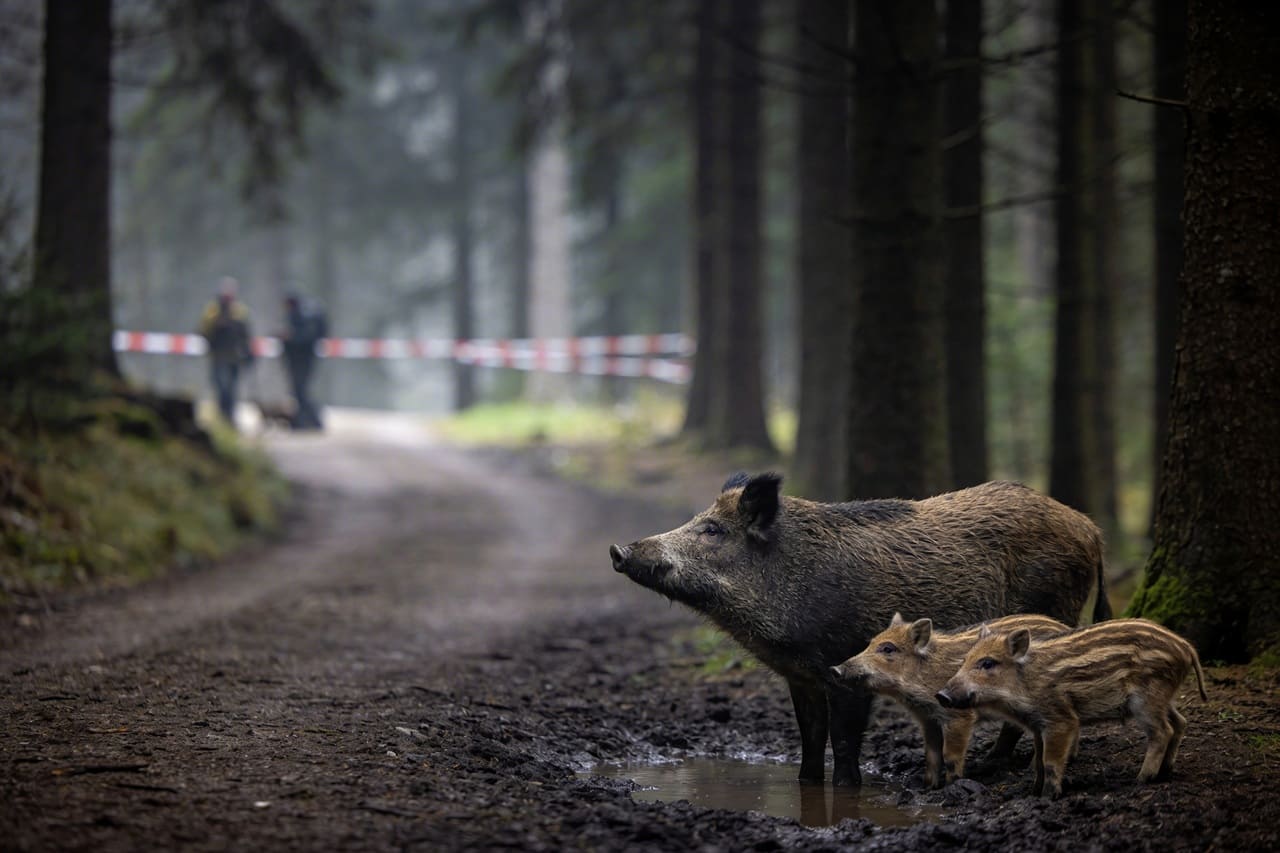
African swine fever (ASF) is caused by a virus that is transmitted primarily through direct contact with infected animals or contaminated products such as meat and sausages.
Clinically, the disease manifests in extreme cases through high fever, weakness, bleeding and very high mortality rates in domestic and wild boar. In Europe, ASF has been spreading for years, with focal points in Eastern Europe and recurring new outbreaks in various regions.
Germany: Epidemic as lever for intensive wild boar hunting
In Germany, ASF has now been detected in wild boar in several regions, including North Rhine-Westphalia with a fenced core area and over 300 confirmed cases. The control strategy works in phases: first hunting ban in the core area, intensive carcass searches and fencing, followed by targeted 'wild boar removal' and intensified hunting in containment zones.
Agricultural ministries and hunting associations emphasize that hobby hunters should 'join forces' to reduce wild boar populations; this includes drive hunts, drone deployment and financial incentives per killed wild boar. The German Hunting Association prominently presents ASF as justification for 'professionalized' and intensified wild boar hunting, offering daily case numbers, action recommendations and contact points.
Austria: Prevention, economy and recreational hunting
Austria has so far been spared major ASF outbreaks in wild boar populations, but positions itself strongly through prevention and economic protection arguments. Official bodies warn that an outbreak would be 'fatal' for pig farmers, emphasizing that ASF in wildlife populations necessitates large-scale trade restrictions and strict regulations of recreational hunting.
For hobby hunters this means: hunting trips to affected states should be undertaken without bringing game meat, biosecurity rules must be observed, and wild boar hunting is communicated as a service to domestic agriculture. This shifts recreational hunting toward supposedly 'systemically relevant' activity, while hunting tourism simultaneously remains a significant risk for virus spread.
Switzerland: ASF-free, but fully prepared for epidemic response
Switzerland is currently officially free from African Swine Fever, but has been operating a national early detection program for wild boar since 2018. All wild boar found dead, shot while sick, or killed in traffic accidents are to be reported and tested for ASF; the Federal Food Safety and Veterinary Office (FSVO) coordinates evaluation.
Cantons like Zurich, Lucerne and Thurgau have prepared detailed scenarios: in case of epidemic, intensive carcass searches, hunting bans in defined zones, restrictions on forest use and killing of domestic pigs in affected operations would be implemented. The FSVO sees the greatest risk for introduction in improper handling of contaminated meat products, such as ham or salami, brought by travelers from affected regions.
The southern corridor is particularly exposed: in Ticino canton, various precautionary measures have been discussed and reviewed in recent years, including information campaigns, controls and scenarios for potential entry from northern Italy.
Epidemic management or pretext for even more recreational hunting?
Officially, ASF management centers on protecting livestock: zones, fencing, carcass searches, biosecurity and monitoring. In practice, however, massive reduction of wild boar through recreational hunting increasingly takes center stage, with shooting premiums, special regulations and rhetoric declaring wild boar hunting the central 'weapon' against the epidemic. How dramatically such strategies impact the field is shown by animal massacres in the name of epidemic control, which we have already reported on.
From an animal and nature protection perspective, several questions arise: How much suffering is caused to wild boar through large-scale driven hunts and tracking in the name of disease control? Is ASF being used to push through existing hunting policy demands for more culling, more technology, more intervention? How consistently are non-hunting measures such as waste management, control of meat transport, and information campaigns being implemented?
Alternatives: Prevention without the hunting spiral
There are numerous approaches to reduce ASF risks without further driving the hunting spiral: stricter controls on meat product imports, consistent education of travelers, safe disposal of food waste, and targeted biosecurity measures in pig farming. Early warning systems, training for agricultural enterprises and transport companies, as well as ecologically compatible habitat design can help limit disease spread without primarily stigmatizing wild boar as 'disease vectors'.
The known pathways for African Swine Fever spread are hunting tourists and meat consumers who leave contaminated food waste in the landscape.
Wild boar are practically never directly in stables with domestic pigs in practice, thus eliminating them as immediate stable 'intruders'. The indirect pathway is decisive: virus circulates in wild boar populations outside, then is carried into domestic pig operations by humans via contaminated shoes, vehicles, feed, bedding, tools, or meat products.
Direct transmission
The direct transmission pathway occurs through contact between infected and non-infected pigs, primarily via blood, but also saliva, secretions, and semen. Typical is contact with carcasses or injured animals, carrion feeding, and dominance fights within the sounder.
Indirect transmission
The indirect pathway involves ingestion of contaminated meat products and food waste (raw sausage, ham, undercooked meat) originating from infected pigs. Equally critical is contact with contaminated objects: vehicles, hunting equipment, shoes, clothing, tools, feed, or bedding on which virus particles adhere. In carcasses and processed meat products, the virus can remain infectious for months, especially in cold and humid conditions.
Role of humans
Humans cannot become infected but play the key role in 'jump transmissions' over large distances (travel provisions, sausage sandwiches at rest stops, hunting tourism, transport of trophies and meat). Within wild boar populations, spread occurs rather slowly within normal movement ranges; the sudden emergence of new herds almost always results from hunting activities.
The main responsibility for virus material transmission between wild boar territories lies not with hikers, but with hunting activities: Those who regularly work with blood, carcasses, and game meat carry high transmission risk, and many of these individuals simultaneously maintain close contact with livestock farming.
Instead of treating ASF merely as a veterinary medical challenge, the epidemic can be read as a lens for our general approach to wildlife: veterinary authorities, agricultural lobbies, and hunting associations define what constitutes 'risk' and focus almost exclusively on wild boar as damage causers, while their ecological role and intrinsic value as sentient beings remain hidden. This allows 'crises' to be politically exploited to legitimize far-reaching interventions, from large-scale driven hunts to culling bounties to increasingly dense control and administrative systems that present hobby hunting as supposedly indispensable protective service.
A more animal-friendly policy would address this by making risk analyzes more independent and transparent, consistently prioritizing non-lethal prevention measures, and no longer viewing wildlife primarily as a disruptive factor in legislation and enforcement, but as co-inhabitants of ecosystems; this includes stricter regulations for international meat trade, effective education instead of symbolic politics at the expense of wild boar, and legal frameworks that do not automatically consider recreational hunting as the solution, but also include it as part of the problem in the discussion.
Concrete proposals for non-lethal measures, from disposal systems to educational campaigns, we have summarized in the article "Effective Alternatives to Recreational Hunting Against African Swine Fever".