
Marmot Switzerland: Ice Age relic and mass shooting
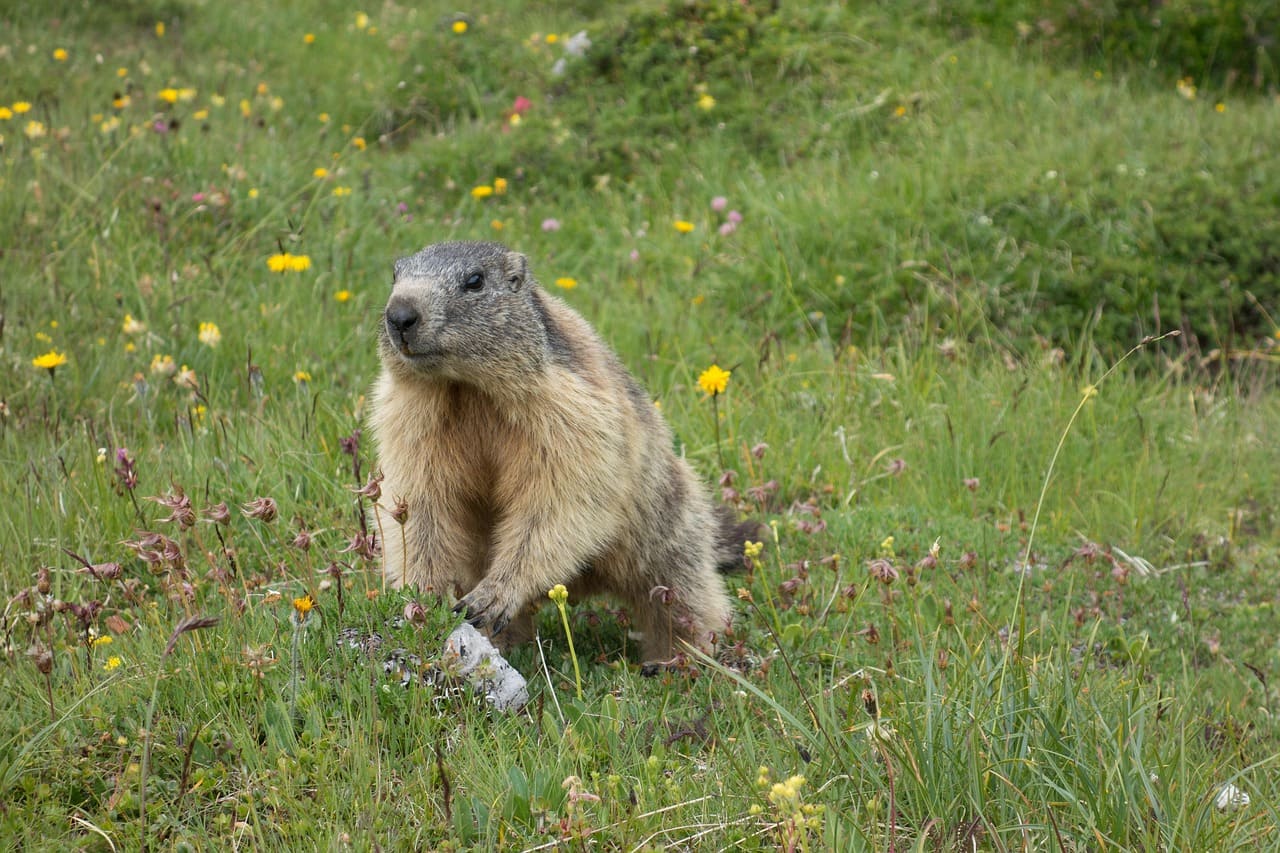
The Alpine marmot is a survivor of the Ice Age and the third-largest rodent in Europe. It lives in family groups, hibernates for up to seven months and warns its colony of dangers with shrill whistles. Tourists love it. The recreational hunting community shoots it by the thousands: In Canton Graubünden alone, 3,000 to 6,000 marmots are killed annually. Across Switzerland, it's around 5,000 to 8,000 animals. Climate change is already measurably affecting the high-altitude dweller. Nevertheless, each hobby hunter is allowed to shoot up to eight marmots during the main hunting season, with special permits allowing 20 more.
Profile
The Alpine marmot (Marmota marmota), also called «Mungg» or «Murmunda» in Switzerland, belongs to the squirrel family (Sciuridae) and is the third-largest rodent in Europe after the beaver and porcupine. It reaches a body length of 40 to 60 centimeters (without tail) and weighs 3 to 8 kilograms, with weight fluctuating by up to 50 percent between summer and winter. In autumn, before hibernation, adult animals weigh the most. The fur is gray-brown to yellow-brown on top, lighter underneath. The marmot has strong digging paws, short ears and large, dark eyes.
Biology and Social Structure
The marmot is one of the most social rodents in the Alps. It lives in family groups of up to 20 individuals, consisting of a dominant parent pair, the young of the current year, and offspring from previous years (Wikipedia, Alpine marmot). The young only reach sexual maturity in their third year and remain in the family group until then, sometimes longer. This cohesion has a vital purpose: during hibernation, family members warm each other, which reduces energy consumption and increases survival chances. Individual animals or small groups have significantly lower survival rates.
Marmots are exclusively diurnal. They cannot see at night and are therefore dependent on daylight hours for feeding. When in danger, they warn their colony with a penetrating whistle. When threatened from the air (golden eagle), a single, long whistle sounds; when facing ground-based dangers (fox, human), a series of short whistles (Wikipedia, Alpine marmot).
Hibernation: Six to seven months on low flame
The marmot's hibernation is one of the most extreme physiological performances among European mammals. From the end of September to March or April, the animals remain in their winter burrows, which can be up to seven meters deep. Body temperature drops from 39 to around 7 degrees Celsius, heart rate falls from 100 to 2 to 3 beats per minute, and breathing pauses extend to several minutes (SAC, Fatal Siesta). The animals lose up to 50 percent of their body weight during this time. Before falling asleep, they seal all entrances to their burrow from the inside with earth, stones, and nesting material.
This survival strategy only works if the animals can build up sufficient fat reserves in summer. This is precisely where climate change becomes a problem.
Food
Marmots are almost exclusively vegetarians. They eat grasses, herbs, flowers, leaves, roots, and seeds. Preferred food plants are Alpine clover (Trifolium alpinum) and Alpine lovage (Ligusticum mutellina), which are particularly rich in omega-6 fatty acids. Professor Walter Arnold from Vetmeduni Vienna has proven that marmots form a special storage fat from these plants that allows them to tolerate lower body temperatures during hibernation and lose less weight (SAC, Fatal Siesta). They must consume around 500 grams of food per day, about 10 percent of their body weight. The time window for this is short: only five months of the year are available for food intake.
Habitat: A high mountain range under pressure
Ice age relic in shrinking habitat
The marmot is a typical ice age relic. During the Pleistocene, it inhabited the European lowlands. With the warming after the last ice age, it retreated to the high elevations of the Alps. Today it lives on alpine grasslands between around 1,400 and 3,000 meters altitude, at least 400 meters above the treeline (SAC, Fatal Siesta; Wikipedia). In the canton of Graubünden, the main habitat of the marmot in Switzerland, around 3,000 square kilometers of alpine grassland are available (Südostschweiz, 2017).
Climate change as an existential threat
Climate change affects the marmot in two ways. First: summer heat. Marmots have no sweat glands and experience heat stress at temperatures as low as 20 degrees Celsius (SAC, Fatal Siesta; Spektrum der Wissenschaft, 2024). On hot days, they stay longer and longer in their cool burrows, which shortens the available feeding time. The consequence: lower fat reserves before hibernation. Less fat means a higher risk of not surviving the six-month hibernation.
Second: lack of snow insulation. The snowfall period in the Alps has shifted. Previously, continuous snow cover from November was the norm. Today, the ground often remains snow-free until the turn of the year. Ground without insulating snow cover cools more rapidly. Marmots in deep hibernation must then produce more body heat, which costs additional energy and fat reserves (Spektrum der Wissenschaft, 2024; Der Pragmaticus, 2024).
Professor Walter Arnold, who has been studying marmots in Avers (GR) for years, has found that the animals are building up fewer fat reserves before hibernation due to heat stress (SAC, Fatale Siesta). The Austrian Animal Protection Association warns: 'Alpine marmots are increasingly unable to adapt to environmental changes. An animal already struggling for survival must not additionally suffer under recreational hunting' (Österreichischer Tierschutzverein, 2026).
Studies by Vetmeduni Vienna also show that the Alpine marmot, as an Ice Age relic, exhibits very low genetic diversity. Isolated populations are more susceptible to diseases and less able to adapt to environmental changes (Tierschutzverein Österreich, 2026).
More on this: Dossier: Hunting and Biodiversity
The Hunt: Mass Culling as Tradition
Legal Situation
The marmot is a huntable species under the Federal Hunting Act (JSG, Art. 5 Para. 1). It is hunted mainly during the general hunting season in patent hunting cantons. The closed season extends across the winter months and breeding period in most cantons. In Graubünden, every recreational hunter may kill 8 marmots during the 21-day general hunting season. With a special permit, issued locally when populations are high, an additional 20 animals may be taken (Südostschweiz, 2017). In Germany, the marmot is huntable but has a year-round closed season and is not hunted in practice.
The Scale of Culling
The kill numbers for marmots in Switzerland are exceptionally high. BirdLife Schweiz cited 5,735 killed marmots for one year and commented: 'Why 5,735 marmots are shot is hardly comprehensible' (BirdLife Schweiz, Jagdstatistik). According to Wikipedia, the nationwide hunting bag stood at 8,300 animals in 2009 and fell to 5,100 by 2015. The main share (72 percent) comes from Canton Graubünden with around 4,300 animals killed annually (Wikipedia, Alpenmurmeltier). Additionally, around 500 animals are shot by wildlife management in Graubünden alone (Südostschweiz, 2017). In Valais, around 600 marmots are killed annually.
During wartime, up to 12,000 marmots per year were shot in Graubünden. This historical dimension shows that marmot hunting originated in food procurement during times of need. Those times of need are over. Today the marmot is hunted out of tradition and as recreational entertainment.
No Reasonable Justification
Marmots cause no wildlife damage to agricultural crops in the strict sense. They live above the tree line, where neither arable farming nor fruit growing takes place. The only regularly cited conflict concerns alpine pastures: lambs can fall into marmot burrows and break their legs, farmers stumble over the holes. In Valais, isolated cases were documented where farmers smoked out and filled in marmot burrows (Südostschweiz, 2017). These conflicts are real but locally limited and can be solved with simple measures (marking burrows, fencing critical areas).
That thousands of marmots are shot annually because occasionally lambs fall into burrows is disproportionate. Marmot hunting is not damage prevention, but folklore hunting in the high mountains, comparable to mountain hare and ptarmigan hunting.
More on this: Dossier: Hunting Myths
Ecological Significance: Keystone Species of Alpine Ecosystems
Food source for the golden eagle
The marmot is the most important prey species for the golden eagle in the Alps. A single golden eagle pair kills up to 70 marmots during the breeding season; these make up to 80 percent of their prey (Wikipedia, Alpine marmot). Without marmots, the golden eagle would not be viable in large parts of the Alps. Ravens, pine martens and red foxes also prey on young animals. The marmot is thus a keystone species that feeds an entire chain of predators in the alpine ecosystem.
Ecosystem engineer
The digging activity of the marmot has far-reaching effects on the alpine landscape. Its extensive burrow systems aerate the soil, promote mixing of soil layers and create microhabitats for insects, reptiles and plants. The excavated material from the burrows forms small mounds that serve as heat stores and germination sites for pioneer plants. Abandoned burrows are used by other species as shelter. The marmot is thus an ecosystem engineer whose activity promotes alpine biodiversity.
What needs to change
- Drastic reduction of shooting quotas: Shooting 5,000 to 8,000 marmots annually is unjustifiable given increasing climate pressure. The shooting quotas per license (8 animals plus 20 with special permits) are not scientifically justified. The cantons must massively reduce shooting contingents and abolish special permits.
- Science-based monitoring: There are no reliable total population figures for marmots in Switzerland. Recreational hunters shoot from an 'undefined stock' (Südostschweiz, 2017). National monitoring based on standardized burrow counts is a prerequisite for any serious hunting planning.
- Consideration of climate change in hunting planning: Shooting plans must consider increasing climate stress. When a species is already under pressure from heat stress, shortened feeding times and reduced fat reserves, it must not be additionally decimated by mass shootings.
- Protection of alpine pastures from forest encroachment: The afforestation of abandoned alpine pastures reduces marmot habitat. Alpine pastoral farming must be preserved and promoted, not only for agricultural but also for nature conservation reasons.
- Restriction of recreational disturbance: Hikers who disturb marmots shorten their feeding time and reduce fat reserves. Wildlife quiet zones in core marmot areas, combined with leash requirements for dogs and path regulations, are urgently needed.
- Ban on marmot hunting trips as recreational offerings: In Austria, organized marmot hunting trips are marketed as adventure experiences. The Austrian Animal Protection Association considers this 'irresponsible'. In Switzerland, such commercialization of wildlife killing must not gain ground.
Argumentarium
'The marmot is not endangered and can therefore be hunted.' That a species is currently not on the Red List does not mean that hunting it is sensible or necessary. Climate change is measurably affecting marmots: reduced fat reserves, shortened feeding times, deteriorated snow insulation in winter. Studies by Vetmeduni Vienna show low genetic diversity that limits adaptability. That the Red List does not (yet) classify the marmot as endangered is due to the lack of current population data, not to assured population stability.
'Marmot hunting has tradition in Graubünden.' Tradition is not an argument for mass culling. During wartime, 12,000 marmots were shot per year because the population needed food. This emergency situation has not existed for over 80 years. Today, thousands of marmots are shot because the quotas permit it. BirdLife Schweiz rightly asks: 'Why are 5,735 marmots being shot?' The answer is: because it can be done, not because it must be done.
'Marmots cause damage to alpine pastures because lambs fall into their burrows.' Isolated incidents do not justify mass culling of thousands of animals across entire regions. Affected areas can be marked, fenced off, or avoided. The marmot has lived on alpine grasslands since the Ice Age, long before sheep were grazed there. Its right to habitat is older than any alpine agriculture.
'Marmots are abundant; culling 5,000 to 8,000 animals does not harm the population.' Nobody knows how large the population actually is. The cantonal hunting administrator of Graubünden himself speaks of an 'undefined population.' Culling on this scale without population data is not sustainable wildlife management, but flying blind. Additionally, climate change increases mortality during hibernation and reduces reproduction rates, amplifying the cumulative effects of hunting.
'The marmot is utilized as game meat, so the culling serves a purpose.' Utilization as game meat applies to only a small portion of the cullings and does not change the lack of wildlife biological necessity for mass removal. The shooting of an animal is not justified by subsequently eating it. The rational reason must exist before the killing, not after.
Quicklinks
Articles on Wild beim Wild:
- Studies on the impact of recreational hunting on wildlife
- Why recreational hunting fails as population control
- Animal welfare problem: Wildlife dies agonizingly because of hobby hunters
Related Dossiers
- The Alpine ptarmigan in Switzerland: Ice Age relic between climate crisis, tourism, and gunshot
- The ibex in Switzerland: Smuggled, rescued, and again degraded to trophy
- The beaver in Switzerland: Eradicated, reintroduced, and newly released for culling
- The woodcock in Switzerland: Endangered, hunted, and politically ignored
- Waterfowl in Switzerland: Winter guests in the line of fire
- Pigeons in Switzerland: Between peace symbol, mass culling, and official starvation
- Corvids in Switzerland: The most intelligent animals in the crosshairs
- The jay in Switzerland: Forest engineer in the crosshairs of small game hunting
- The marmot in Switzerland: Ice Age relic under climate stress, tourist attraction, and mass culling
- The wild rabbit in Switzerland: severely endangered, yet huntable
- The mountain hare in Switzerland: Ice Age relic between climate crisis and gunshot
- The raccoon in Switzerland: Released for culling because it has the wrong origin
- The stone marten in Switzerland: Cultural follower between attic and gunshot
- The pine marten in Switzerland: Shy forest dweller under hunting pressure
- The badger in Switzerland: Ecosystem engineer in the crosshairs of small game hunting
- The red deer in Switzerland: Eradicated, returned, and degraded to culling target
- The roe deer in Switzerland: most shot wildlife and victim of misguided hunting policy
- The wild boar in Switzerland: Why recreational hunting exacerbates the problem instead of solving it
- The chamois in Switzerland: Between high hunting, climate stress, and the myth of overpopulation
- The brown hare in Switzerland: Endangered, hunted, and politically ignored
Source references
- Federal hunting statistics, BAFU/Wildtier Schweiz: http://www.jagdstatistik.ch (culling data marmot)
- Wikipedia: Alpine marmot (Marmota marmota)
- BirdLife Schweiz: The current hunting statistics and the revised hunting law (birdlife.ch)
- Südostschweiz (2017): Grisons hunters shoot 3,000 to 6,000 marmots per year
- SAC Swiss Alpine Club: Fatal Siesta, Marmots and Climate Change (sac-cas.ch)
- Spektrum der Wissenschaft (2024): Climate change makes it too hot for marmots
- Der Pragmaticus (2024): The last summers of the marmots
- Austrian Animal Protection Association (2026): The Alpine Marmot, a silent survival artist
- Arnold, W. et al.: Research Institute of Wildlife Ecology, Vetmeduni Vienna (Long-term marmot studies Avers/GR)
- EU Research Project ARC (2016): Adaptive responses to climate change, 22-year study on marmots
- Stadtwildtiere Deutschland: Species Portrait Alpine Marmot
- Federal Act on Hunting and Protection of Wild-living Mammals and Birds (JSG, SR 922.0)
Our Standards
The marmot is the animal that brings the Alps to life. Its whistle belongs to the soundscape of the high mountains like the ringing of cowbells. It is a tourist attraction, postcard motif and crowd favorite. At the same time, thousands are shot in Switzerland, year after year, without the public taking notice. In the canton of Grisons, a single recreational hunter may kill up to 28 marmots per hunting season. These quotas stem from a time when marmots served for food procurement. Today they are the relic of folklore hunting that is neither biologically nor ethically justified. Climate change is already measurably affecting the marmot. Heat shortens its feeding time, lack of snow insulation endangers its hibernation, genetic impoverishment reduces its adaptability. In this situation, shooting thousands of animals per year from a population that nobody counts is the opposite of wildlife management. It is resource waste disguised as tradition. This dossier is continuously updated when new figures, studies or political developments require it.
More on recreational hunting: In our Hunting Dossier we compile fact-checks, analyses and background reports.