Severe animal suffering in fur farms is unavoidable
It is not possible to guarantee adequate animal welfare in fur farms. The EU decision on a ban on fur farming remains pending.
This was confirmed by the European Food Safety Authority (EFSA) in its scientific opinion within the framework of the Fur Free Europe ECI process.
Animal welfare organisations are calling on the European Commission (EC) to act on this opinion and to ban fur farming in the EU, as millions of EU citizens are demanding.
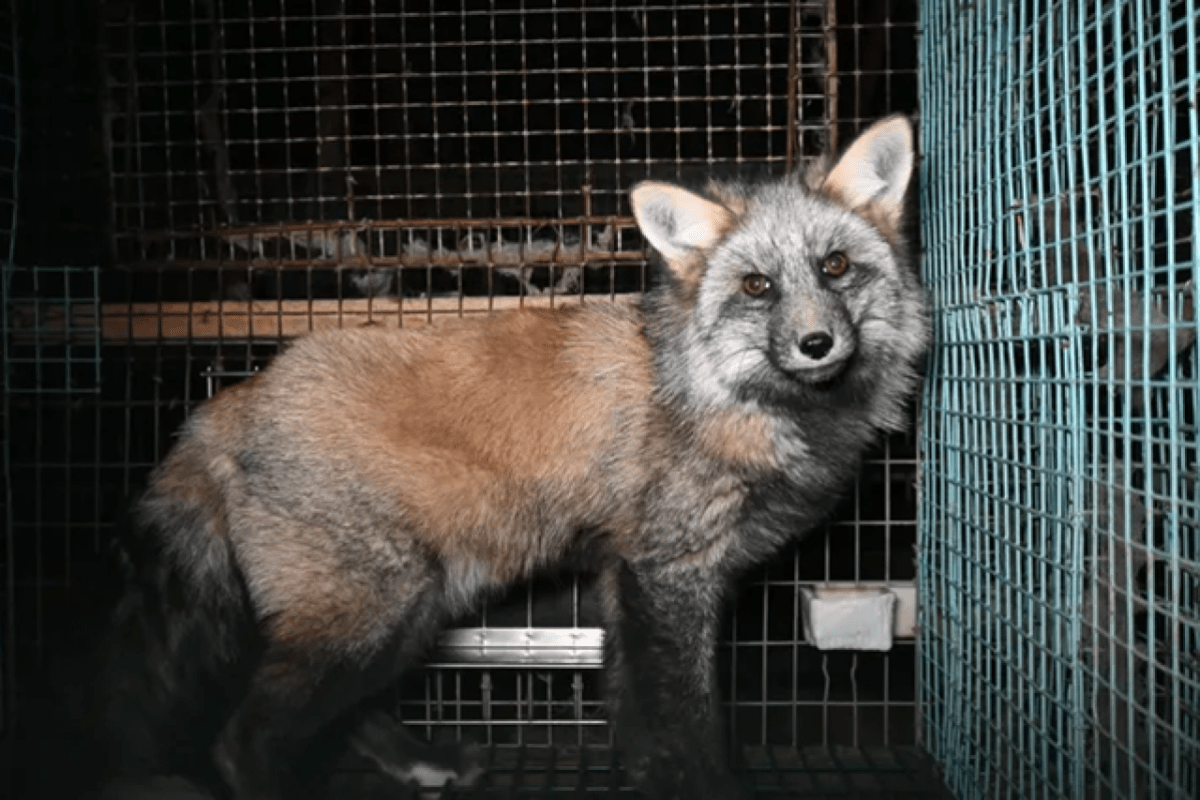
At present, more than 6 million mink, raccoon dogs, foxes and chinchillas are kept on almost 1’200 fur farms across Europe – in Finland, Poland, Denmark, Spain and Greece, among others. Meanwhile, fur farming is already banned in 22 European countries, including 16 EU member states – most recently in Estonia, Latvia, Lithuania and Romania. In Germany, there have been no fur farms since 2019 due to high animal welfare standards, but there is no official ban. The situation is similar in Bulgaria and Sweden.
The EFSA findings confirmed what scientists have been stressing for years: fur farming is fundamentally incompatible with animal welfare. It highlights the serious consequences for the well-being of mink, foxes, raccoon dogs and chinchillas in fur production, including restrictions on movement, isolation stress, tissue damage and lameness, and concludes that the complex behavioural and physiological needs of these animals simply cannot be met in the fur farming industry.
Given that the only husbandry system currently in use is based on wire-mesh cages, this conclusion is consistent with a large body of research demonstrating the harmful effects of keeping animals in cages, whether domesticated or not.
Since it is scientifically proven that neither a redesign nor a modification of the system can meet the needs of fur animals, and since the fur industry is in decline, the European Commission should seize the opportunity of the current revision of the EU animal welfare legislation to recognise and adopt the EFSA's demands.
A ban on fur farming
A ban on the placing of farmed fur products on the European market, to ensure that furs produced under similarly cruel conditions in third countries are not sold in the EU.
This demand was also supported by the Federation of Veterinarians of Europe (FVE), which represents 330,000 veterinarians in 39 countries. The FVE stated that fur farming is not future-proof and called for a complete ban on the farming and sale of fur products in the EU.
The newly published EFSA opinion holds no real surprises: caging animals that are wild by nature for a luxury product that serves no essential purpose violates the most fundamental principles of animal welfare. In light of this new EFSA assessment and the well-documented risks to public health and the environment associated with fur farming, we call on the European Commission to ban fur farming throughout the entire EU, as citizens are demanding. – Reineke Hameleers, Chief Executive Officer, Eurogroup for Animals
According to the EFSA opinion, the central animal welfare problems in today's fur farms include:
- Cages of insufficient size and complexity, along with «barren housing conditions» that severely restrict freedom of movement, in addition to unsuitable wire mesh flooring.
- Sensory under- or over-stimulation – depending on the species – resulting in chronic boredom and/or stress.
- Inability to express basic behaviours such as playing, exploring, foraging, digging, jumping or chewing – chinchillas also lack access to sand baths, and mink lack access to open water for swimming.
- Stress, aggression and injuries, including cannibalism and the killing of young (infanticide), triggered by lack of space, overcrowding, unsuitable group housing (e.g. fights among cage-mates, fur-biting) or competition for resources.
- Fear and stress due to the lack of habituation to humans, as well as injuries caused by being caught with neck tongs – including during forced insemination.
- Stereotypical behaviours such as monotonous pacing back and forth and head-bobbing.
- Lameness as well as malpositioned or weak legs.
- Gastrointestinal diseases and inadequate feeding; prolonged hunger or excessive feeding – depending on the husbandry conditions.
Facts about fur:
- Health risk: Fur farms pose a risk of zoonoses. On almost 500 mink farms in 13 countries across Europe and North America, animals were infected with COVID-19, and millions were killed for reasons of infection control. The avian influenza virus (HPAI H5N1) has also been detected on 72 European fur farms so far. As a result, around 500’000 mink, arctic foxes, red foxes and raccoon dogs were killed.
- Environmental impact: The carbon footprint of 1 kg of mink fur (309.91 kg CO₂ equivalent) is 31 times higher than that of cotton, 26 times higher than that of acrylic and 25 times higher than that of polyester. Raccoon dog and fox fur also have a dismal climate balance – up to 23 times worse than cotton. The comparison with other animal products shows: the breeding of carnivorous animals such as mink is particularly harmful to the climate – it causes around seven times more emissions than the production of 1 kg of beef.
- Fashion without fur: More and more leading fashion brands are going fur-free – including Max Mara, Saint Laurent, Gucci, Alexander McQueen, Balenciaga, Valentino, Prada, Armani, Versace, Michael Kors, Jimmy Choo, DKNY, Burberry and Chanel. Worldwide, over 1’600 brands and retailers have already committed to a fur-free corporate culture. Fur is increasingly perceived as unsellable and ethically indefensible – which is why many fashion houses today rely on innovative, animal-friendly alternatives.
Dr Joanna Swabe, Senior Director of Public Affairs at Humane World for Animals Europe, says: “The EFSA opinion confirms what animal welfare advocates and veterinarians have been saying for decades: keeping animals such as mink, foxes, raccoon dogs and chinchillas for fur fashion in small, barren cages leads – unsurprisingly – to serious, chronic animal welfare problems. These include the suppression of vital behaviours, stress, injuries and health complaints. The considerable physical and psychological suffering that the multinational panel describes in detail is utterly incompatible with modern ethical animal welfare standards. Throughout the report, the experts conclude that this suffering can neither be prevented nor substantially alleviated on current fur farms. This is a damning verdict that leaves the fur industry no prospect for the future.
Addendum: EU decision still pending
The EU Commission was originally due to decide by March 2026 whether to propose an EU-wide ban on fur farming. The date was postponed, and the responsible Commissioner Olivér Várhelyi announced in March 2026 that it would take a position «shortly». A definitive EU decision is still outstanding.
Independently of this, individual countries have already introduced their own bans: in December 2025, Poland ended fur farming, and Italy followed suit.
More on the subject of recreational hunting: In our dossiers on recreational hunting gather fact-checks, analyses and background reports. The scientific evidence is presented in the overview Studies on the Effects of Recreational Hunting.
The position of IG Wild beim Wild: IG Wild beim Wild rejects recreational hunting. Our model is the canton of Geneva, which has managed without recreational hunting since 1974: without hunting seasons, without hunting dogs, without driven hunts, without high seats, without the animal cruelty and crime that go hand in hand with hunting season elsewhere. What has worked there for over fifty years disproves every position paper by JagdSchweiz. An association that bases its policy on claims it refutes in its own documents is not a professional organisation, but a factory for misinformation.
Support our work
With your donation you help to protect animals and give their voice a hearing.
Donate now →