Is the global bird die-off a bad omen?
Bird populations are declining rapidly worldwide, with hundreds of species threatened with extinction. When the bird world is not doing well, humans will eventually face problems too. Recreational hunting contributes significantly to the decline. More on biodiversity and nature conservation.


Bird populations are declining rapidly worldwide, with hundreds of species threatened with extinction. This should serve as a warning to us humans: when the bird world is not doing well, we will eventually face problems too.
This year, a red kite was found in the canton of Vaud close to death.
The staff at the Centre ornithologique de réadaption (COR) in Genthod GE fought a literally life-and-death battle. The bird was lying on the ground and had already attracted the attention of cats at a campsite. «When I saw this beautiful bird that could no longer fly, I spoke gently to it and stroked it,» recounts the woman who found it. She then carefully placed it in a bag.
She was eventually able to hand over the comatose, seizure-stricken bird to the specialists at the COR. Patrick Jacot, the person in charge at the COR, says that in 40 years of operation they had never seen a red kite there before. At first, a collision with a vehicle or a window pane was suspected. Only later did they conclude that the animal was suffering from poisoning caused by pesticides.
The red kite has been protected for decades
The red kite was placed under protection in Switzerland as early as 1925. However, since it continued to be shot until the 1950s, it took a long time for the population to begin recovering. In the meantime, it has spread somewhat again. The roughly 90 breeding pairs recorded during the first census in 1969 have since grown to around 1,500 pairs. In other parts of Europe, however, the population continues to decline.
At the bird station, the first emergency measure for the red kite was to pump out its crop, a pouch-like structure in the esophagus where food is collected. “The crop was full, about the size of a tennis ball,” says Emilie Bréthaut, veterinarian at the COR. An enema was then administered using a tube — a procedure requiring great sensitivity. Bréthaut brought to light dirt and plant matter that smelled strongly of chemical substances.“When you see something like that, it really makes you think about the fruits and vegetables we consume,” said the veterinarian.


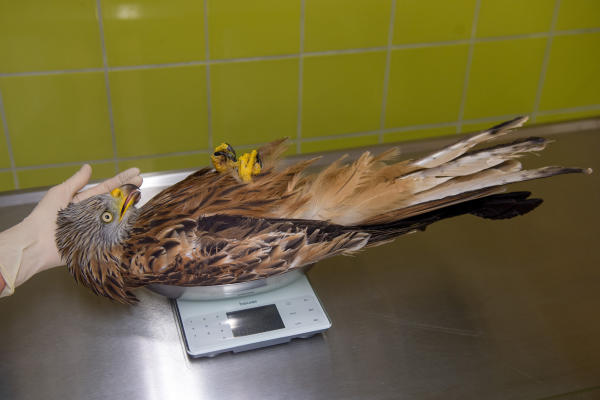
After the emergency procedure, the red kite was put on an IV drip. “The situation remained very critical. I gave it less than a 50 percent chance of survival,” says Bréthaut. But by the next day, the bird of prey already seemed somewhat stronger. It also began eating on its own, but then suddenly refused. «The red kite is a species that is very sensitive to stress,» says the expert. For this reason, they began feeding the starving raptor with tweezers.
These are stories like those now unfolding across Europe and North America — indeed, virtually the entire world: the mass die-off of birds.
Populations of certain farmland birds have shrunk across Europe, while grassland birds are disappearing in North America. Numbers are falling in the tropics, in Costa Rica and the Caribbean, and populations are also declining in Scandinavia, Australia, China, Patagonia, the Mediterranean region, and many other parts of the world.
The 2012 Red List of Threatened Species published by the International Union for Conservation of Nature and Natural Resources lists 130 bird species that have gone extinct worldwide since the year 1500. In addition, an unknown number of bird taxa are considered lost or presumed extinct, as they have either not been documented for decades or their habitat has been so severely destroyed that further survival seems unlikely. The year 1500 serves as a key date for the IUCN, as it was from this point that Europeans began exploring and settling the most remote corners of the earth, with both humans and non-native animal species — such as cats and rats — causing a mass extinction of many bird taxa. Calculations published in the scientific journal Proceedings of the National Academy of Sciences found that today around twelve percent of all bird species are acutely threatened with extinction, with a further twelve percent considered endangered. Based on the available data, researchers estimate that by the end of the 21st century, at least ten bird species per year will become extinct. In Europe, only one species has become extinct in recorded history: the great auk.
According to estimates by scientists, approximately 500 million animal species have gone extinct to date. That represents over 99 percent of all animal species.
This list does not include animals that went extinct in prehistoric times (such as dinosaurs, mammoths, and similar creatures) or plants, but only those that became extinct in recorded history and are relatively prominent. Most were wiped out directly (through hunting) or indirectly (through habitat destruction, introduction, or accidental introduction of non-native species) by humans.
Scientists are frantically searching for solutions
Birds that formerly existed in very large numbers appear to be under extreme pressure, according to the findings of ornithological researchers. In many cases, ecologists and ornithologists know the causes precisely. Action must be taken, as the decline of bird populations is also a problem for humans. In some regions, potential solutions have already been identified, writes welt.de.
Henrique M. Pereira can confirm this. A few weeks ago, he and a team of international biodiversity researchers published the results of a long-term analysis of North American bird populations in the journal «Global Change Biology». The researchers evaluated the North American Breeding Bird Survey for the years 1971 to 2010 as well as other sources. A total of 519 bird species were analyzed in detail. Two findings emerged: on the one hand, and this initially seems positive, the number of species remains constant in many regions. On the other hand, however, the number of individual birds is declining.
[youtube https://www.youtube.com/watch?v=axAZLCeF4ms&w=1280&h=720%5D
One explanation for this is that more and more fallow land is being brought under agricultural use, both in the USA and in Europe. «Increasing mechanization, the establishment of large monocultures, the destruction of hedgerows, and the use of pesticides are bad for farmland birds», says Pereira, who is a professor at the German Centre for Integrative Biodiversity Research and at the University of Halle-Wittenberg. «Many farmland birds can no longer find nesting sites, or their nests are being destroyed.»
Species that breed in grasslands and fields and prefer open landscapes are particularly struggling. Skylarks, lapwings, and grey partridges can barely manage to raise their broods. Farm machinery destroys nests, and chicks that are painstakingly fed by their parents are killed.
The number of insects is also declining dramatically
The destruction of habitats is an important reason why there are fewer birds. But it is not the only cause of shrinking populations: if you drove through the countryside back in the 1970s, after a short time you could barely see out of your windscreen — it was so dirty. You constantly had to clean it, with masses of insects stuck to the glass.
Over the past 15 years, the number of insects has declined dramatically, as a study from North Rhine-Westphalia demonstrates: over a period of 25 years, tent traps were set up at 87 sites in the Orbroicher Bruch nature reserve near Krefeld from May to October, with which researchers collected flying insects.
In 1989, scientists caught an average of 1.6 kilograms of insects in each trap. In 2014, it was only 300 grams per trap. The biomass per trap had been reduced by up to 80 percent, according to researchers led by Martin Sorg of the Krefeld Entomological Society.
[youtube https://www.youtube.com/watch?v=PTmW41tNNiw&w=1280&h=720%5D
What is being observed in the Krefeld region is a global trend: the International Union for Conservation of Nature (IUCN) estimates that one third of all insect populations worldwide are declining sharply. This is fatal for birds. They simply can no longer find enough to eat — not for themselves and not for their young.
Birds quickly recognize when something is wrong with the environment
Birds play an important role in the ecosystem. They eat insects, carrion, and waste, and help disperse plant seeds. But beyond that, according to Berthold, they offer even more: observing them can allow us to detect global changes or health risks to humans at an early stage. They are bioindicators — by watching them, we can tell when something in the environment is amiss.
Climate warming, for example, was noticed by experts through changes in bird behavior very early on. In 1990, ornithologist Peter Berthold recalls, he gave a lecture to an international audience at the International Ornithological Congress in New Zealand — on how climate warming would change the world of birds.
Migratory birds were leaving for the south later, no longer flying as far, and returning earlier. Species living on mountains or in other cool regions were struggling to cope with the warmer temperatures. «Half the audience laughed and said: ‘Come on, the man is going senile and talking nonsense.’ The other half said: ‘If that’s true, then God help us!’» If birds are doing poorly, humans will sooner rather than later face problems too.
In Sweden, for example, around 1970, kestrels and yellowhammers — two normally common species — had almost disappeared. «When dead yellowhammers were found with increasing frequency, researchers plucked feathers,» explains Berthold. They compared the mercury content in the freshly deceased yellowhammers with that found in feathers from museum specimens up to 100 years old. «The difference was worlds apart.»
Since mercury accumulates in fish, Sweden revised its dietary recommendations. People were advised to eat fish from Swedish waters no more than once a week. In 2009, the Swedish government even imposed a total ban on mercury. Today, fewer mercury-containing biocides are used, and the situation is slowly improving.
How harmful pesticides like DDT can be was also revealed through problems observed in the bird world: «Bald eagles in North America had serious problems in the 1950s and 60s. The shells of their eggs were too thin and had cracks. The embryos died, and the population declined drastically. And all of this simply because the birds ingested the insecticide through insects, fish, and larger prey», Berthold explains.
The poison ended up not only in the eagles' prey, but consequently also in the human food chain. Without birds, a large part of humanity would already have had to say goodbye.
Regional reforestation helps birds
All the more important, then, to closely monitor the many changes taking place in the bird world. Due to rising temperatures, for example, not all migratory birds need to fly long distances anymore — they can still find sufficient food in the north during winter.
Some species can even expand their range; the cattle egret from the Mediterranean region and escaped parakeets from the Middle East feel quite at home in Freiburg, Stuttgart, or Düsseldorf. The result is that the total number of species in Germany is actually rising, even as populations are generally shrinking. The arrival of new species masks what is otherwise a rather negative trend.
Yet there are occasionally some genuinely good news stories. «Overall, the dying-off is no longer continuing to increase in some regions», says Henrique Pereira. «For some woodland bird species in Europe or North America, populations are even recovering.» This is due to regional reforestation. When animals are given their habitat back, they reproduce quickly again. In research jargon, this is called «renaturation versus defaunation».
Peter Berthold also wants to make use of this relatively simple form of bird conservation. Twelve years ago, he joined forces with the Heinz Sielmann Foundation to establish the Biotopverbund Bodensee. The foundation acquires small, unused parcels of land from towns and municipalities, restores them to their natural state, and protects them.
The number of insects is now increasing, and birds are once again finding enough bushes and shrubs for their nests. The habitat network is now set to be expanded across all of Germany. «Ten of the sixteen federal states have already expressed interest», says Berthold. The aim is to make Germany insect- and bird-friendly once more.