Grisons sends recreational hunters on nocturnal wild boar stalk
Grisons is sending 22 recreational hunters out at night onto meadows in the Mesolcina — without pay, but with the right to the meat. The problem: in neighbouring Ticino, year-round intensive hunting has doubled wild boar kills over ten years without reducing the population. And the meat may be radioactively contaminated.
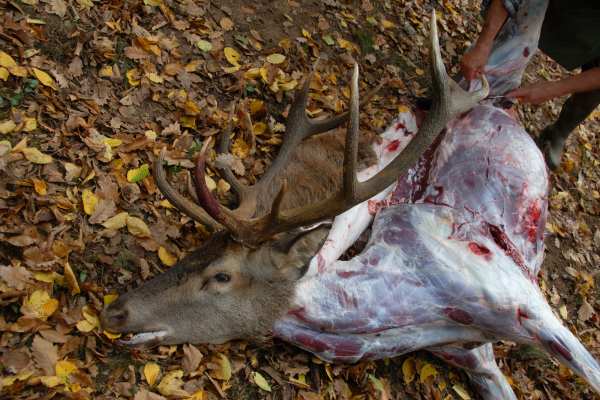
Because wild boars are churning up ever more agricultural land in the Mesolcina, the canton of Grisons has since 2025 been testing a scheme that is as simple as it is telling: specially licensed recreational hunters hunt wild boars at night and outside the regular high hunt – without compensation, but with the right to keep the meat of the animals they kill.
The Grisons Office for Hunting and Fishing is expanding this pilot project in the summer of 2026. On eleven selected meadows in the Mesolcina, licence holders may wait for wild boars from 1 July to 10 August between 9 pm and 6 am. The requirement: a valid high hunt licence as well as at least ten nights of waiting on the allocated area. 39 people applied in 2026, of whom 22 were drawn by lot – this year exclusively male.
A pilot project without a success criterion
According to Lukas Walser, hunting planner at the Grisons Office for Hunting and Fishing, the aim is explicitly not the maximum reduction of wild boars. The intention is to investigate whether targeted night hunting on particularly vulnerable meadows can prevent damage to agriculture. In the first project year, 2025, 14 wild boars were killed.
What stands out: the project names no concrete success criterion. How it is to be measured whether it works – a reduction in damage in francs, population development, the return behaviour of the sounders – remains open. Without a defined metric, after several years one can merely note that “experience has been gathered”. In parallel, the canton is trying out non-lethal measures such as acoustic deterrent devices (wild boar scarers), which play threatening sounds at irregular intervals. These measures are, however, treated as a footnote in the report.
The Ticino evidence: more kills, no decline
That intensive hunting does not control wild boar populations can be demonstrated within the immediate geographical context. The Mesolcina borders directly on Ticino, and belongs climatically and ecologically to the same habitat. In Ticino, wild boar are hunted year-round.
The cantonal kill statistics of the Federal Statistical Office (BFS) show the trend with no room for interpretation: in 2015, 1’437 wild boars were killed in Ticino. In 2024 the figure was 2904 – a doubling within ten years (+102 per cent). Between 2022 and 2024 alone, kills rose by 73 per cent. In not a single year of this decade did the number of animals killed permanently decline, despite the increased hunting intensity.
What matters here is the correct interpretation: these figures clearly prove, however, that no effective population control has taken place – and this despite year-round, area-wide hunting by around 880 recreational hunters, who in the first summer hunting season of 2023 alone killed over 1’100 animals. Rising kill figures primarily reflect a growing population, not successful regulation.
The underlying mechanism has been described in scientific detail: wild boars exhibit compensatory reproductive dynamics. Losses from killing are offset by increased reproduction rates, as individual animals produce more offspring and young animals reach sexual maturity earlier. In 2014, the European Food Safety Authority (EFSA) calculated that an annual removal rate of over 67 per cent of the population would be necessary to achieve a lasting reduction – a figure that is practically unattainable in open populations with immigration from neighbouring areas. In reality, the kill rate in Switzerland is around 40 per cent. To make matters worse, intensive recreational hunting destroys the social structure of the sounders: without experienced lead sows, younger animals expand their ranges and cause damage across broader zones.
Radioactively contaminated and the meat as an incentive
The Ticino problem has a second dimension that remains remarkably unmentioned in the Grisons pilot project. Wild boars from the Mesolcina and the adjacent Ticino have demonstrably been contaminated with caesium-137 as a result of the 1986 Chernobyl fallout. Of all Swiss cantons, Ticino was the most heavily affected – heavy rainfall after the reactor accident carried radioactive particles directly into the region's forest soil. According to the Grisons cantonal veterinarian, the border between Grisons and Ticino lies within a geographical and seasonal hotspot with particularly high soil contamination.
Since 2013, the BAG has systematically examined wild boars killed in Ticino. Around two to five per cent of the animals exceed the marketing limit of 600 Bq/kg; individual animals have been measured with values of up to 4’721 Bq/kg. The canton of Grisons carried out comprehensive controls for the first time in 2020, after a surprisingly large number of positive findings had occurred in southern Grisons. Controls have been conducted here ever since.
Now to the decisive legal situation, which is problematic in the context of the pilot project: anyone who does not sell the wild boar they have killed themselves but consumes it privately is exempt from the measurement requirement in Grisons. According to a statement by cantonal councillor Marcus Caduff in the cantonal parliament (October 2021), the canton deliberately refrains from regulating private use and relies on the personal responsibility of recreational hunters. The BAG does recommend not serving such meat to one's family. There is no obligation to do so.
The pilot project offers the 22 recreational hunters selected by lot the meat of the killed animals as the only incentive. In an area with known caesium contamination, without mandatory individual-animal control within the project framework, this is a relevant health gap – especially as a study by the TU Vienna and the Leibniz University of Hanover (2023, «Environmental Science & Technology») shows that the actual Chernobyl caesium has not yet reached its maximum in the forest soil and that the elevated levels will persist for several more years.
What really works and why is it missing from the concept?
Anyone who consults the scientific literature on wild boar prevention finds clear evidence for non-lethal measures that, at best, appear only at the margins of the Grisons pilot project. Electric wire fences around vulnerable meadows are considered the most effective single measure for preventing damage – not cheap, but demonstrably effective. Added to this are adjustments in land management: harvest timing, maize-planting distances from the forest, avoidance of attractant structures. Feeding bans demonstrably reduce the concentration of sounders in agricultural zones. And cross-cantonal coordination – wild boars know no cantonal borders – is entirely absent from the Grisons concept.
A game warden model along the lines of the Geneva example would bring all these measures together under state responsibility: without conflict of interest, with scientific support and a clear mandate. In the canton of Geneva, where recreational hunting has been banned since 1974, wildlife damage is managed by state game wardens in a targeted and documented manner. This model is not limited to the canton of Geneva – it can be transferred to any canton willing to understand wildlife damage management as a state task.
Night hunting: animal welfare risks that no one names
Wild animals have evolutionarily adapted to a rhythm that separates rest and activity. For many species, the night is traditionally the time of least hunting pressure – an ecologically necessary recovery phase. Technically upgraded night hunting with night vision devices, thermal imaging optics and silencing equipment structurally abolishes this protection.
Research documents the consequences precisely. A broad meta-analysis by Gaynor et al. (2018, Science) examined 76 mammal species across all continents and reached an unambiguous conclusion: animals increased their nocturnal activity by a factor of 1.36 as a direct response to human disturbance — consistently across species, habitats and forms of disturbance. Science speaks of a “Landscape of Fear”: a landscape of risk in which wild animals are under permanent strain, even when no immediate attack occurs. Dr Konstantin Börner of the Leibniz Institute for Zoo and Wildlife Research summarises the mechanism as follows: wild animals are more likely to choose to go hungry than to venture into a perceived danger. That means they remain in cover rather than searching for food on the meadows and fields.
For the Grisons pilot project this entails a paradox of relevance to animal welfare law. The aim is to pursue wild boars on eleven selected meadows. Yet it is scientifically predictable that the animals will increasingly avoid the affected areas during their active periods and instead frequent adjacent, unhunted areas. Damage shifts; it does not disappear. At the same time the animals now have no respite either by day from human presence or by night from armed recreational hunters equipped with night vision technology.
This also has a concrete dimension relevant to animal welfare: night vision devices are no substitute for assessing wild animals under suitable visibility conditions. They encourage shots under conditions in which age, sex and leadership status — decisive for the social structure of the sounder in wild boars — can hardly be reliably judged. If a shot wounds an animal without killing it instantly, a follow-up search at night is de facto impossible; the animal may suffer a slow death. These animals appear in no kill statistics and in no project balance sheet of the canton.
A conflict of interest by design
The Grisons model illustrates a structural logic that is widespread in Swiss hunting policy: state protection duties are outsourced to recreational hunters – unremunerated, but with extended powers outside regular hunting seasons. The interests at play are not neutral: anyone who, as a recreational hunting licence holder, benefits from being permitted to hunt wild boars at all has no incentive to establish the ineffectiveness of this measure. An independent assessment of success by a body unconnected with hunting is not envisaged in the pilot project.
That wild boars can cause considerable agricultural damage is undisputed. That culling is the most effective means against it – that is shown by Ticino's kill statistics of the past ten years as clearly as hardly any other body of data.
More on the subject of recreational hunting: In our dossiers on the criticism of recreational hunting gather fact-checks, analyses and background reports. The scientific evidence is presented in the overview Studies on the Effects of Recreational Hunting.
The position of IG Wild beim Wild: IG Wild beim Wild rejects recreational hunting. Our model is the canton of Geneva, which has managed without recreational hunting since 1974: without hunting seasons, without hunting dogs, without driven hunts, without high seats, without the animal cruelty and crime that go hand in hand with hunting season elsewhere. What has worked there for over fifty years disproves every position paper by JagdSchweiz. An association that bases its policy on claims it refutes in its own documents is not a professional organisation, but a factory for misinformation.
Support our work
With your donation you help to protect animals and give their voice a hearing.
Donate now →