Open up hunting ban areas, shoot wolves all year round? Why this policy is untenable
The new bill allows wolves to be shot even in protected areas. Instead of relying on herd protection and genuine wildlife habitats, politicians are opting for symbolic gestures in favour of alpine farming – at the wolf's expense.
Switzerland is facing the next major attack on wolf protection.
The Federal Council wants to amend the hunting act so that so-called «problem wolves» can in future be shot all year round, even in hunting ban areas. Of all places, those very areas intended as refuges for wild animals are to be opened up for shooting.
This development is not simply a technical adjustment to hunting law. It is a political decision about direction. And it runs counter to what research, species conservation and even the very logic of protected areas suggest: anyone who genuinely wants to reduce conflicts with livestock must strengthen herd protection and preserve sensitive wildlife areas, not normalise shooting.
What is now planned
The bill provides that wolves with a shooting permit can in future also be killed during the closed season and in hunting ban areas. The media reported that the Federal Council wants to make the shooting of «problem wolves» significantly easier and has opened the consultation procedure for this purpose.
Politically, this is the next stage of escalation. In recent years the rules for shooting wolves were already loosened step by step, first via the hunting ordinance, later via preventive regulation phases. Now the flexible shooting regime is to be enshrined at the level of the act.
What hunting ban areas are for
Federal hunting ban areas were created to protect wild animals and their habitats. There are 42 such areas in Switzerland; they are part of the ecological infrastructure and are intended to secure refuges for rare and endangered mammals and birds.
The basic idea is simple: there is a need for spaces in which wild animals are not constantly under pressure from hunting and exploitation. If wolf kills now become possible there too, the hunting ban area loses an essential part of its protective function. A retreat becomes a politically relativisable space in which protection only applies as long as no lobby successfully exerts pressure.
This is particularly explosive for predators. The wolf is not just some disruptive factor, but part of natural ecological processes. If shooting is permitted even in the core areas of wildlife protection, the state sends the signal that, in the end, it is not the logic of protection that counts, but the political loudness of the interest groups.
What kills actually achieve
The claim that more kills would automatically lead to less damage holds up poorly under scientific scrutiny. Several studies conclude that lethal interventions are often unreliable and can even exacerbate conflicts.
In a much-cited study, livestock damage even increased after kills in a large proportion of the cases examined. Only in a minority was there a small, short-term decline. Non-lethal measures such as electric fences, livestock guardian dogs or night pens, by contrast, reduced damage significantly and more reliably.
Evaluations from Switzerland also show that farms with consistent herd protection perform considerably better than farms that rely primarily on kills. Nevertheless, the political logic of the bill is: shoot more, more room for manoeuvre, more exceptions. This is not an expression of a fact-based approach, but of symbolic politics.
The IG Wild beim Wild firmly rejects the planned opening of the hunting ban areas and the further relaxations regarding the wolf kill. Anyone who opens up protected areas for kills declares wild animals to be disruptive factors in their own habitat. This has nothing to do with modern, science-based wildlife policy
Herd protection works – if you really want it
Herd protection is not a buzzword, but a bundle of very concrete measures: electric fences, night pens, adapted grazing management, shepherding and well-trained livestock guardian dogs. These instruments reduce conflicts without undermining the wolf's protected status.
The actual problem therefore does not lie with the wolf, but with the setting of priorities. Instead of implementing herd protection consistently and funding it adequately, the kill is being increasingly normalised. This creates the false impression that coexistence has failed – although in many places the protective measures are simply inadequate, too late or implemented half-heartedly.
A modern wolf policy would have to take the opposite path: first secure effective herd protection, then remedy enforcement deficits, and only after that examine narrowly limited individual cases. The current proposal turns this order on its head.
The myth of the «Alpine farming ecosystem»
In the political debate, Alpine farming is readily portrayed as a quasi-natural «ecosystem». From a technical standpoint, this is misleading. Alpine farming is a form of land use, not an independent ecosystem.
It is true: under certain conditions, genuinely extensive use in subalpine areas can locally promote plant diversity – for example where moderate stocking is practised without liquid manure. This is exactly what some studies show. But even this research emphasises that fertilisation and more intensive use can massively reduce the number of species.
Other works reach the opposite conclusion: intensification, overuse, structural losses and technical interventions place a heavy burden on alpine habitats. Alpine meadows in particular react sensitively: the soils are thin, regeneration is slow, and damage to the vegetation is often permanent.
Caution is therefore warranted when political actors, under the label of «Alpine farming», pretend that every form of use above the tree line is automatically nature conservation. In truth, it is often a subsidised production system that is safeguarded economically and politically, and for whose protection the wolf is then expected to give way.
Wildlife area instead of production space
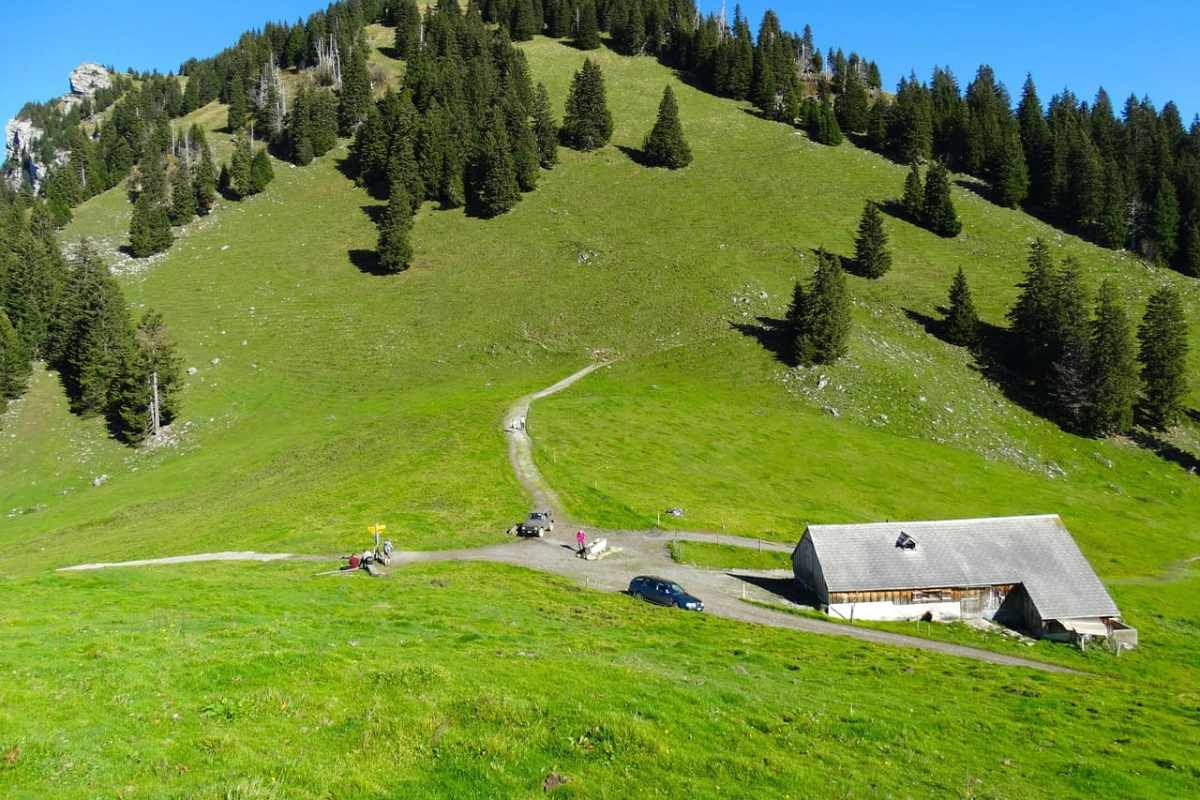
Above the tree line lie some of the most sensitive habitats in Switzerland. Alpine meadows, rocky grasslands and dwarf-shrub heaths are habitats for specialised species that depend on low-disturbance conditions. The growing season is short, the soils are thin, and the restoration of damaged areas takes a very long time or fails altogether.
This is where the priority should lie — with wild animals and biodiversity, not with the expansion of an already heavily subsidised production area. When this area is first used intensively and the wolf is then declared a problem, cause and effect are reversed: it is not the wolf that intrudes into alpine farming, but rather the use that encroaches ever deeper into sensitive wild animal habitats.
It is precisely for this reason that opening up hunting ban areas is so serious. It combines two problematic tendencies: the expansion of human use into sensitive habitats and the subsequent political devaluation of wildlife protection.
Not every alp needs livestock
Another blind spot in the current debate: it is treated as though every alp must necessarily be stocked with livestock in order for the landscape to remain «livable». That is not true. The most beautiful and ecologically most valuable areas of Switzerland are often precisely those in which extensive animal husbandry is no longer pushed – such as the Swiss National Park or landscapes like the Centovalli. There, forests, wild animals and alpine habitats can develop largely free of the pressure of animal production.
No one has a fundamental right to an alp with sheep or cattle – least of all where herd protection is not seriously implemented or is declared «impossible». Anyone who cannot or will not protect their livestock on an alp simply has no business being there. A responsible policy would have to state this clearly: in conflict-prone and sensitive locations, it is more consistent to forgo animal husbandry rather than forcing the wolf to adapt and opening up protected areas. Whoever voluntarily chooses to make use of such areas also bears the responsibility of doing so in a way that does not make wild animals and ecosystems pay the price.
Esther Friedli and the reality of the animal industry
Politically, behind this wolf and alpine farming line stand figures such as Esther Friedli. She presents herself as a defender of alpine farming and likes to speak of a supposed «alpine farming ecosystem». At the same time, she supports an animal industry in which more than 80 million animals are killed every year in Switzerland, above all chickens, plus millions of pigs, cattle, sheep and goats.
Anyone in Bern who rhetorically elevates Alpine farming to a sacred natural institution, yet politically safeguards these slaughter figures, is doing above all one thing: damage control for a production system that would not function without cheap meat and high animal numbers. Within this narrative the wolf serves as a convenient scapegoat. It distracts from the real question of how many livestock animals this country can actually sustain without further overburdening biodiversity, the climate and wild animals.
This is precisely where the contradiction lies: on the one hand, the wolf is portrayed as a «danger» to a supposed Alpine-farming ecosystem. On the other hand, the industrial and semi-industrial killing of over 80 million animals per year is defended as a matter of course and worthy of protection. Anyone who takes this seriously quickly realises: this is not about nature, but about interest-group politics. The wolf stands in the way because it makes visible that animal production in its current form is neither ecologically nor ethically fit for the future. «The biomass of wild-living mammals worldwide now amounts to only around 3 to 4 per cent. About two-thirds is accounted for by livestock, and just under a third by humans.»
International criticism of Swiss wolf policy
With its kill policy, Switzerland is under the scrutiny of international observers. The Bern Convention obliges the contracting states to ensure the preservation of protected species. The competent body has already criticised Swiss practice and expressed doubts about threshold values, justifications and compatibility with the idea of protection.
At the same time, large numbers of wolves have already been regulated or released for killing in recent years. Dozens of kills per season have become the new normal. Against this backdrop, the new proposal does not look like a cautious correction, but like a further step towards permanent escalation.
What is really at stake politically
The proposal is being sold as a pragmatic answer to conflicts with livestock. In reality, it is also about questions of power: who defines what a protected area is still worth? Who decides whether research or lobbying pressure counts? And why, of all animals, is one exception after another being created for the wolf, even though the effectiveness of this strategy is poorly substantiated?
The debate becomes particularly cynical when the same political camp morally elevates alpine farming while simultaneously defending a system in which more than 80 million animals are slaughtered in Switzerland every year. The wolf is staged as a disturbance, while the industrial and semi-industrial use of animals is taken for granted.
An honest approach to the conflict would have to name both: the protection of wild animals and the reality of animal production. Anyone who makes the wolf a scapegoat diverts attention from the real question of how much use sensitive landscapes should still be able to bear at all.
What is needed now
A credible policy would do three things. First: defend hunting ban areas as genuine protected spaces and not open them up for short-term interests. Second: make herd protection a priority, because its effectiveness is far better proven than that of kills. Third: stop romantically marketing the alpine region as an «alpine farming ecosystem» and instead recognise it for what it largely is: a sensitive wildlife and natural habitat whose limits of tolerance have long since been reached or exceeded.
The current proposal goes in the opposite direction. It weakens protected areas, normalises kills and rewards the kind of rhetoric that ignores scientific uncertainties and turns the wolf into a symbolic adversary.
Anyone who wants a future-proof wolf policy must reject this course. Not because every use of the Alps would be wrong, but because protected areas must deserve their name, because herd protection works better than shooting and because wild animals in Switzerland deserve more than ever new exemptions from protection law.
Support our work
With your donation you help to protect animals and give their voice a hearing.
Donate now →