New hunting act in Lower Saxony: progress and setbacks
The new Lower Saxony hunting act brings genuine animal welfare progress, but weakens state control over hobby hunting. An assessment from a Swiss perspective.
On 23 June 2026, Lower Saxony adopted a new hunting act.
The responsible minister Miriam Staudte (Greens) sells it as «more animal welfare, less bureaucracy». A closer look reveals: both are partly true, and both have a flip side. The act brings genuine animal-welfare-relevant progress, but elsewhere weakens state control over hobby hunting. An assessment from a Swiss perspective.
The progress: what really improves
Several points of the act are, from a wildlife protection point of view, long overdue and deserve recognition. The use of dogs in natural burrows, the so-called earth hunting of foxes and badgers, is being banned. The ministry's justification is remarkably candid: this form of hunting carries a high risk of injury for dogs and hunted animals, with earth dogs repeatedly having to be buried and dug out, destroying natural habitats in the process. This is exactly what animal welfare organisations have been criticising for years.
Furthermore, kill-traps are banned in principle, with a single exception. Live traps may, from 2028, only be operated with digital alarm devices, in order to shorten the period of stress for the trapped animal. Poaching dogs may no longer be shot, only captured. The killing of poaching cats is being restricted. And particularly telling: hunting enclosures for commercial hunting are being opened up after a five-year transition period, because, according to the ministry, they are «neither in keeping with hunting ethics nor with the times» — an admission that comes even from hunting circles.
Improvements are also being made to education: the hunting examination was previously possible without a prior training course; in future this is mandatory. And with regard to fawn rescue, those authorised to hunt must in future tolerate that rescue measures are also carried out by the land managers if the hunting community itself remains inactive.
The flip side: where control is lost
But behind the label of «reducing bureaucracy» also lie measures that weaken state control over hobby hunting. The central point: the kill quotas for roe deer, which until now had to be drawn up annually, are being abolished, according to the ministry on account of their «limited informative value and steering capacity». In future, the «personal responsibility of landowners and hunting lessees» will apply.
The contradiction is remarkable: in training, the state is finally becoming stricter with a compulsory course, while at the same time it withdraws from steering wildlife populations and relies on the self-administration of hobby hunting.
Important for context: this only concerns roe deer. For red deer and for fallow deer, the kill quotas remain in place, now generally as three-year plans. So it is specifically the planning for the most common and most heavily hunted species of cloven-hoofed game that is being dropped. Animal welfare associations warn: this increases the risk that roe deer populations will collapse locally in individual hunting grounds, because no binding official guardrails exist any more.
Also being scrapped is the obligation to display trophies, that is, the official inspection of the animals killed. And with the new coypu toleration obligation, hunting ground holders can be forced to tolerate hunting by third parties, which is justified on the grounds of flood protection.
How risky it is to want to steer the regulation of cloven-hoofed game solely through kill quotas and hunting self-responsibility is demonstrated, of all places, by the canton of Grisons. There, red deer kills have been massively increased since the 1930s – from a few hundred to today regularly several thousand animals per year, without the populations settling at a forest-compatible level. The protection forest continues to suffer, while the authorities try, with ever more new special hunts and technologised hunting methods, to fulfil their own botched plans.
In the Swiss National Park, by contrast, where no hobby hunters are active, the red deer populations have settled at a largely stable level under scientific supervision and without kill quotas. The comparison suggests: more shooting is no substitute for consistent ecological steering, and certainly not for the responsibility of the state to set clear guardrails, instead of leaving population management to hobby hunting.
The wolf: from nature conservation into hunting law
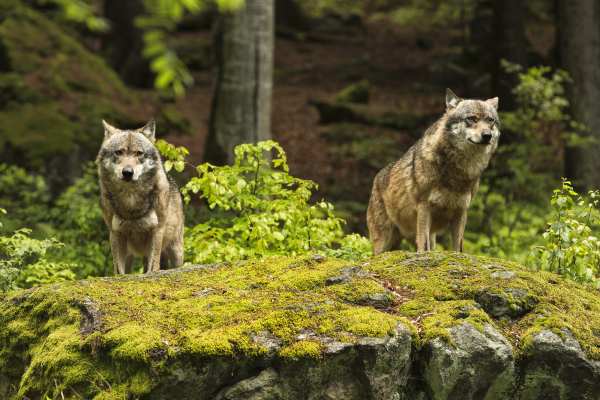
The politically most explosive part concerns the wolf. Since 2 April 2026, the wolf in Germany has been subject to federal hunting law. Lower Saxony is newly transferring responsibility for wolf management from the districts to the upper hunting authority in the Ministry of Agriculture. The stated aim: to be able to respond to damage events «quickly, with legal certainty and without bureaucracy through targeted removals».
This is the same logic that has shaped hunting policy in Switzerland since 2023: the predator is redefined from a protected wild animal into a manageable damage factor, the hurdles for kills are lowered, and the decision is moved closer to hunting interests. The fact that this happens in parallel with genuine animal welfare progress makes it politically clever, but no less problematic.
What Switzerland can learn from it
For Switzerland, the Lower Saxony law is instructive in two respects. Firstly, the ban on earth hunting shows that animal-welfare-violating hunting methods can be politically abolished when the will is there. This is precisely what Swiss animal welfare has been demanding for the country's earth hunting for years. Secondly, the abolition of the roe deer kill quotas serves as a warning against giving up state control in the name of cutting bureaucracy.
In Switzerland, the cantons approve the kill plans for cloven-hoofed game independently; the federal government, via the FOEN, is only responsible for protected species such as the wolf and lynx. How effective this planning is can be seen in Grisons: the largest red deer canton plans the kill of just under 5’000 red deer per season and reduces the kill quota for female animals where wolf packs naturally dampen the reproduction rate. In Appenzell Outer Rhodes, the cantonal government sets precise figures each year, for example 594 roe deer in three districts for 2026/27. This control is not bureaucratic busywork, but the hinge between wildlife monitoring and hunting practice.
The lesson for Switzerland is therefore twofold: adopt animal welfare progress such as the ban on earth hunting, but avoid weakening state population control. Anyone who wants to manage wildlife populations responsibly needs official guardrails, not self-administration by hobby hunting.
LET'S STAY IN TOUCH!
We would like to send you the latest news and offers in our newsletter.