Game meat and health risks: What studies show
Lead, parasites and PFAS: The overlooked side of wild game consumption.

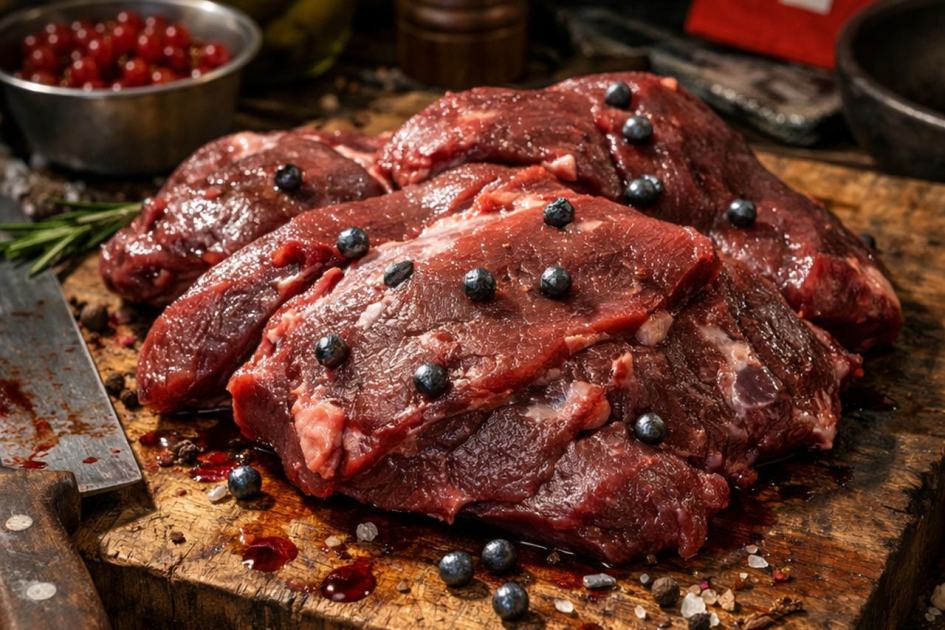
Game meat is marketed as natural and healthy, yet lead residues from hunting ammunition, parasites, bacterial contamination and the absence of mandatory meat inspections make it a food with a specific risk profile.
Swiss and European authorities have acknowledged this risk, with recommendations that amount to a warning for large sections of the population. The FSVO advises children under seven, pregnant women and breastfeeding mothers to avoid game meat when the use of lead ammunition cannot be ruled out.
Lead from hunting ammunition: Invisible, but detectable
When a lead bullet strikes an animal's body, it fragments. The fragments spread through the meat, even far from the bullet channel and wound zone. They are not visible to the naked eye and are neutralised neither by cooking, freezing nor heating.
A study (PLOS ONE) showed that people do absorb lead through the consumption of game killed with lead ammunition. In Switzerland, according to a 2022 investigation by the STS, five out of thirteen samples of game meat products from domestic hobby hunting contained lead concentrations above the limit value of 0.05 mg/kg.
The Federal Food Safety and Veterinary Office (FSVO) recommends that children up to 7 years of age, pregnant women, breastfeeding mothers and women wishing to become pregnant should avoid eating game wherever possible if it cannot be ruled out that the animal was killed with lead ammunition. Germany's Federal Institute for Risk Assessment (BfR) issues the same recommendation.
No safe threshold for lead
Lead is harmful at any concentration; there is no threshold below which no effect occurs. As little as 3.5 micrograms per decilitre of blood can trigger behavioural problems in children. The European Chemicals Agency (ECHA) estimates that a general ban on lead ammunition in hunting across the EU would prevent IQ loss in around 7,000 children per year in households that regularly consume game meat.
Hobby hunter families with high personal consumption are particularly exposed: According to surveys, Swiss hobby hunter households consume up to 90 portions of game meat per year. The Dossier on Lead Ammunition describes how the EU Commission has, since February 2025, been proposing a general ban on lead ammunition for recreational hunting and sport shooting, so far without reaching agreement.
Parasites: The Risk of Trichinosis in Wild Boar
Wild boar are considered high-risk game for trichinellosis, a zoonosis caused by the roundworm Trichinella spiralis. Infection can occur through insufficiently heated meat and leads to serious muscle inflammation.
In Switzerland, there is a requirement for trichinella testing of domestic and wild pigs. However, this control covers only a portion of the game meat actually consumed. What is privately hunted, field-dressed, and consumed is not subject to standardized meat inspection — unlike slaughterhouse animals, whose entire processing chain is documented and monitored.
Hygiene Risks: What Happens Between the Shot and the Plate
Commercial slaughter is governed by strict standards: stunning, immediate bleeding, cooling according to defined protocols, separation of meat from intestinal contents, and continuous documentation. In hobby hunting, none of these steps are standardized.
After death, autolysis and bacterial growth begin immediately. Heat, long lying times in the field before retrieval, fly contact, dirt, fur, and soil all increase contamination. In the case of an abdominal hit — a common shot outcome — intestinal contents leak out and substantially contaminate the meat. Stress caused by driven hunts, pressure from dogs, and fleeing alters the pH of the meat and increases oxidative processes that lead to faster spoilage.
Food Standards Scotland (2020) identified an elevated risk of STEC contamination (Shiga toxin-producing Escherichia coli) in game meat. The Dossier on Game Meat in Switzerland summarizes these risk factors and notes: «Regional» is not a hygiene or health certification, but a statement of origin with no defined standards.
The Myth of “Organic Game”
Game meat is frequently marketed as «organic wild»: naturally raised, free-living, without antibiotics. Yet «organic wild» is not a recognised certification. There are no defined standards, no inspections, no mandatory documentation. What appears at the point of purchase to be a nature-close product is a legally meaningless marketing term.
In the province of Ontario (Canada), game from recreational hunting may not be sold commercially, because it does not meet the legal requirements for inspection and traceability. In Switzerland, direct sales without standardised controls are possible — a regulatory gap that the Dossier on Game Meat in Switzerland explicitly addresses.
Wildlife diseases and their transmission routes
Recreational hunting does not only affect the meat that ends up on the plate — it also affects the dynamics of disease within wildlife populations. The Dossier on Hunting and Wildlife Diseases notes that fox hunting increases the risk of Lyme disease, tick-borne encephalitis (TBE), and hantavirus, because foxes naturally regulate mouse populations. Fewer foxes means more mice, more ticks, and more zoonotic cases.
The fox tapeworm (Echinococcus multilocularis) illustrates the same relationship: a four-year study conducted in Nancy documented that infestation rates in hunted areas rose from 40 to 55 percent, while remaining stable in the control area. The study authors’ conclusion: fox hunting is «an inappropriate paradigm» for controlling the fox tapeworm.
African swine fever: recreational hunting as a risk factor
African swine fever (ASF) is a viral disease that is almost invariably fatal for pigs but poses no danger to humans. However, the European Food Safety Authority (EFSA) and other expert bodies note that intensive recreational hunting of wild boar can accelerate the spread of the virus, as it disturbs animals, scatters them over wide areas, and thereby creates new contact zones. The Dossier on Swine Fever as a Justification for Recreational Hunting documents how ASF is nonetheless instrumentalised as an argument in favour of more recreational hunting.
The most significant transmission route for ASF over long distances is human activity: via contaminated meat products, hunting equipment, vehicles, and travel provisions.
Lack of transparency as a structural problem
Anyone who buys game meat — whether at a restaurant, a butcher, or directly from a hobby hunter — generally does not know what ammunition was used to kill the animal, how long it lay before being refrigerated, what wound zone was involved, or whether a follow-up search was necessary. This information is crucial for assessing the risk, yet it is not available.
The FSVO's recommendation is explicitly directed at vulnerable groups. In doing so, it indirectly acknowledges that complete safety cannot be guaranteed for game meat from hobby hunting as long as there is no documentation of lead ammunition use, no standardised hygiene controls, and no transparent labelling of origin.
Conclusion
Game meat is not automatically a safe food. Lead residues from hunting ammunition, parasite risks, hygiene uncertainties, and lack of oversight make it a product that should be transparently labelled — with information on the type of ammunition, shot placement, time of refrigeration, and the results of meat inspection. As long as these standards are absent, marketing game meat as a particularly healthy or natural food is misleading. Authorities have acknowledged the risk profile, but have so far not introduced any mandatory standards.
Sources
- FSVO (Federal Food Safety and Veterinary Office): Consumption recommendations for game meat
- BfR (German Federal Institute for Risk Assessment): Recommendations on lead in game meat
- STS (Swiss Animal Protection): Investigation into lead in game meat, 2022
- ECHA: Restriction Report Lead in Shot, Bullets and Fishing Tackle, 2023
- Food Standards Scotland (2020): STEC contamination in game meat
- Nancy study on fox tapeworm in hunted vs. non-hunted areas
- EFSA: Opinions on African swine fever and hobby hunting
- TSchG, SR 455; Food Safety Act (LMG), SR 817.0