Forest-Wildlife Conflict: Myth, Browsing Damage and the Hunting Narrative
Hunting pressure as a cause of browsing damage and the concealed role of forestry.

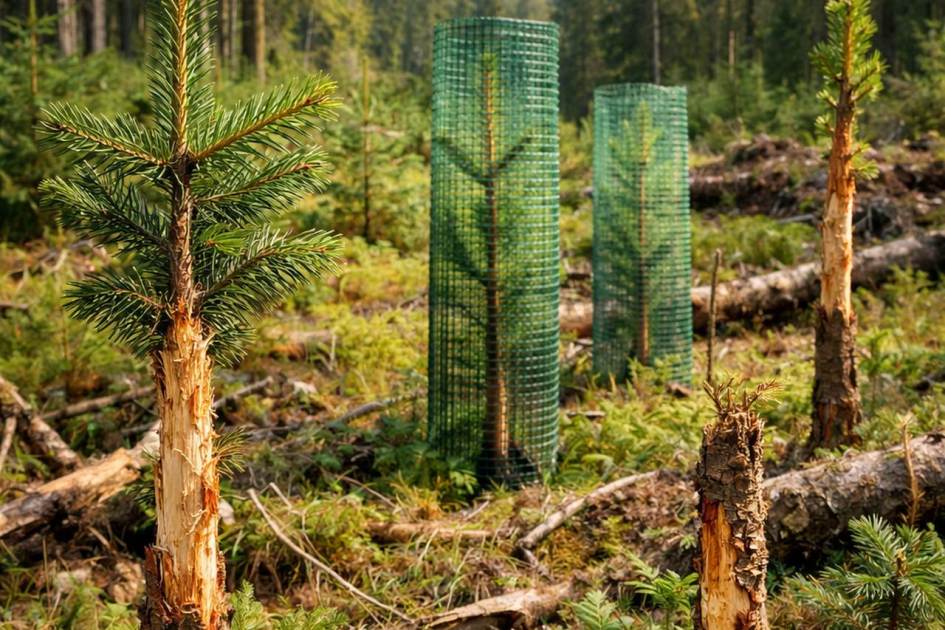
The “forest-wildlife conflict” describes the tension between wildlife behaviour and forestry, yet the hunting lobby systematically inverts cause and effect on this issue.
Roe deer and red deer browse or strip bark from trees, which forestry regards as a problem. What is consistently left unsaid: the problem arises primarily from habitat loss, human disturbance and misguided hunting practices themselves.
What is meant by the forest-wildlife conflict?
The forest-wildlife conflict refers to the tension between the living and feeding habits of wild animals and the interests of forestry. Roe deer and red deer eat buds, shoots and the bark of young trees — a natural behaviour that becomes a forestry problem in the wrong context. When wild animals have no retreat areas, no broad food supply and no undisturbed zones, browsing and bark-stripping become concentrated on specific areas.
The Forest-Wildlife Conflict Dossier shows how this narrative came into being, how it is deployed by the hunting lobby and what research has to say about it.
The role of recreational hunters in creating the problem
Herein lies a decisive contradiction: intensive autumn hunting, particularly the high-season hunt, drives wild animals out of their established habitats into lower elevations and denser forests. In places where wild animals cannot graze undisturbed, they fall back on readily accessible tree shoots. Recreational hunting thus aggravates the very problem it purports to solve.
The Roe Deer Switzerland Dossier analyses why the roe deer — the most frequently shot wild animal in Switzerland — is simultaneously the primary defendant in the forest-wildlife discourse.
Habitat loss as the primary cause
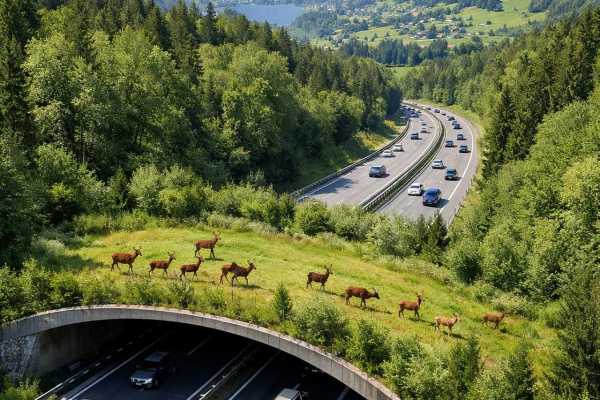
In Switzerland, wildlife has increasingly fewer undisturbed refuges. Intensive agriculture, urban sprawl, ski tourism, hiking tourism, and recreational pressure are reducing viable habitats. Where animals can no longer find extensive, undisturbed foraging niches, they concentrate in what remains. This concentration — not some abstract "overpopulation" — is the true cause of wildlife-related forest damage.
The red deer in Switzerland is particularly affected: its natural migration routes and winter habitats have been largely fragmented by the expansion of human settlements.
What does science say?
Scientific studies demonstrate that browsing damage can be reduced through a combination of extensive habitat design, wildlife corridors, designated quiet zones, and in individual cases targeted interventions. Blanket culling campaigns without habitat adaptation, by contrast, show no lasting effect: wildlife migrates in, and populations adapt to hunting pressure.
The Dossier on Hunting Myths examines the common claim that recreational hunting reduces browsing damage and assesses its scientific basis, arriving at a sobering conclusion.
The political exploitation of the forest-wildlife conflict
The narrative of the forest-wildlife conflict is a perennial fixture in Swiss hunting policy, because it legitimises culls and implies the ecological necessity of recreational hunting. Forestry interests and hunting interests converge here: forestry operations demand wildlife reduction, and the recreational hunters offer themselves as service providers. What falls by the wayside is a factual analysis of the actual causes and solutions.
The Dossier on the Hunters' Lobby in Switzerland shows how this narrative is politically cultivated and enshrined in cantonal hunting legislation.
Predators as regulators
Ironically, the most effective "regulation" of wildlife populations would be the restoration of functioning predator-prey systems. Wolf and lynx regulate wildlife populations sustainably, selectively, and without human intervention. They also alter the behaviour of their prey: deer and roe deer that fear predators do not linger in one place and browse less.
The lynx in Switzerland is a well-documented example: in areas where lynx are present, browsing damage is demonstrably lower.
Forest transformation instead of wildlife reduction
The long-term solution to the forest-wildlife conflict lies not in the rifle, but in the conversion of forests into mixed forests with a broad food supply, in the establishment of quiet zones and wildlife corridors, and in the reduction of disturbances caused by tourism and recreational traffic. Such measures are more effective, more cost-efficient, and more consistent with animal welfare standards than intensive hunting.
The Dossier Wolf in Switzerland discusses what role natural regulation can play in forest health.
Conclusion
The forest-wildlife conflict is real, but recreational hunting is not its solution. The hunting lobby's narrative inverts cause and effect: wildlife is portrayed as a problem that can only be managed with a shotgun. In reality, the conflict arises from habitat loss, disturbance pressure, and hunting practices that drive wildlife into spaces where browsing damage becomes inevitable. An honest forest policy would not pit wildlife interests against forestry interests, but would consider both within an integrated concept.
Sources
- JSG (SR 922.0): Federal Act on Hunting
- Swiss Biodiversity Strategy
- Federal Hunting Statistics (FOEN/Wildtier Schweiz)
Further Content
- Forest-Wildlife Conflict
- Roe Deer Switzerland
- Red Deer Switzerland
- The Lynx in Switzerland
- Hunting Myths
- Wolf in Switzerland
More on the subject of recreational hunting: All Dossiers at a glance bring together fact checks, analyses and background reports. What the research says about this is shown by Hunting fact-checked: the state of research.
The position of IG Wild beim Wild: IG Wild beim Wild rejects recreational hunting. Our model is the canton of Geneva, which has managed without recreational hunting since 1974: without hunting seasons, without hunting dogs, without driven hunts, without high seats, without the animal cruelty and crime that go hand in hand with hunting season elsewhere. What has worked there for over fifty years disproves every position paper by JagdSchweiz. An association that bases its policy on claims it refutes in its own documents is not a professional organisation, but a factory for misinformation.