Wildlife Corridors in Switzerland: Function, Facts and Criticism of Hunting
Corridors as lifelines of biodiversity and the role of hobby hunters.

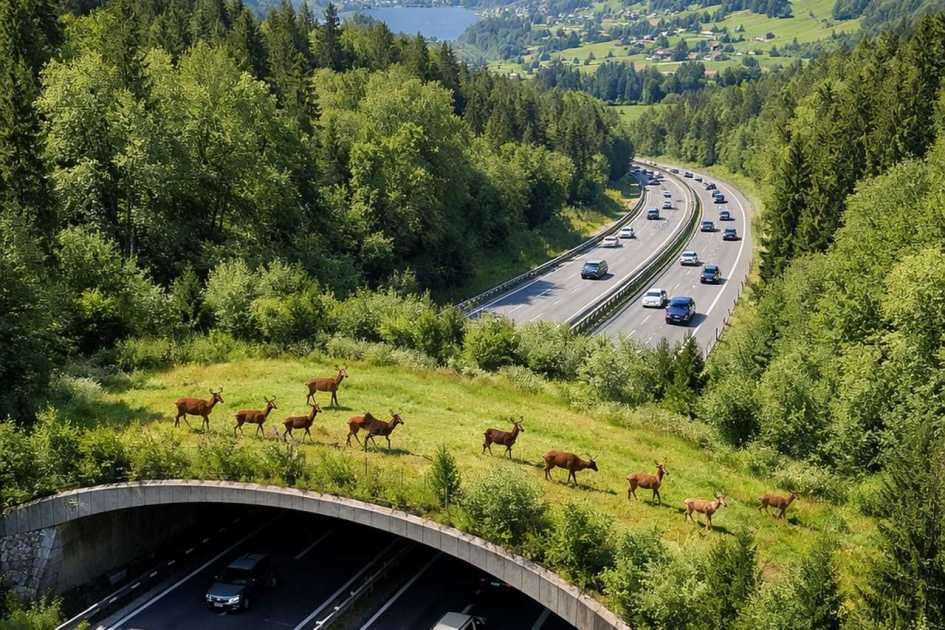
What are wildlife corridors and why are they needed?
Wildlife corridors are connecting axes between isolated habitats that enable wild animals to move, disperse and exchange genetic material.
In Switzerland, over 300 such corridors have been identified, many of them interrupted by roads, settlements and intensive land use. Culling does not solve the problem of habitat fragmentation; on the contrary, hobby hunting intensifies the stress situation and drives animals into unsuitable areas.
What is a wildlife corridor and how does it work?
A wildlife corridor is a strip of landscape or a connecting axis that links two or more habitats. It must be wide enough for animals to want and be able to use it, and it must be sufficiently undisturbed for animals to actually pass through it. A corridor on paper that is bisected by a heavily trafficked road or an unsecured industrial site does not fulfil its function.
Corridors serve not only the migration of individual animals, but the long-term genetic exchange between populations. Without this exchange, inbreeding, declining reproduction rates and ultimately the local collapse of entire populations are at risk. This is not theory — it is already a reality for the Swiss lynx : both subpopulations in the Alps and the Jura suffer from severe genetic impoverishment because the populations are not connected to one another.
How many wildlife corridors are there in Switzerland and what condition are they in?
The Federal Office for the Environment (FOEN) has identified over 300 wildlife corridors in Switzerland. Many of these are interrupted or severely impaired in their function, by motorways, railway lines, settlement areas and intensive agriculture. The national highway A1 in the Mittelland is one of the greatest barriers for migratory large mammals such as the red deer, which seasonally migrates between summer and winter habitats, often covering several dozen kilometres in the process.
Wildlife bridges and underpasses are being built, but slowly. In the meantime, many corridors remain nominally present but biologically ineffective. This has direct consequences for genetic diversity and the long-term survival of populations that depend on connectivity.
Why are wildlife corridors crucial for biodiversity?
According to the Federal Biodiversity Strategy, the main threats to biodiversity in Switzerland are not hobby hunters or predators, but habitat loss due to urban expansion, intensive agriculture, pesticides, light pollution, climate change, and lack of connectivity. The latter is decisive: an animal confined to an isolated habitat cannot respond to change. It finds no mates, it finds no alternative areas, it goes locally extinct.
Wildlife corridors are therefore not a luxury, but a fundamental prerequisite for functioning ecosystems.Hunting and Biodiversity shows how hobby hunting, by displacing wildlife into forests, exacerbates fragmentation: animals avoid open terrain, retreat into refuges, and no longer use corridors.
What is the connection between hobby hunting and fragmentation?
Hobby hunters hunt predominantly within game districts or under licences; they have no interest in animals migrating away. At the same time, hunting pressure causes lasting stress behaviour: wildlife shifts to nocturnal activity, avoids open terrain, and retreats into dense forests. This is devastating for corridors, because an animal that must pass through a corridor is particularly exposed during this transit phase.
Studies confirm that red deer in areas with high hunting pressure become predominantly nocturnal and avoid open passages (ZHAW/HAFL 2024). This means: even if a corridor is structurally in place, it will not be used by stressed, hunting-pressured animals.The forest-wildlife conflict arises not least because animals are concentrated in forests and cause more browsing damage there than they would in an undisturbed, wide-ranging habitat.
Which wildlife species are particularly dependent on corridors?
Large mammals that depend on extensive home ranges suffer most from fragmentation. The red deer requires connected landscapes to move between summer and winter habitats and to enable genetic exchange. The wolf returned to Switzerland naturally after decades of absence via Italy and France, proof that wildlife can travel vast distances when corridors function.
The lynx requires a home range of 100 to 300 km² (males) and 50 to 150 km² (females) respectively. The isolation of the Jura population from the Alpine population is today one of the greatest threats to the long-term survival of Swiss lynx. Wildlife accidents on roads are one of the most common non-natural causes of death, a direct product of fragmentation.
Do wildlife corridors also help smaller species?
Yes. Corridors are not only relevant for large mammals. Amphibians, reptiles, insects and plants also depend on connected habitats. In fragmented landscapes, even small roads or fences can prevent the dispersal of amphibians. Hedgerows, streams, field copses and edge habitats form a network that fulfils the function of wildlife corridors for many species.
The Geneva model of professional wildlife management demonstrates what intensive habitat connectivity can look like: ten percent of agricultural land was designated as high-quality ecological compensation areas. The result: from a few hundred to up to 30,000 overwintering waterfowl, and the restoration of populations of rare species. Alternatives to hobby hunting such as habitat management, rewilding and habitat connectivity are demonstrably effective.
What role do natural predators play in corridor use?
Predators such as wolves, lynx and foxes alter the behaviour of their prey, and this has a direct impact on corridor use. In areas where wolves are present, deer avoid certain zones, allowing vegetation to recover and making the landscape structurally richer. This phenomenon, known as the “Landscape of Fear”, has been extensively documented in Yellowstone: with the return of wolves, willows and aspens regenerated, in turn benefiting beavers, fish and birds.
In Switzerland, studies by WSL (Kupferschmid/Bollmann 2016) show that wolf presence changes the spatial use of red deer and reduces browsing on fir, maple, and rowan in core areas.Hunting and Biodiversity documents how natural predators regulate more precisely and sustainably than recreational hunters.
What does hunting criticism specifically demand for wildlife corridors?
From a hunting-critical perspective, what is needed first is the expansion of wildlife bridges and underpasses over national roads and rail infrastructure, with sufficient width and accompanying structures. Second, rest zones (wildlife quiet zones) are needed along corridor axes, where recreational hunting, mountain biking, off-leash dogs, and other disruptive activities are restricted or prohibited. Third, the protection of natural predators is required, as keystone species that indirectly make corridors usable.
The Alternatives to Recreational Hunting explicitly identify wildlife corridors as one of the central non-lethal measures for an effective biodiversity policy. Their expansion also aligns with the federal biodiversity strategy, which aims to significantly increase the proportion of effective protected areas by 2030.
Conclusion: Corridors Instead of Culling
Wildlife corridors are not a luxury or the fantasy of nature romantics. They are fundamental biological infrastructure, and their absence or degradation costs species their long-term survival capacity. Culling does not help. On the contrary: hunting pressure drives wildlife into refuges, causes them to avoid corridors, and prevents natural dispersal.
The solution lies in interconnected, undisturbed, structurally rich landscapes; in natural predators that ecologically and intelligently regulate the behaviour of their prey; and in professional wildlife management following the model of the Canton of Geneva, which protects habitats rather than shooting living beings.
Sources
- FOEN: Over 300 identified wildlife corridors in Switzerland
- Federal Biodiversity Strategy Switzerland (2012/2017)
- ZHAW/HAFL (2024): Red deer spatial use and hunting pressure
- WSL, Kupferschmid/Bollmann (2016): Wolf presence and browsing reduction
- Yellowstone Wolf Reintroduction: Ripple & Beschta (2012), Landscape of Fear
- Canton of Geneva: Loi sur la faune (ban on recreational hunting since 1974)
Further Content
- Hunting and Biodiversity
- Forest-Wildlife Conflict
- Alternatives to Recreational Hunting
- Red Deer in Switzerland
- Wolf in Switzerland
- The Lynx in Switzerland
Unterstütze unsere Arbeit
With your donation, you help protect animals and give them a voice.
Donate now →