Valais had a mother animal shot as a "lone wolf", then four pups turned up
Game wardens killed the she-wolf F168 in the Rappental valley, even though indications of offspring had been documented for months. The post-mortem report by the University of Bern has been available since the end of October 2025, but the canton kept it under wraps for eleven months. State Councillor Christophe Darbellay had previously dismissed critics as "militant animal welfare activists".

«Four Pups»
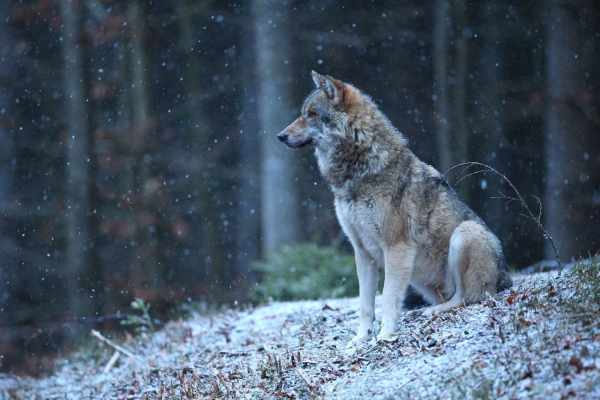
On 4 August 2025, Valais game wardens killed a she-wolf with the identifier F168 in the Rappental valley.
The canton had ordered the kill four days earlier, citing two livestock kills in protected situations. What was explicitly authorised was the kill of a lone wolf, i.e. an animal with no pack ties. It is precisely this classification that lies at the heart of the scandal.
Because three days after the shot, the cantonal wolf map showed an explosive entry: in the neighbouring Binntal valley, a wildlife camera filmed four wolf pups. Experts from the University of Bern examined F168's carcass. Their finding is unambiguous. The she-wolf had given birth in May 2025. The Federal Office for the Environment confirmed the results upon enquiry. The report has been available since the end of October 2025. No one made it public.
Why the classification as a "lone wolf" is so sensitive
A canton decides on the kill of a single animal on its own authority. If it wants to regulate an entire pack, it needs the approval of the federal government, and parent animals may only be shot between June and January. Anyone who summarily declares a nursing or leading she-wolf to be a packless lone wolf thereby circumvents the entire federal oversight. This pattern is no isolated case in Valais, as we documented in the case of the wolf kill in Staldenried , in which the federal government had to take the canton to court.
That F168 could have been a mother animal had long been suspected. As early as September 2025, the «Walliser Bote» made the canton's own monitoring data public. It documented the presence of a wolf pair within what later became the kill perimeter. A game warden noted in April that the female might be pregnant, with visible teats. In July, a game warden recorded a possible sign of lactation. So the evidence existed before the kill, not only afterwards.
Christophe Darbellay's statements
This is precisely where the public appearances of the responsible State Councillor become a genuine political issue. When the Gruppe Wolf Schweiz accused the canton of having ordered the kill without sufficient grounds, Christophe Darbellay rejected this. It was, he said, not scientifically proven that the mother animal of the new pack had been killed; one had to wait for the University of Bern's report.
This statement is now coming back to haunt the department. The report, whose findings were supposedly still awaited, was in fact available from the end of October 2025 onwards and confirmed exactly what the critics had said. Instead of transparency, silence followed. The document remained under lock and key for eleven months. To this day, the responsible authority declines to comment on why.
The tone is also noteworthy. Darbellay referred to members of the Gruppe Wolf Schweiz as «militant animal welfare activists» who deliberately spread unsubstantiated claims. For David Gerke, managing director of the Gruppe Wolf Schweiz, the finding now confirms the criticism voiced at the time: the canton's approach was demonstrably improper. So it was not the critics who spread unsubstantiated claims, but the authority that withheld incriminating evidence.
Darbellay shows the same rhetoric towards the federal government. In the Staldenried case, he accused the Federal Office for the Environment in the «Walliser Bote» of behaving in an «overly bureaucratic» manner, while the canton made its decisions «on the ground». This pattern of thinking, according to which proximity to the field outweighs law and science, runs through the whole of Valais wolf policy, as our analysis of Valais wolf management shows in detail.
Four pups, vanished without a trace
What became of the four Binntal pups remains unclear to this day. The canton no longer disputes the killing of a mother animal, but stresses that it is unclear whether F168 was the mother of these pups. In 2026, no wolf pack was detected in the Binntal anymore. After August 2025, all trace of the young animals is missing. Without genetic identification, the office states, further investigation is practically impossible. Four pups, documented shortly after the killing of their presumed mother and then vanished, no longer appear in any record.
No oversight takes place
No authority has ever reviewed the legality of F168's kill. No one challenged the order. Since the beginning of 2024, the Federal Office for the Environment has lodged an appeal against only a single such order nationwide, and of all places it concerned Valais. This shows just how patchy the oversight of cantonal kill decisions really is. Anyone who declares mother animals to be lone wolves, withholds incriminating expert reports, and brands critics as militant can, in practice, expect little resistance.
And even where a case does end up in court, the consequences remain symbolic. For the shot she-wolf of Herbriggen, the Valais judiciary recently imposed a fine of 300 francs, and the hunting licence remained valid. Where killing a strictly protected predator costs so little, the law has no deterrent effect. We continuously document exactly this pattern of missing oversight, minimal sanctions, and official silence in our live ticker on the Valais 2026/27 hunting season and in the Valais wolf report 2025/2026.
More on the subject of recreational hunting: In the dossier Poaching and hunting crime in Switzerland we document cases, legal questions and recurring patterns. The scientific evidence is presented in the overview Studies on the Effects of Recreational Hunting.
The position of IG Wild beim Wild: IG Wild beim Wild rejects recreational hunting. Our model is the canton of Geneva, which has managed without recreational hunting since 1974: without hunting seasons, without hunting dogs, without driven hunts, without high seats, without the animal cruelty and crime that go hand in hand with hunting season elsewhere. What has worked there for over fifty years disproves every position paper by JagdSchweiz. An association that bases its policy on claims it refutes in its own documents is not a professional organisation, but a factory for misinformation.

All articles are written by IG Wild beim Wild as well as by external co-authors. Research, structuring and editorial processes may be supported by AI-assisted tools.
Support our work
With your donation you help protect animals and give their voice a hearing.
Donate now →