Double life of a scandal journalist: plagiarism in the Federal Palace, ruin in the hunting forest
The recreational hunter and deputy editor-in-chief of «Nebelspalter» copied texts, coordinated legal campaigns to destroy animal welfare advocates, and failed in court. Now his NZZ career is history.
«The green network of favouritism»
He was considered one of the most influential right-wing opinion-makers in German-speaking Switzerland.
Dominik Feusi, deputy editor-in-chief of «Nebelspalter», recreational hunter and close confidant of publisher Markus Somm, was on the verge of what seemed to be the peak of his career: on 1 July he was due to move to the business desk of the Neue Zürcher Zeitung (NZZ) as a Federal Palace correspondent. Instead, his reputation now lies in ruins.
But the real scandal is bigger than a case of plagiarism.
The milieu that shaped Feusi
To understand the Feusi case, one must understand what «Nebelspalter» has become under Markus Somm. The former satirical magazine was deliberately transformed into a far-right platform: close to the SVP, hunting-friendly, and geared towards culture war. Feusi was not a marginal figure in this, but its face and driving force. Together with Somm, he runs the podcast «Bern einfach», the flagship of this opinion-making.
This milieu is no coincidence. As we documented in our article on the overlaps between recreational hunters and right-wing extremists, far-right circles and organised recreational hunting share far more than just a love of weapons: the same mindset of enemy images, the same readiness to use violence as a solution to problems, the same sect-like insulation against criticism. Terms such as «predator», «pest» or «plague» are not biological categories, but rhetoric of devaluation intended to legitimise killing. And journalists like Feusi carry this rhetoric straight out of the hunting forest and into public discourse.
Somm himself narrowly failed to become NZZ editor-in-chief in 2015, due to resistance from the editorial team. Now Feusi, his closest ally, was meant to step in. A Trojan horse from the right-wing opinion-making milieu.
90 per cent lifted from London
Research by Blick has now revealed that in October 2024, Feusi copied around 90 per cent of a Middle East analysis from the British daily newspaper «Telegraph», translated it into German, and published it under his own name at «Nebelspalter». The original text was by «Telegraph» columnist Allister Heath. Feusi did not just take over paragraphs, but also the structure, arguments, historical examples, metaphors and conclusions.
«Nebelspalter» editor-in-chief Somm attempted to keep the incident under wraps. The article was subsequently amended to include source citations, with a note stating that the first version had «erroneously omitted the sources». A brazen trivialisation of outright plagiarism.
When Blick confronted the NZZ with its findings, Feusi's contract was terminated before his very first day of work. Feusi publicly expressed remorse: «There is absolutely no excuse for what I did. This is clear plagiarism, and something like this must never happen.»
Yet while he presents himself as contrite in public, his private conduct has long told a completely different story.
An independent journalist had to leave before Feusi arrived
What has received hardly any attention in the reporting on the plagiarism scandal is the real collateral damage: when it became known within the NZZ editorial team that Feusi was to join as the Federal Parliament correspondent, long-serving, pro-European Federal Parliament bureau chief Fabian Schäfer resigned. It is an open secret in the industry that Feusi was the reason for this prominent departure. Shortly before that, the renowned economics expert Hansueli Schöchli had already left the NZZ for political reasons.
That is the real pattern: Feusi alone is not the problem, but rather the pull generated by his type of journalism. Independent, serious editors leave an outlet when right-wing opinion-makers move in. This is not an isolated observation, but a structural phenomenon that is becoming ever more apparent at the NZZ under editor-in-chief Eric Gujer, who has for years consistently steered the paper towards a staunchly right-wing liberal stance.
Hunting lobby, intimidation and coordinated abuse of the judiciary
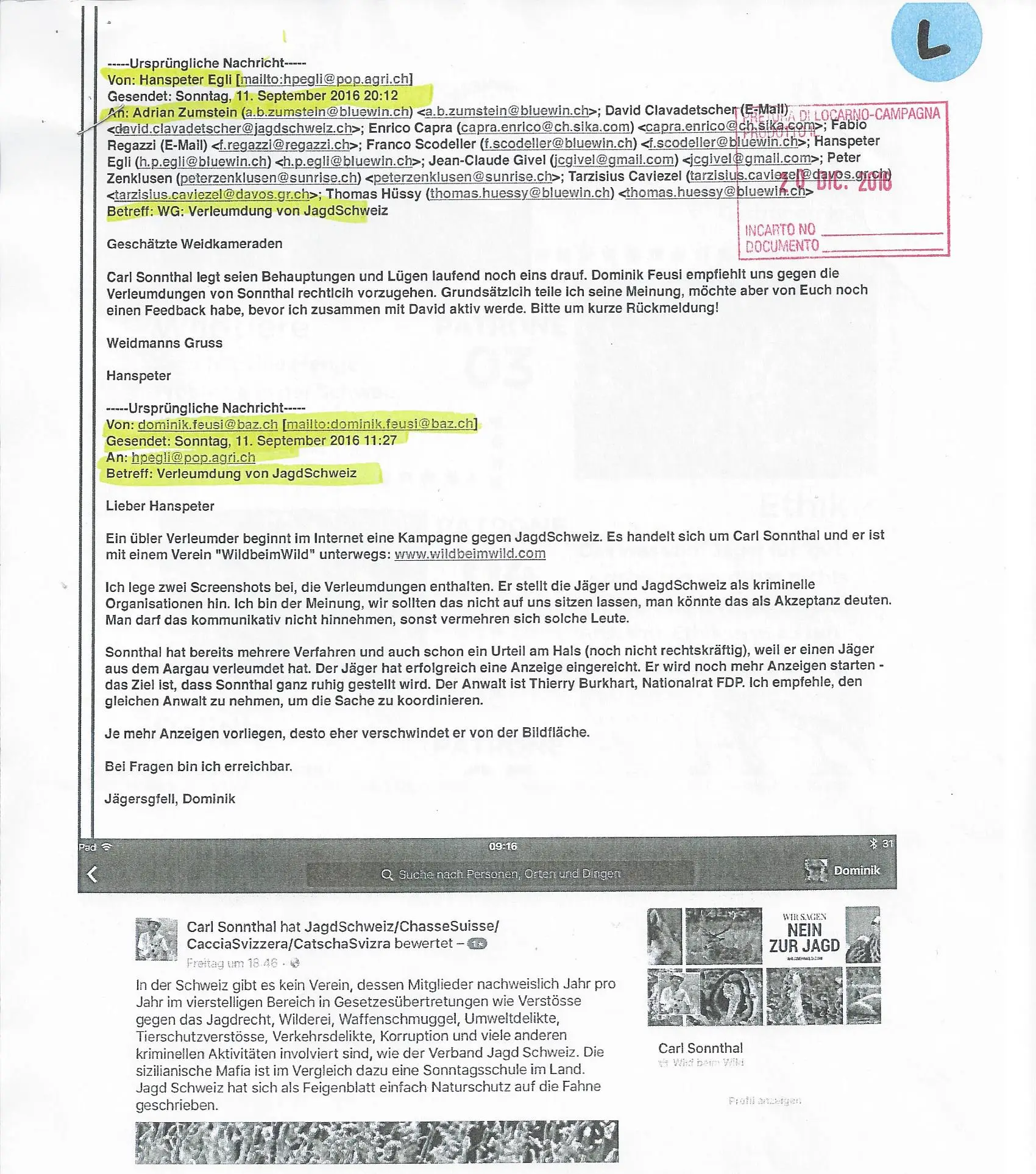
Alongside the plagiarism, a leaked email exchange shows how Feusi operated outside the editorial office. In messages to hunting official Hanspeter Egli, he drafted an aggressive campaign against hunting critic Carl Sonnthal and the IG Wild beim Wild. His goal was not factual debate, but organised destruction of livelihoods.
In the jargon of a hardliner, Feusi wrote: «He will launch even more complaints. The goal is for Sonnthal to be completely silenced. […] The more complaints there are, the sooner he'll disappear from the scene.»
This is not journalism. This is coordinated abuse of the justice system as a tool of intimidation: a flood of criminal complaints designed to wear down critical voices financially and psychologically. The exact same logic that far-right circles have used for years against unwelcome opponents, applied here to the recreational hunting lobby's fight against its critics.
Cronyism reaching into federal politics
Feusi recommended that the association JagdSchweiz use the same lawyer, «to coordinate the matter» – namely Thierry Burkhart, FDP member of the Council of States. A journalist who was supposed to report independently from the Federal Palace was simultaneously exploiting top politicians and criminal law to silence animal welfare critics.
This is the circle closing: far-right media, the recreational hunting lobby, and federal politics as a coordinated network that doesn't answer criticism, but destroys it. That Feusi, as the NZZ's Federal Palace correspondent, should have been reporting on precisely these entanglements is the bitterest irony of the entire case.
A resounding slap in the face before the court
The intimidation tactic failed completely. The association JagdSchweiz dragged the IG Wild beim Wild before the criminal court of the canton of Ticino in Bellinzona on charges of alleged defamation. The result: a complete acquittal on all counts. Judge Siro Quadri stated unequivocally that fact-based criticism of recreational hunting is a legally permissible expression of opinion in the public interest. The association also came away bloodied before the civil court in Locarno: the proceedings were completely suspended.
The legally binding verdict sets a clear standard: anyone who takes part in societal debates cannot lock away inconvenient truths with criminal complaints. More on the crime associated with recreational hunting we document on an ongoing basis.
A system that exposes itself
The Dominik Feusi case is no accident. It is the logical result of a milieu that places opinion above craft, ideology above integrity, and networking above independence. A recreational hunter and right-wing opinion-maker who fabricates texts, wears down critics with floods of complaints and enlists federal politicians for lobby campaigns is not a journalist. He is the extended arm of a lobby.
And the fact that, with his rise at the NZZ, a serious federal parliamentary journalist left the paper before Feusi had even worked a single day says everything about the weight this type of journalism exerts on independent editorial offices.
Whoever sits in the glasshouse of fabricated articles should not try to crush the existence of animal welfare advocates through mass complaints.

All articles are written by IG Wild beim Wild as well as by external co-authors. Research, structuring and editorial processes may be supported by AI-assisted tools.
Support our work
With your donation you help protect animals and give their voice a hearing.
Donate now →