RTR hunting licence: ombudsman shields broadcaster, UBI to decide
Toni Hess sees no problem in the kill hotline, the hunting licence raffle or the trophy photo competition. 114 people are taking the case to the appeals body in Bern.

Photo: Jacob Hodgson / Unsplash
Smile, Please
The ombudsman of SRG.R, Toni Hess, has rejected the complaint lodged by IG Wild beim Wild against RTR's hunting portal on all counts. According to his final report of 30 October 2026, the kill hotline, the hunting licence raffle and the competition for the “most beautiful” trophy photo do not breach any programme rules. On 2 November, IG Wild beim Wild took the case further to the Independent Complaints Authority for Radio and Television (UBI) in Bern. 114 people are supporting the complaint with their signatures.
We described in detail at the end of September what this is about: on every hunting day, RTR takes reports of kills, raffles a hunting licence among those who report, and lets the public vote for the “most beautiful” trophy photo. A media ethicist has also defended the raffle; what this assessment overlooks, we have likewise documented.
What the ombudsman decided
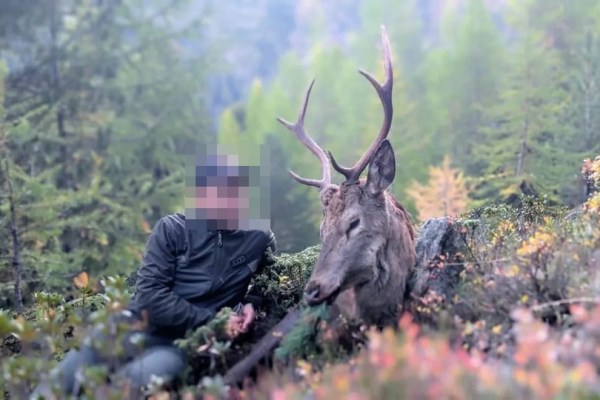
Hess considers all the objections unfounded and refrains from making any recommendation to RTR. On the trivialisation of violence he writes: “A realistic depiction of hunting is simply not possible without images of killed animals.” The award-winning photos showed the animals “in a respectful manner”. As evidence he states: “In particular, the areas where the animals had been gutted to remove the entrails were in each case covered with fir twigs.” Whether such a photo gallery should be created at all, he says, is a matter of programme autonomy.
On the protection of minors, Hess states that the trophy photos are “part of hunting, and thus part of real life”, and do not endanger minors. The requirement of factual accuracy, he argues, does not even apply, because RTR was not concerned with information but with the “entertaining depiction” of hunting.
What RTR argues
Flavio Bundi, head of distribution, commented on behalf of RTR. 'La Preda' was not running a 'killing game', he said; it was 'a mere random prize draw'. In the photo competition, 'bloody, sensationalist or disrespectful depictions' were excluded from publication. The children's item on the programme 'Minisguard', which explains the necessity of hunting to children, dates from 2021; the deadline for lodging a complaint had expired. RTR had chosen a cantonal game warden to draw the lot in order to underline 'the commitment to law and order'.
RTR confirmed that the Graubündner Kantonalbank is financing the 2027 hunting licence as part of a 'media partnership'. At the same time, the broadcaster announces that it will 'review the labelling in the online teasers and ensure that sponsorships and prize donors are clearly visible to the audience at all times'. During the high hunt this was not the case: on 26 September 2026, the registration page for 'La Preda' contained no mention of the bank whatsoever. RTR has since added it.
Where the final report falls short
Nobody has disputed that RTR may report on recreational hunting. What is objected to is the format: a hotline in which only those who have killed an animal can take part, and a prize draw whose prize is the permission to kill again. No dead animal, no ticket. A picture entered into a beauty contest serves no informational purpose. It is meant to please.
The fir sprigs that Hess cites as a sign of respect prove the opposite. The wound is concealed, the animal is dressed up for the camera, and the killing appears without its consequences. The hunting code of the Grisons Cantonal Licence Hunters' Association, which the ombudsman himself quotes, rejects 'unnecessarily staged depictions of killed game'. And when the ombudsman describes the formats as an 'entertaining portrayal' of hunting, he is describing exactly what the Radio and Television Act prohibits: trivialising violence as entertainment.
Add to that what RTR itself knows. On 12 September 2026, the broadcaster's culture desk summarised a study by the Hochschule Burgenland involving 1’050 young adults: between 96.1 and 98.5 per cent of emotional reactions to photos showing kills are negative, and 73.3 per cent want a content warning before such images are shown. A few weeks later, RTR put exactly such images to a public vote without any warning whatsoever. The final report does not address this.
Hess accepted RTR's claim that bloody images were excluded without checking it. In the RTR gallery for the second week of the hunt, image 8 shows a girl holding a dead chamois in her arms, with blood clinging to the animal's muzzle. RTR selected this image editorially and published it.
The ombudsman did not adopt RTR's objection that the 'Minisguard' item had lapsed. Nor, however, did he assess it: whether a children's item that explains the necessity of killing to children, without any opposing position, is compatible with the protection of young people is a question the final report leaves unanswered.
The way the report is put together is also striking. It reproduces RTR's statement verbatim over four pages, refers integrally to the broadcaster's replies on the question of diversity 'in order to avoid unnecessary repetition', and cites a consideration 'above, E. 4.3' that does not exist in the report.
Children next to dead animals
The complaint to the UBI also objects to the images of children in the photo competition gallery. Four photographs show children beside dead wild animals, from a toddler next to a shot fox captioned 'Content with the first kill' to two children holding the antlers of a dead red deer. In two cases, the names and place of residence in the captions make the children identifiable. We deliberately do not show these images.
The Stiftung Kinderschutz Schweiz states that children have a right to privacy and to their own image, and that parents may not post anything without their consent. A toddler cannot consent to publication on a portal accessible nationwide. What specialist agencies advise parents against, a licence-fee-funded broadcaster with editorial responsibility has itself done here.
What happens next
The UBI (Independent Complaints Authority for Radio and Television) is examining whether the programmes «La Preda» and «Salids da chatscha», as well as the articles on the hunting portal, breached the ban on trivialising violence, the requirement of fair and accurate reporting, the protection of minors and the fundamental rights of the children depicted. If it finds a breach, the SRG must set out what measures it will take. The lack of labelling of the sponsorship falls within the remit of the Federal Office of Communications; the complaint requests that this part be referred to that office.
RTR itself set the standard. The day after our complaint, Flavio Bundi wrote in a debate piece that anyone who shows only the positive sides distorts reality. On RTR's hunting portal, the missed shot, the abandoned follow-up search and the shot pets appear only in passing. What is rewarded is the staged trophy photo.
We thank all 114 people whose signatures made the complaint possible. We will report on the UBI's decision here.
More on the subject of recreational hunting: In the dossier The Role and Criticism of Recreational Hunters we shed light on the training, power and self-image of recreational hunters. What the research says about this is shown by Hunting fact-checked: the state of research.
The position of IG Wild beim Wild: IG Wild beim Wild rejects recreational hunting. Our model is the canton of Geneva, which has managed without recreational hunting since 1974: without hunting seasons, without hunting dogs, without driven hunts, without high seats, without the animal cruelty and crime that go hand in hand with hunting season elsewhere. What has worked there for over fifty years disproves every position paper by JagdSchweiz. An association that bases its policy on claims it refutes in its own documents is not a professional organisation, but a factory for misinformation.
Wild animals need a voice
Once a week: research, petitions and background information on recreational hunting. Free of charge and can be unsubscribed from at any time.

All articles are written by IG Wild beim Wild as well as by external co-authors. Research, structuring and editorial processes may be supported by AI-assisted tools.
Support our work
With your donation you help protect animals and give their voice a hearing.
Donate now →