Baby raccoons killed: hunting association spreads false claim
EU Regulation No 1143/2014 contains no obligation to kill. Rescue centres are explicitly exempt. Non-lethal measures such as neutering are legally permissible — and already successfully applied in practice in Kassel. The German Animal Welfare Federation publicly and unequivocally contradicts the NRW hunting association.
“Scapegoat machine”
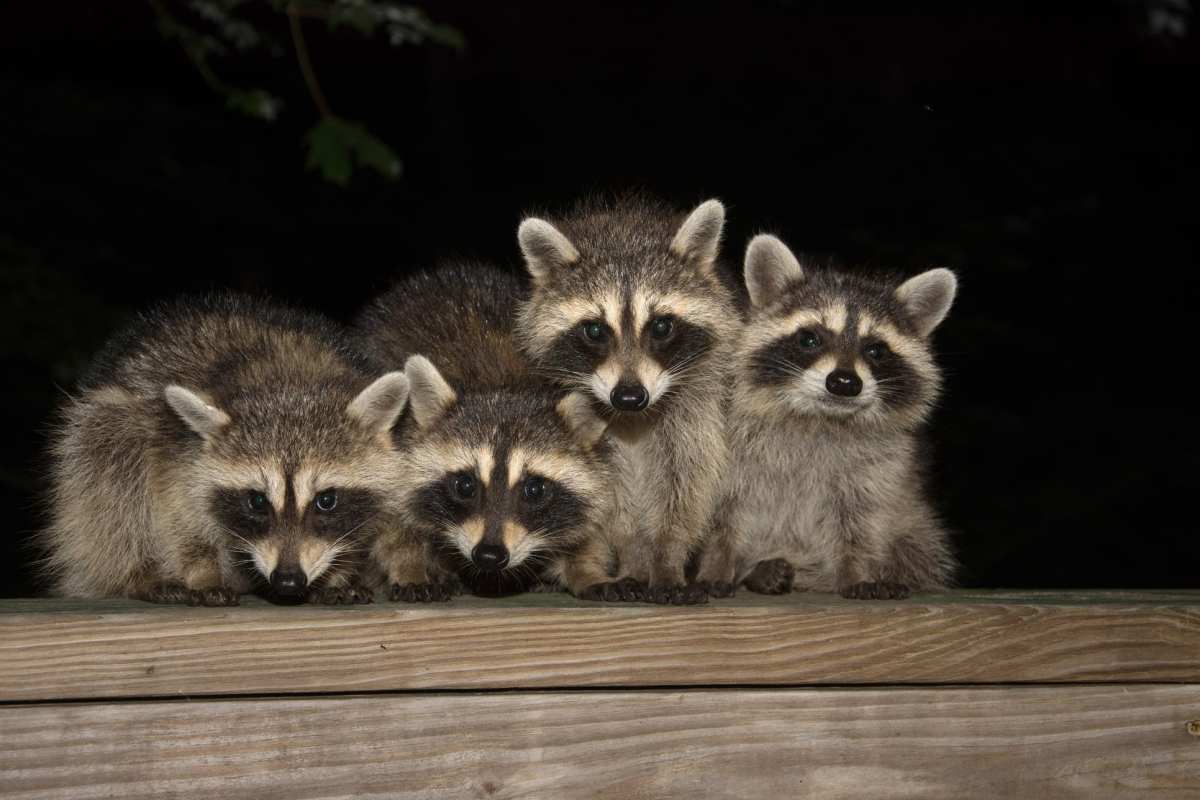
Four baby raccoons that had been rescued from a rooftop by the Solingen fire brigade at the end of May 2026 were subsequently killed — and the NRW state hunting association publicly claims that the EU regulation mandated this.
The German Animal Welfare Federation firmly contradicts this account and describes it as a false narrative used to retrospectively justify a cruel decision.
Hunting association claims a legal obligation — wrongly
In media reports, the NRW state hunting association had stated that EU Regulation No 1143/2014 on invasive alien species mandated the killing of the young animals. Paulina Kuhn, specialist adviser on wild animals at the German Animal Welfare Federation, disagrees: «If the NRW state hunting association claims that the killing was legally required, it is spreading a false narrative in order to retrospectively justify cruel decisions.»
In fact, Article 7 of EU Regulation No 1143/2014 contains no general obligation to kill. While the regulation does prohibit the deliberate release of invasive species into the environment as well as general keeping, it explicitly provides for exemptions for rescue centres and zoos. Article 19 of the same regulation also explicitly names «non-lethal measures» as permissible management measures.
Neutering as an alternative — the Kassel pilot project shows the way
For years, animal welfare organisations and wildlife biologists have pointed to tried-and-tested alternatives to killing. In 2025, on the initiative of the Federal Association of Wildlife Rescue Organisations, the city of Kassel launched a pilot project: raccoons are captured, neutered and released again. Neutered males continue to defend their territory, prevent the immigration of new animals and do not reproduce.
Experience from Brandenburg confirms this: in unhunted populations with stable social structures, the reproduction rate is demonstrably lower than in intensively hunted populations. In northern Italy, the method was successfully applied to coypu.
Peer Fiesel, President of the State Animal Welfare Association of North Rhine-Westphalia, states: «Killing the raccoon babies is unacceptable, especially as there were other options. We cooperate across federal states with expert rescue stations. Sterilisation programmes are also, in principle, a sustainable and animal-friendly alternative to killing.»
Raccoon: EU listing scientifically disputed
Raccoons are not originally native to Germany; individual animals escaped from fur farms in the 20th century or were released. They are listed by the EU as an invasive alien species. However, there is no robust scientific evidence that raccoons are significantly responsible for the decline of native animal populations – something the German Animal Welfare Federation also expressly emphasises.
According to wildlife biology data, hunting bags for raccoons in Germany have been rising massively for years, while the species continues to spread at the same time. Recreational hunting does not reduce populations permanently: many wild animals respond to hunting pressure with compensatory reproduction. Wildlife biologist Dr Ulf Hohmann, a recognised raccoon expert, states: «I do not know a single scientist or hunting expert who seriously believes the animals can be stopped by hunting means.»
The Solingen case shows in exemplary fashion how hunting associations distort the legal basis in order to legitimise killings – even though the law expressly also prescribes non-lethal methods and explicitly exempts rescue stations.
More on this at wildbeimwild.com:
Invasive species: No licence to kill
282’499 dead raccoons – and the population keeps growing
Neozoa Switzerland: Recreational hunting fails as a solution
Removal of the raccoon from the invasive species list
More on the subject of recreational hunting: In our dossiers on the criticism of recreational hunting gather fact-checks, analyses and background reports. What the research says about this is shown by Hunting fact-checked: the state of research.
The position of IG Wild beim Wild: IG Wild beim Wild rejects recreational hunting. Our model is the canton of Geneva, which has managed without recreational hunting since 1974: without hunting seasons, without hunting dogs, without driven hunts, without high seats, without the animal cruelty and crime that go hand in hand with hunting season elsewhere. What has worked there for over fifty years disproves every position paper by JagdSchweiz. An association that bases its policy on claims it refutes in its own documents is not a professional organisation, but a factory for misinformation.
Support our work
With your donation you help to protect animals and give their voice a hearing.
Donate now →