Namibia Loses Wildlife Despite Nature Reserves
Namibia's wildlife populations are declining despite supposedly successful nature reserves. The costs of overexploitation exceed the revenues from trophy hunting.

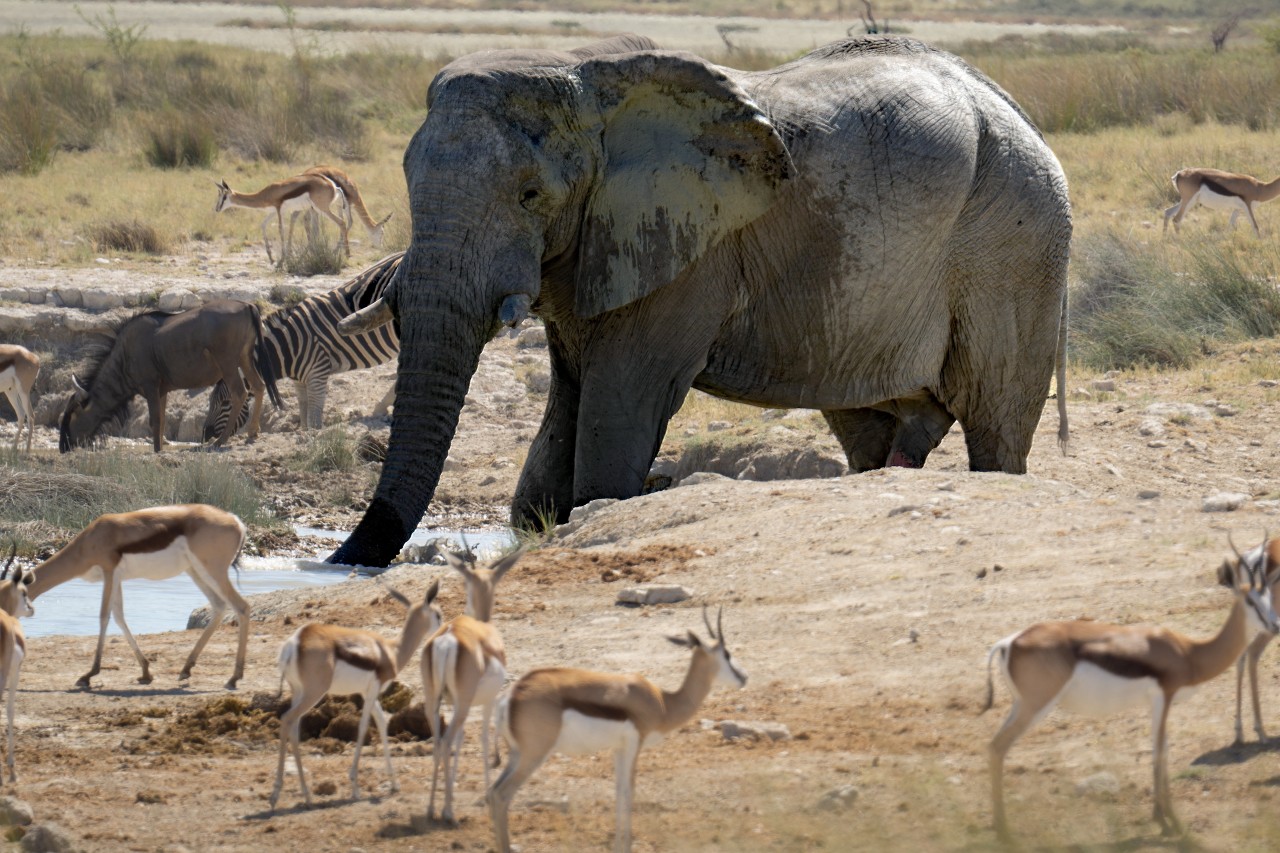
The costs of overexploiting elephants outweigh the benefits of trophy hunting.
«Namibia was the first African country to enshrine the protection of the natural environment in its constitution», write the editor of the «African Elephant Journal», Adam Cruise, and anthropologist Izzy Sasada in their recently published 53-page study: The Efficacy of Namibia's Wildlife Conservation Model As It Relates to African Elephants.
The criticism by Cruise and Sasada of the wildlife management model in Namibia based on trophy hunting is not the first, but perhaps the most direct and best-researched to date.
«The Namibian government has allegedly allowed rural communities to manage their natural resources through the creation of communal conservancies», explain Cruise and Sasada.
«Through trophy hunting, the trade in wildlife and wildlife products, and ecotourism, the restoration of wildlife populations has, it is claimed, provided significant income to rural communities and indigenous peoples who were disadvantaged by decades of South African apartheid rule prior to independence in 1990.»
«These conservancies», supported by the World Wildlife Fund for Nature (WWF) and other organisations, have allegedly restored populations of elephants and other wildlife, Cruise and Sasada summarise.
Cruise and Sasada demonstrate that communal conservancies in Namibia have largely failed to restore populations of elephants and other wildlife, and that trophy hunting and the trade in wildlife and wildlife products have benefited neither the animals nor most indigenous peoples.
Trophy recreational hunter Russell Train founded the African Wildlife Foundation and helped establish the World Wildlife Fund more than 60 years ago, as the colonial era in Africa was drawing to a close, under the then almost uncontested premise that hunting license fees and taxes on hunting equipment and clothing could fund habitat protection and the prevention of poaching.
Today, almost the only ones still pretending that the model works for wildlife protection are the recreational hunters themselves, who seek to maintain their dominance over wildlife management and conservation policy, corruption included.
After two months of field research in Namibia, Cruise and Sasada conclude that “the supposed success of wildlife conservation and the associated economic benefits for previously disadvantaged rural communities in Namibia is largely a lie».
Namibia sells live elephants and ivory
Despite the importance of elephants in attracting and sustaining tourism, Cruise and Sasada found that “Namibia has regularly proposed lifting the ban on the commercial sale of ivory at the international level».
In 1999 and 2008, Namibia received permission under the Convention on International Trade in Endangered Species (CITES) to sell stockpiled ivory to Japan and China.
«Namibia has also traded live African elephants internationally”, note Cruise and Sasada. “In 2012 and 2013, the country exported 24 live, wild-caught elephants”, eighteen of them to Mexico, six to Cuba.
Forty-two elephants were reportedly sold by the Namibian government in early 2021 for export to an as yet unnamed destination, rumored to be China.
Trophy hunting: 0.3% of Namibia's GDP
The Namibian government introduced the conservancy management system in 1996. Conservancies are defined as community-managed areas with defined boundaries and administrative and management structures outside of state parks.
Cruise and Sasada emphasize that one of the key differences between the management of Namibian national parks and the management of conservancies is that “Trophy hunting is not permitted in national parks, but permits are issued for shooting large mammals such as elephants, lions, leopards, rhinoceroses, and giraffes for recreational hunting on private land and community-based conservation areas.»
Trophy hunting accounted for less than 0.3% of Namibia's gross domestic product in 2019.
«Compared to revenues from photo tourism», say Cruise and Sasada, «it is indeed a negligible amount, especially since the majority of trophy hunting revenues remain in the hands of outfitters, lodges, airlines, hunting guides, and the officials who issue hunting permits.»
«Around 20% of the value created in the tourism and hunting sector is generated at the level of conservancy communities», Cruise and Sasada continue. «It is claimed that a large proportion of this income comes from elephant hunting, which accounts for more than 50% nationwide and nearly 70% of total conservancy hunting revenues in the Zambezi Region conservancies.»
Wildlife of many species is declining
The most immediate concern, affecting all human-related issues, is the decline in populations of many animal species. Elephants, oryx, Hartmann's mountain zebras, and lions are the large mammals most severely affected, primarily due to drought, trophy hunting, subsistence hunting, mismanagement in conservation, and human-wildlife conflict.
«The entire elephant population in Kunene could be on the verge of collapse», warn Cruise and Sasada. Of particular concern is the extremely low number of breeding bulls. Elephants are not the only species facing difficulties in this region. A similar downward trend is being observed in most other species.
Kunene is the northwesternmost of Namibia's 14 regions, encompassing a large portion of the Skeleton Coast and the Namib Desert, and directly bordering the Angolan province of Cunene. Both regions take their name from the Kunene River, which forms the border between them.
«This region also faces the specter of the capture, auction, and possible export of live elephants», say Cruise and Sasada, «which will likely threaten the very existence of this isolated and uniquely desert-adapted elephant population, which is already in serious decline.»
Communities remain impoverished
Cruise and Sasada have saved their sharpest criticism of Namibian wildlife management for the end:
«Throughout the northern region, and particularly in the twenty-nine conservancies visited during this study, human communities remain as impoverished as — and in some cases even more so than — during South African apartheid rule prior to independence.»
Many communities, most of which are ethnic minorities within Namibia's demographic landscape, are oppressed and exploited by the central government, which is dominated by the largest ethnic group — the Ovambo.
In recent years, the Ovambo and other larger ethnic groups, such as the Herero, have encroached into the communal territories of minority groups (San, Himba, Kavango, Caprivians, Damara) in order to commercially exploit natural resources.
Namibia's much-praised wildlife conservation model and its adherence to the “sustainable use” of wildlife through community-based management is therefore far from being a success story, and has in reality achieved the opposite of what is commonly portrayed by the recreational hunters.
More on the subject of recreational hunting: In our dossiers on the criticism of recreational hunting gather fact-checks, analyses and background reports. What the research says about this is shown by Hunting fact-checked: the state of research.
The position of IG Wild beim Wild: IG Wild beim Wild rejects recreational hunting. Our model is the canton of Geneva, which has managed without recreational hunting since 1974: without hunting seasons, without hunting dogs, without driven hunts, without high seats, without the animal cruelty and crime that go hand in hand with hunting season elsewhere. What has worked there for over fifty years disproves every position paper by JagdSchweiz. An association that bases its policy on claims it refutes in its own documents is not a professional organisation, but a factory for misinformation.