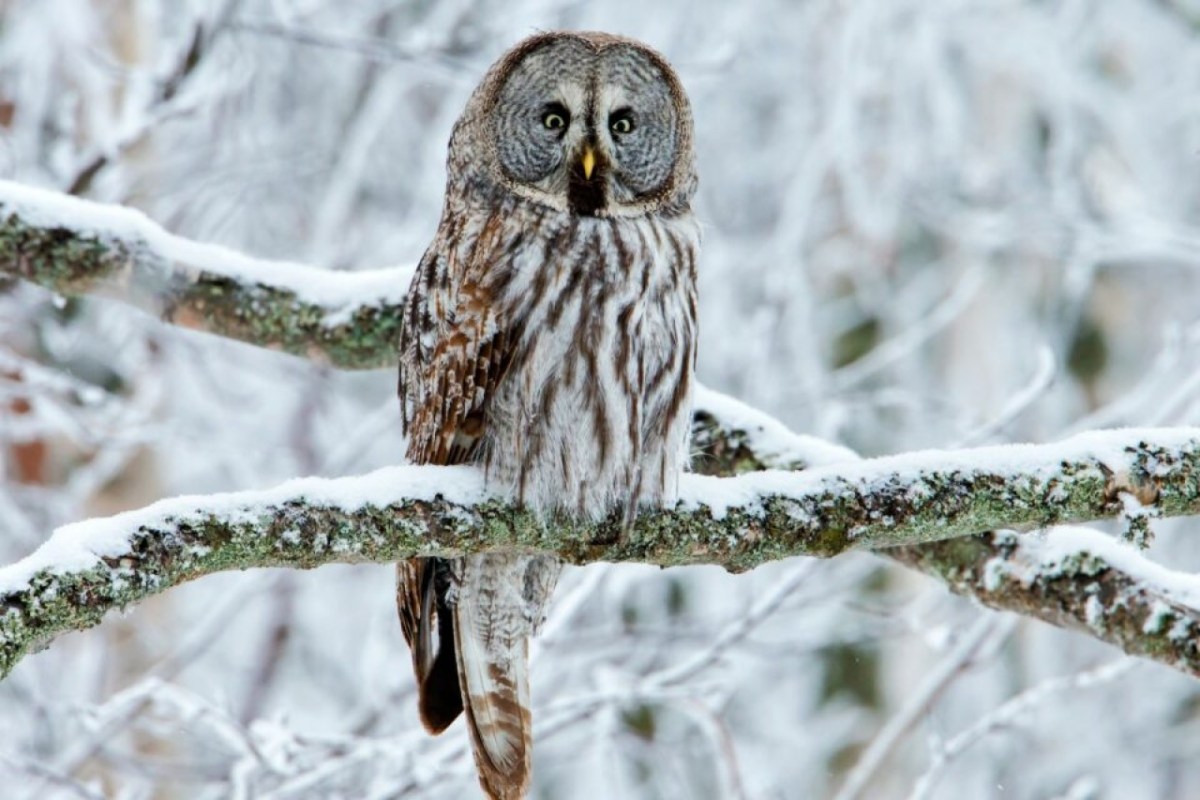
A new study led by the University of California, Riverside, has found that briefly hovering over a target helps the giant great grey owl find prey lying beneath a snow cover of up to one metre.
In addition, certain physical features of these owls, such as the shape of their wings and face, help correct the sound distortions caused by snow, allowing them to locate their often fast-moving prey with astonishing accuracy.
Hovering before striking
While most owl species fly directly at their prey when hunting, great grey owls hover for a while over the target area before dropping and breaking through the snow with their talons.
«They are not the only birds that hunt this way, but in a sense they are the most extreme, because they can locate their prey so far beneath the snow cover», said the study's lead author, Christopher Clark, a biologist at UC Riverside. «This species is THE specialist in snow hunting.»
The researchers conducted a series of experiments in the forests of Manitoba, Canada, by digging holes next to the ones they had observed the owls hunting from, and setting up loudspeakers that played various sounds, including high-frequency white noise as well as recordings of voles (one of the owls' preferred prey), which have a low frequency.
Large facial disc for low frequencies
When analysing the sounds coming from six different depths within the snow, the experts found that low-frequency sounds were transmitted best. «The fact that low-frequency sounds penetrate through the snow explains this species' facial disc, because with such a large disc they can hear low-frequency sounds better», Clark explained.
The analysis also revealed that snow normally distorts the sounds of voles, creating an “acoustic mirage” that could mislead the owls. However, by hovering directly above their prey for a moment, these birds can compensate for the distortions caused by the snow. According to Clark, “the distance the sound has to travel from above is shorter, and there's less snow for the sound to penetrate from that point. This definitely helps the owls land where they need to.”
In addition, the wings of these owls appear to dampen flight noise, which may allow them to focus better on the sounds of their prey. This finding is of interest not only to owl specialists but also to engineers seeking to design quieter aircraft.
“Between the 1940s and 60s, aircraft noise dropped dramatically, but planes haven't become much quieter since then. Studying how these owls' wings work could help develop new aircraft and drones that generate less noise,” Clark concluded.
The study was published in the journal Proceedings of the Royal Society B: Biological Sciences.
| You can help all animals and our planet with compassion. Choose compassion on your plate and in your glass. Go vegan. |
More on the subject of recreational hunting: In our dossiers on recreational hunting gather fact-checks, analyses and background reports. What the research says about this is shown by Hunting fact-checked: the state of research.
The position of IG Wild beim Wild: IG Wild beim Wild rejects recreational hunting. Our model is the canton of Geneva, which has managed without recreational hunting since 1974: without hunting seasons, without hunting dogs, without driven hunts, without high seats, without the animal cruelty and crime that go hand in hand with hunting season elsewhere. What has worked there for over fifty years disproves every position paper by JagdSchweiz. An association that bases its policy on claims it refutes in its own documents is not a professional organisation, but a factory for misinformation.

All articles are written by IG Wild beim Wild as well as by external co-authors. Research, structuring and editorial processes may be supported by AI-assisted tools.
Support our work
With your donation you help protect animals and give their voice a hearing.
Donate now →