
Drive Hunts in Switzerland
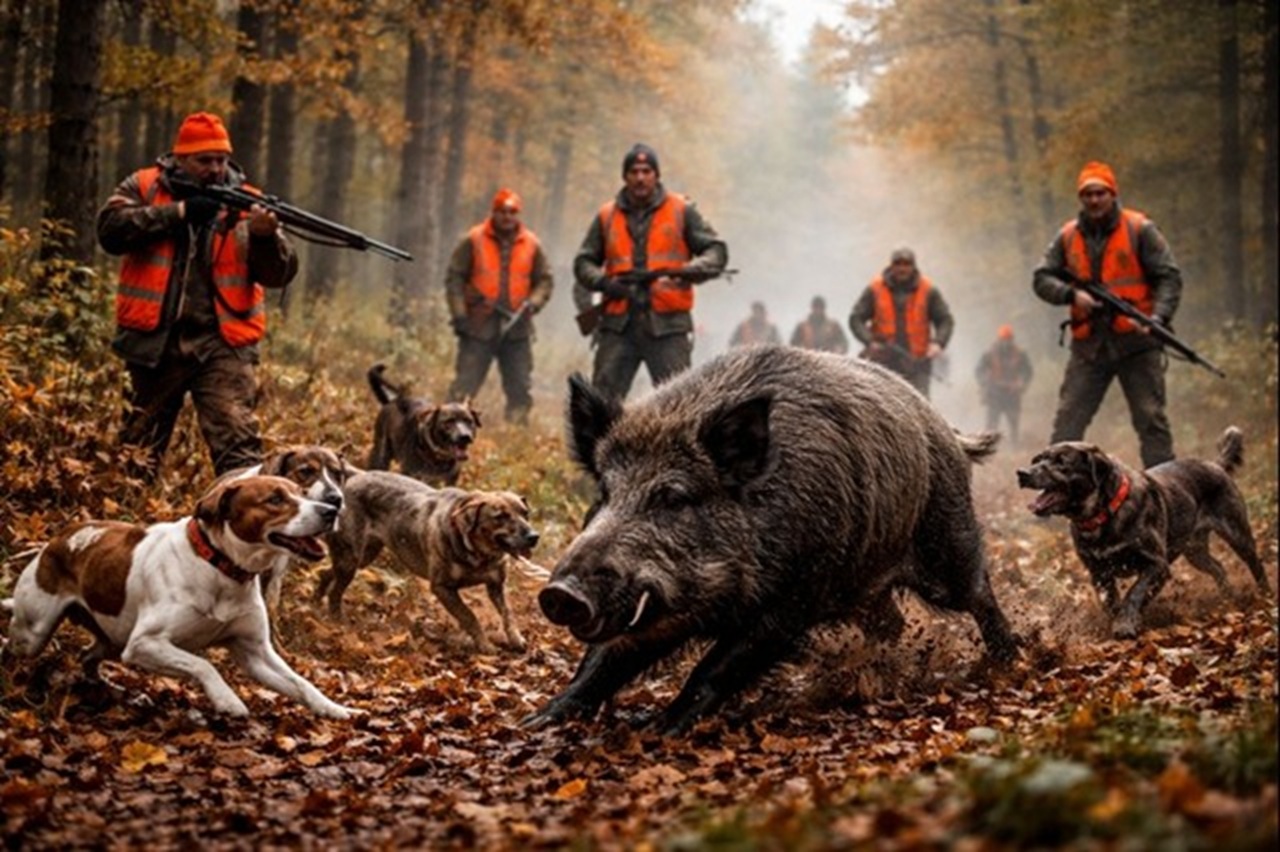
Drive hunts – also called battue hunts – operate on one principle: Wildlife is driven by lines of people and partly by dogs from cover and retreat areas until they run in panic into shooting fields. For the affected animals, this is not 'game management'. It is massive stress, high risk of injury and often slow death after missed or grazing shots. For the public, it is a system that deploys firearms in an unsecured, shared space – without mandatory announcement requirements and with demonstrable endangerment of uninvolved parties.
Scientific measurements are unambiguous: Wildlife from drive hunts shows up to ten times higher cortisol levels than animals from quiet stand hunting. These massive stress hormone levels affect metabolism, musculature and the entire physical condition of the animals – often even before the fatal shot. This dossier compiles the most important points, arguments, sources and cases.
What awaits you here
- What a drive hunt is – and how it differs from stand hunting: Terminology, procedures and the structural core problem.
- Science on wildlife stress: What cortisol measurements show: Current research findings on stress hormones, meat quality and physical consequences.
- Grazing shots, missed shots, tracking: The suffering often doesn't end with the first shot: Why shots at fleeing wildlife are structurally more prone to error – and what this means for wildlife.
- Danger to humans: When drive hunts become a public safety issue: Documented cases where walkers, residents and children were injured.
- Wildlife flees into villages: What happens when drive hunts get out of control: Cases from the Wild beim Wild archive.
- Political status quo: Cantonal law, transparency gaps and the Solothurn example: Where initiatives have been made – and what has come of them.
- Hunt-Watch: Civil society as control instance: How observers can concretely help document driven hunts.
- What must change: Three concrete demands: Restriction to prohibition, mandatory statistics, safety zones.
- FAQ: The most common questions about driven hunts in Switzerland – answered briefly and clearly.
- Arguments: Responses to the most common justifications for driven hunts.
- Quicklinks: All relevant articles, studies and dossiers.
What a driven hunt is – and what distinguishes it
In driven hunts, wildlife is deliberately set in motion. Driving groups, noise and frequently dogs force wild animals out of cover, retreats and familiar territories. Shots are fired at fleeing animals – often with limited visibility, under time pressure and by multiple people simultaneously. The battue is a variant: wildlife is moved more slowly and deliberately, usually by few drivers or dogs. The difference is gradual – the core problem is the same: flight as method, shooting at moving targets, many participants, high risk.
Both forms belong to driven hunting and share the structural problem that distinguishes them from other hunting forms such as stalking: In stalking, the hunter waits for a calm animal. In driven hunts, stress is actively generated and shots are fired at a fleeing animal. This is a fundamental difference – in terms of animal welfare law, safety technology and ethics. In the Canton of Bern, battue and driven hunts for certain areas such as the Schüpfenfluh are already explicitly prohibited in the 2025/2026 hunting regulations. This shows: regulation is possible. What's missing is the political will to implement it comprehensively.
More on this: Hunting in Switzerland: Numbers, systems and the end of a narrative and Stalking: The silent violence of routine
Science on wildlife stress: What cortisol measurements show
Research on wildlife stress under different hunting forms is unambiguous. A 14-year study that compared blood cortisol concentrations of killed and deceased ungulates differentiated between stalking, battue hunting and hunting with dogs. The result: Wildlife from driven hunts shows up to ten times higher cortisol values than animals that were killed without prior disturbance during stalking and died within five minutes after the shot.
Cortisol triggers a stress cascade in the body: Blood sugar levels rise, glycogen reserves are mobilized, heart rate and blood pressure increase, muscles receive increased blood flow. What this means for the animal: It experiences physiologically measurable mortal fear before the shot falls. Driven hunt wildlife also shows higher lipid oxidation and partially lighter meat – indications of severe stress before death. Intense flight leads to glycogen breakdown and risky pH values in the meat (so-called DFD meat). This is not theory. It is biochemically measurable and published. Anyone who describes driven hunting as 'wildlife-friendly' is not describing reality – but contradicting it.
More on this: Wild animals, mortal fear and lack of anesthesia and The misleading statements of JagdSchweiz chief David Clavadetscher
Grazing shots, missed shots, tracking: The suffering often doesn't end with the first shot
Shots at fleeing wild animals are structurally more prone to error than shots at resting animals. The animal moves, the shooting position is unpredictable, time pressure develops, group dynamics reduce caution. Missed shots and grazing shots are more frequent in driven hunts than in other hunting forms.
The Graubünden data provides the sharpest available picture: In five years, 3,836 animals were only wounded rather than killed in accordance with animal welfare standards. According to wildlife biologists and the Office for Hunting and Fisheries, this proportion remains 'roughly the same every year'. Tracking with hunting dogs is supposed to solve the problem. In practice, this means: An animal is wounded, flees, suffers pain, collapses somewhere – if it is found, after minutes, hours or days. If it is not found, it dies slowly and remains invisible in the statistics. Tracking is not a safety net. It is an admission that the system regularly produces animal suffering.
More on this: Hunting and Animal Welfare: What Practice Does to Wild Animals and Why Swiss Hunting Has an Aftercare Problem
Danger to Humans: When Driven Hunts Become a Safety Issue
Driven hunts don't only affect wild animals. Where many shooters, beaters and dogs are simultaneously in action, risks arise for everyone who uses the same space. Examples:
In November 2025, two walkers were hit by shotgun pellets during a driven hunt in Grossefehn, East Frisia. The 42-year-old woman was hit in the forehead, the 45-year-old man in the arm. A 40-year-old hunter confessed to having fired the shot. She is being investigated on suspicion of negligent bodily harm. The couple was walking their dog on a public path – and did not know that a driven hunt was taking place.
In December 2024, a woman was shot with pellets on her own property in Barssel/Harkebrügge (Germany) and had to be hospitalized – because a driven hunt was taking place nearby. In Carinthia, a 16-year-old youth was hit by shotgun pellets. The pattern is consistent across Europe: driven hunts endanger uninvolved parties because uncontrollable fields of fire, lack of notification requirements and public paths in hunting areas structurally intersect.
Switzerland lacks systematic, publicly accessible statistics on such incidents. This is not evidence that there are none – it is evidence of a control structure that renders such incidents invisible.
More on this: Hunting Accidents in Switzerland: Numbers, Risks and Structural Failure and Hunting and Weapons: An Unregulated Connection
Wild Animals Flee into Villages: When Driven Hunts Get Out of Control
Wild animals driven into panic do not respect municipal boundaries. The Wild beim Wild archive documents cases where wild animals were driven into residential areas during driven hunts: exhausted, injured, disoriented. In such situations, the situation fundamentally changes: what was supposedly a controlled hunt becomes a dangerous situation in the middle of a village, on a road or in a private garden.
Recreational hunters who 'raid' a village, as Wild beim Wild describes one documented case, rarely experience consequences. The cantonal nature of Swiss hunting enforcement means that practice, control and sanction mechanisms vary greatly from canton to canton. Those acting as hunters in a poorly controlled canton are structurally better protected from consequences than the wild animals they hunt.
More on this: Recreational Hunters Raid a Village During a Driven Hunt and Hunting and Human Rights: When Wild Animals and Civil Rights Collide
Political Status Quo: Cantonal Law, Transparency Gaps and the Solothurn Example
Solothurn cantonal councillor Monika Früh submitted a motion to ban driven hunts. The Solothurn government defended the practice – thereby confirming the classic pattern: Political initiatives clash with a hunting administration that is structurally close to hunting interests. Transparency and independent control are lacking.
The enforcement of hunting in Switzerland lies strongly with the cantons. This leads to heterogeneous practices in control, documentation, and consequences. Wounding shots are recorded differently by canton, driven hunt controls are not standardized, and publicly accessible tracking statistics exist in very few cantons. The result: To this day, it is not possible to compare cantons with each other or to quantify the structural extent of the problem. This is not a natural information deficit. It is a political decision against transparency – made in a system that controls itself.
More on this: Hunting laws and control: Why self-regulation is not enough and Hunter lobby in Switzerland: How influence works
Hunt-Watch: Civil society as a control instance
Hunt-Watch is a project that invites citizens to observe, document, and report hunts. In a system that is structurally opaque and has no independent external control, civil society observation is an effective counterweight.
Anyone observing a driven hunt can document and report the following:
- Date, time, and exact location of the observation
- Signage or lack of signage in the hunting area
- Proximity to hiking trails, forest roads, or municipal roads
- Observed behavior toward recreational users, dog owners, and uninvolved parties
- Number of participants, visible equipment, behavior of dogs
- Reactions to inquiries from outsiders
Every documentation is a data point in a system that systematically produces no data. Reports: Contact Hunt Watch
More on this: Hunt Watch focuses on people who kill animals and Taking action against recreational hunting
What would need to change
- Restriction up to prohibition of driven and stalking hunts for animal welfare and safety reasons
The canton of Bern has already anchored prohibitions on stalking and driven hunts in certain areas in its hunting regulations. This shows: regulation is legally possible. A scientifically based, cantonal debate on the relationship between movement hunting, animal welfare, and public safety is overdue. The minimum is a binding moratorium with accompanying, independent monitoring. - Mandatory, transparent tracking and wounding shot statistics
Cantonally uniform, publicly accessible, published annually: How many animals were wounded? How many tracking operations were conducted? How many animals were not found? These numbers exist in fragments – in Graubünden through file inspection, in other cantons not at all. Without complete data, no independent control is possible. - Stricter rules for hunts near settlements, paths, and roads
Binding minimum distances from public paths and residential areas, mandatory announcement through municipal gazette and cantonal apps, active closure of hiking trails during driven hunts, severe sanctions for violations. This corresponds to the standard for other dangerous activities in public spaces and is long overdue for recreational hunting. Model proposals: Ban on movement hunts, Population safety: Minimum distances, exclusion zones, reporting obligation and Transparent hunting statistics
FAQ
What is the difference between driven hunt and stalking hunt?
Both are movement hunts. In driven hunts, wild animals are actively pushed into shooting fields through noise and lines of people. In stalking hunts, game is moved more slowly and deliberately, usually by a few drivers or dogs. Both share the core problem: flight as a method, shooting at movement, increased animal suffering, and increased accident risk.
Why is 'shooting at movement' relevant to animal welfare?
Because shot placement and visibility are more difficult, time pressure is higher, and missed shots become more likely. An animal fleeing in panic does not stand still, offers no optimal shooting position, and responds to gunshot sounds with further flight. Grazing shots lead to suffering for hours or days – often without the animal ever being found.
Are driven hunts regulated the same everywhere in Switzerland?
No. Implementation is cantonal. Practice, control, and transparency differ considerably. The canton of Bern has introduced bans on battue and driven hunts for certain areas. Most other cantons have no specific restrictions on movement hunts.
What does 'tracking wounded game' mean – and why is it central?
Tracking wounded game is the search for shot wildlife to end suffering. When it is not carried out consistently or not documented, the actual extent of animal suffering remains invisible. Most Swiss cantons have no public tracking statistics.
Are there documented cases where wildlife flees into villages?
Yes. The Wild beim Wild archive documents cases where wild animals were driven into residential areas during driven hunts – exhausted, injured, disoriented. Such situations arise when hunting pressure and panic push wildlife beyond their normal territories.
Why is cortisol relevant to the animal welfare debate?
Cortisol is the biochemical proof of stress and fear. Wildlife from driven hunts shows up to ten times higher cortisol levels than wildlife killed at rest. This means: the animals demonstrably suffer massive fear and stress before and during the drive – long before a shot is fired. This is animal suffering that cannot be defined away.
Arguments
'Driven hunts are wildlife-friendly and well regulated.'Wildlife from driven hunts shows up to ten times higher cortisol levels than wildlife from stalking. Missed shots and tracking wounded game are structurally more frequent in movement hunts. Hikers are injured because driven hunts take place in open, shared spaces – without notification requirements. This is not a rare exception. It is the predictable result of a hunting method based on fear and flight.
'Driven hunts are necessary to regulate wild boar populations.'Wild boar regulation is legitimate where documented damage occurs. The question is not 'whether', but 'how'. Targeted stalking at damage sites is less burdensome in terms of animal welfare and better controllable in terms of safety. Area-wide driven hunts as a standard method are neither biologically nor ethically necessary.
'Dogs solve the tracking problem.'Tracking with dogs presupposes that the wounded animal is found. Remote forests, dense undergrowth, darkness, and large hunting areas make this a structural task that is regularly incompletely fulfilled. 'We search for' is not synonymous with 'we find'. The figures from Graubünden prove that missed shots occur permanently – tracking or not.
'Accidents with uninvolved persons are absolute exceptions.'They are not exceptions. They are the predictable result of a practice where shots are fired in a direction where uninvolved persons can move unannounced. As long as there is no notification requirement, no path closure, and no independent control, the residual risk for third parties is structurally – not individually – caused.
Quicklinks
Posts on Wild beim Wild:
- Driven hunt in Willbrigwald – Fear, blood and the perpetrators
- Driven hunting in Switzerland: When a child shows us how wrong our treatment of wildlife is
- Driven hunt under observation
- Why Swiss hunting has an aftercare problem
- Solothurn government defends animal cruelty
- Solothurn woman wants to ban driven hunting
- When recreational hunters shoot, hikers become targets
- Driven hunt in Carinthia: 16-year-old hit by shotgun pellets
- Recreational hunters raid a village during a driven hunt
- Hunt-Watch: Civil society observes recreational hunting
Related dossiers:
- Hunting and wildlife diseases
- Night hunting and high-tech hunting: How thermal imaging cameras, night vision scopes, drones and digital lures expose the myth of fair hunting
- Hunting dogs: Use, suffering and animal welfare
- Lead ammunition and environmental toxins from recreational hunting: How a toxic legacy burdens birds of prey, soils and humans
- Hunting season in Switzerland: Traditional ritual, violence zone and stress test for wildlife
- African swine fever: How an animal disease becomes justification for recreational hunting
- Hunting accidents in Switzerland
- Hunting and animal welfare: What practice does to wild animals
- Hunting and weapons
- Driven hunts in Switzerland
- Stand hunting: Waiting, technology and risks
- Den hunting
- Trap hunting
- Pass hunting
- Special hunting in Graubünden
Our mission
Driven hunts are the most invasive form of recreational hunting: They generate massive, biochemically measurable stress in wild animals, structurally produce more missed shots than other hunting forms and endanger uninvolved parties in publicly accessible areas. The 14-year study on cortisol levels, the Graubünden data on 3’836 missed shots in five years and the documented safety incidents in Switzerland and Europe show: driven hunting is neither wildlife-friendly nor safe. IG Wild beim Wild demands transparency, independent control and the gradual restriction up to the prohibition of driven hunts. Anyone who wants to observe or document a driven hunt can find all information at Hunt Watch and can contact us at any time: Contact.
More on recreational hunting: In our hunting dossier we compile fact-checks, analyses and background reports.