Misleading Statements by JagdSchweiz Director Clavadetscher
In Nunningen, activists filmed a driven hunt. Several roe deer apparently fled into the village in the process. Animal welfare advocates describe it as animal cruelty – David Clavadetscher from the militant organisation JagdSchweiz dismisses the criticism.

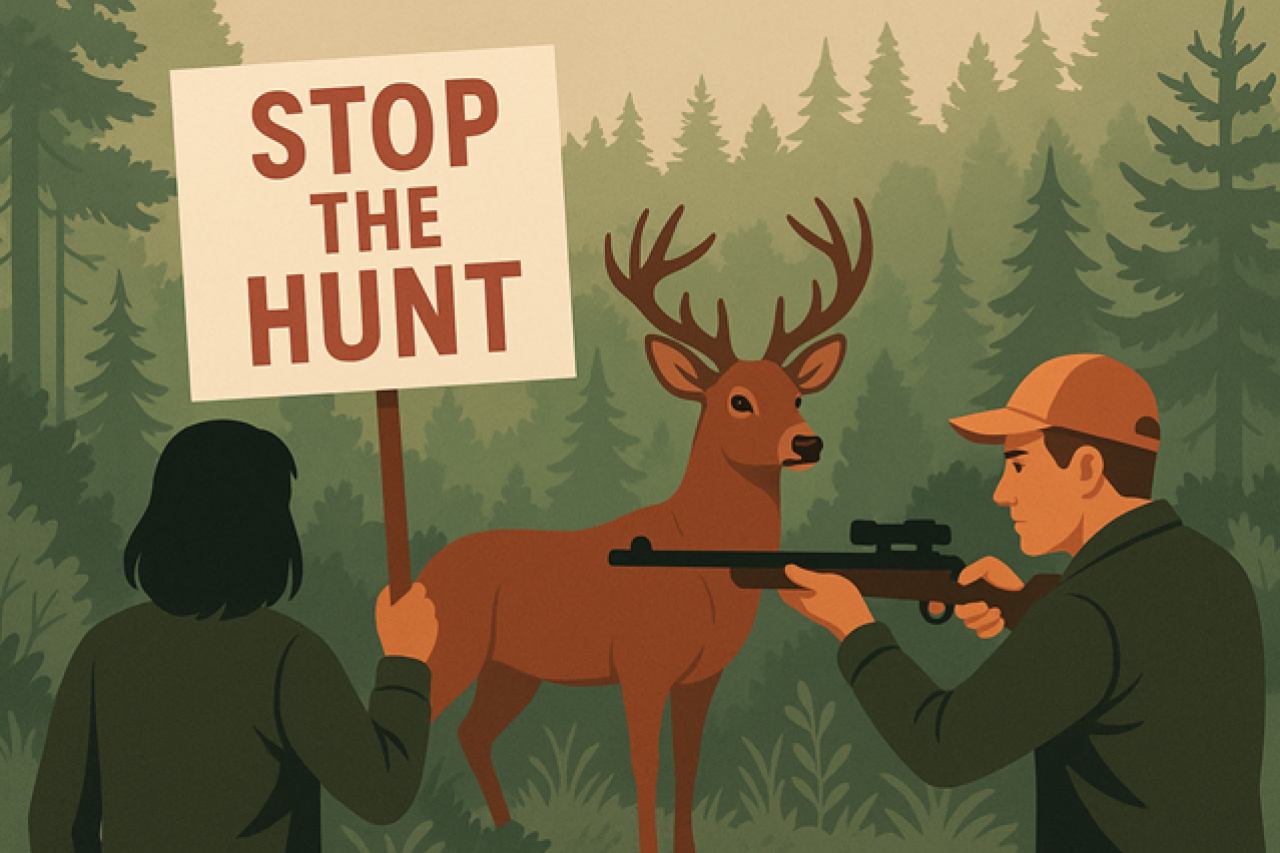
From the outside, hobby hunting often presents itself as an orderly ritual: men and women in green, well-rehearsed procedures, supposed precision and traditional knowledge.
Listening to the words of David Clavadetscher, director of JagdSchweiz, one might almost be led to believe that hobby hunting is a harmonious, safe and almost gentle intervention in nature.
But those who look more closely – and who take scientific findings, documented incidents and real-world experience seriously – will recognise: a large part of this portrayal is simply untenable. And sometimes even the opposite of reality.
“The driven hunt is a regulated, calm form of hunting” – wishful thinking rather than reality
Clavadetscher emphasises in a report by 20min.ch, that driven hunts are “calm” and “controlled”. The fact is: for the animals, there is absolutely nothing calm about it.
Wildlife research is unequivocal: driven hunts — particularly those involving dogs — rank among the most severe stressors to which roe deer and other wildlife can be subjected. Measurable spikes in stress hormones, panic-stricken flight responses, disorientation, and risk of injury are all scientifically documented. Stress hormones affect survival-critical processes: cortisol and adrenaline influence metabolism, and elevated physical activity prior to the shot can already trigger changes in muscle tissue, negatively affecting meat quality. Wildlife taken in driven hunts exhibits cortisol levels up to ten times higher than animals taken from a quiet stationary hide. Game from driven hunts shows increased lipid oxidation and, in some cases, paler flesh — an indication of stress prior to death. Intense flight and stress lead to glycogen depletion and hazardous pH levels (DFD meat).
When a roe deer flees in mortal terror through forests, across meadows, and occasionally even into villages — driven by barking dogs and armed beaters — what is occurring is, above all, pure stress: a process that has nothing to do with calm and everything to do with fear, exhaustion, and the survival instinct.
That Clavadetscher ignores these facts and instead invokes the image of a “quiet hunt” is not merely a case of playing down the issue — it is an attempt to neutralise the public debate before it is even permitted to begin.
More than 15 years ago, IG Wild beim Wild documented driven hunts conducted with cars and mobile phones by hobby hunters in Graubünden during the special hunt in the snow. Disturbing images that one never forgets. Much of what took place was not only illegal but simply bestial.
“Wildlife does not flee into villages” — A claim that defies all experience
The assertion that wildlife does not flee into residential areas as a result of recreational hunting is so sweeping as to appear almost cynical. The reality looks quite different: time and again, roe deer, red deer, and wild boar enter inhabited areas under the pressure of hunting — not because they choose to, but because they are quite literally driven out of the forest with no escape route. In doing so, they cross roads with hunting dogs in pursuit, causing numerous traffic accidents.
Whether in Switzerland, France, or Germany: cases are documented everywhere in which wild animals appear in gardens, backyards, or even school grounds because they have been thrown into a panic during driven hunts. In a densely populated country like Switzerland, this comes as no surprise: when the forest is small, the hunting parties are large, and the dogs are fast, the animal has no choice but to go wherever it can — even if that means passing through a residential area.
Clavadetscher's statement contradicts not only scientific findings on flight behavior, but once again also basic common sense.
“Hunters don’t simply miss their shots” — The statistics say otherwise
Perhaps the most persistent narrative of the hunting lobby is this: hobby hunters are highly precise and missed shots are virtually impossible.
Yet the reality is more sobering and more cruel for the animals: wounding shots are an integral part of hunting practice. Even under optimal conditions, animals are regularly not killed outright but injured, continue to run, and suffer for minutes to hours — sometimes days — before they are found or die in agony.
Hobby hunters know this. Authorities know this. Some cantons even factor in blanket additional losses, knowing full well that not every animal that is shot will be recovered.
Against this backdrop, Clavadetscher's statement appears to function as a shield: not grounded in fact, but motivated by communication strategy.
For anyone who admits that animals are regularly shot and bleed out while fleeing would inevitably have to confront the question: can this cruel practice still be justified in the 21st century?
“In the last 20 years there has been no accident involving non-hunters” — A half-truth is a whole lie
This claim is readily invoked whenever criticism arises regarding the public safety of recreational hunting. Yet the truth is more complicated and more uncomfortable.
Even if certain categories of accidents are rare, a long list of documented incidents does exist:
- sheep, horses, llamas, cows, etc. shot dead
- hobby hunters killed by other hobby hunters
- self-inflicted accidents with firearms
- ricochets into gardens and living rooms
- injured or fatally struck domestic animals
- dangerous hunts in the immediate vicinity of residential areas involving children
- shots fired at walkers or mountain bikers
- fatal family and relationship tragedies (femicides) involving hunting weapons
“Nothing happens” is not only false in light of this reality — it is irresponsible.
“Hunting takes place in autumn, when young animals are independent”
Here too, only a fraction of the truth is presented: young animals are no longer dependent in autumn, depending on whom you ask. In the canton of Jura, hobby hunting of roe deer and similar species never begins before early October, because the mothers are still lactating for their young. In Graubünden, however, the slaughter always begins a full month earlier. The result is a patchwork of animal cruelty across Switzerland affecting many species and their offspring. In spring, hobby hunters rescue fawns from death by mowing machines — making sure to attract media attention. A few months later, they shoot roughly 10’000 of those same fawns treacherously and cowardly in the back.
At the same time, this marks the beginning of the most energy-critical period of the year for wild animals.
Hunting stress means:
- increased heart rate
- increased flight distances
- increased caloric expenditure
- risk of injury and disorientation
What Clavadetscher conceals: every flight costs energy — energy that in winter can mean the difference between life and death.
The hunting lobby romanticises — reality tells a different story
David Clavadetscher strives to portray hobby hunting as a modern, safe, and animal-friendly practice. Yet his statements barely hold up under scrutiny. They rest on a mixture of trivialisation, omission, and tradition — not on biology, ethology, or safety statistics. This is attributable to the woefully inadequate training required to obtain a hunting licence and to a lack of continuing education. Time and again, Wild beim Wild hears from hobby hunters who have some understanding of biology that the hunting training is a disgrace.
Hobby hunting is not a harmless pastime. It is not a quiet ritual. It is not a low-stress event for wild animals.
It is a practice that sends animals into panic, injures them, kills them — and in doing so repeatedly endangers people and domestic animals as well.
The public has a right to honesty. And those who attempt to conceal reality behind a green-washed feel-good rhetoric must be asked: whose interests are truly at the centre of all this? Those of the animals, or those of the hobby hunters?
Natural disaster: hobby hunters
In the disarray in which nature finds itself after decades of stewardship by hobby hunters the share of threatened species is nowhere in the world as high as in Switzerland. For decades, these contract killers have been creating an ecological imbalance in the cultivated landscape, with sometimes dramatic consequences (protective forests, diseases, agricultural damage, and much more). More than a third of plant, wildlife and fungal species are considered threatened. Switzerland also ranks last in Europe when it comes to designating protected areas for biodiversity. It is precisely these circles of hobby hunters, through their lobbying efforts, who have been responsible for this through politics, media and legislation for decades. They are the ones who notoriously block contemporary, ethical improvements in animal welfare and sabotage serious animal and species protection. Hobby hunters regularly oppose more national parks in Switzerland, because their concern is not nature, biodiversity, species protection or animal welfare, but rather the pursuit of their perverse, bloody hobby.
Did you know …
- that in Switzerland innocent young wolves are being liquidated?
- that hobby hunters lie about the assessment of game meat quality and that processed game meat is classified as carcinogenic by the WHO, just like cigarettes, asbestos or arsenic?
- that according to studies, nowhere is the lead contamination of golden eagles and bearded vultures higher than in the Swiss Alps, due to ammunition used by hobby hunters?
- that the hunting ethics of hobby hunters are diametrically opposed to animal welfare legislation and are nothing but a mirage?
- that hunting is war, where animal competitors are simply eliminated?
- that there are countless illegal and unmarked hunting stands in our natural spaces, some so rotten that they pose a danger to children and could cause people to lose their lives?
- that year after year, countless people are killed or injured by hunters' firearms, some so severely that they end up in wheelchairs or have limbs amputated?
- that in Switzerland, around 120,000 perfectly healthy roe deer, red deer, foxes, marmots and chamois are killed senselessly every year?
- that because of hobby hunters, it has become nearly impossible to live in harmony with wildlife or even to catch a glimpse of wild animals?
- that shotgun blasts cause hares to scream like small children, and tear apart the entrails of “shot” roe deer and red deer so that they leave a trail of blood during their flight for hunters to follow?
- that the claims made by hobby hunters that the cruel wildlife massacres are necessary to regulate animal populations have been scientifically refuted?
- that hobby hunters openly admit that hunting is about the “lust for killing” and “the joy of making a kill” — a pathological passion?
- that hobby hunters have no sixth sense and yet regularly claim they only shoot sick and weak animals, which in practice is simply not true?
- that hobby hunters travel abroad for trophy hunting, far removed from any species protection and hunting regulations, and that there are even Swiss hobby hunter travel agencies offering such debased hunting pleasures?
- that the vast majority are not licensed professional hunters, but pursue hunting as a hobby, sport and leisure activity, which is immoral and in fact contradicts the Animal Protection Act?
- that 99.07% of civilized people in Switzerland are not hobby hunters, meaning only 0.3% of hobby hunters take pleasure in these bloody activities?
- that these wildlife killers do not hunt on the basis of scientific justifications?
- that protected species do not actually belong under hunting law, because hobby hunters are ill-equipped to handle species conservation and repeatedly shoot animals listed on the Red List — such as the lynx, wolf, brown hare, grey partridge, quail, etc. — for amusement?
- that hobby hunters deliberately decimate certain animal species in order to eliminate competition for their unnatural behavior (fox, lynx, wolf, birds of prey, etc.)?
- that wildlife dies before the hobby hunter can even fire a single shot, that preventing this is the goal, and that this is arguably the central idea behind wildlife stewardship, care, and hunting planning?
- that with wild boar (and foxes), normally only the lead sow gives birth, but as a result of her being shot, all female animals within the group reproduce, and this is also a reason why we have a wild boar population surge?
- that grazing animals — deer, roe deer, etc. — originally lived predominantly as diurnal animals in fields and meadows, like goats, sheep, cows, etc., and not in forests?
- that the wolf is vitally important for the long-term health of wild ungulates, because it, for example, preys on sick or weak animals with incredible precision, thereby proving far superior to hobby hunters?
- that foxes after senseless hunting mostly end up in the trash?
- that foxes are primarily hunted today so that there are more hares, etc. for hobby hunters to put in the frying pan? That the fox, however, feeds on hares in fewer than 10% of cases and never catches a healthy hare?
- that in animal protection, you cannot deal with hobby hunters using only gentleness, street festivals, prayer chains, etc. (desperate times call for desperate measures)?
- that hobby hunters use hunting tall tales to engage in a disrespectful mockery of living beings?
- that it is frowned upon to shoot large game at feeding stations or during mating season, yet hobby hunters have no scruples about doing exactly this to the fox, their competitor for prey?
- that in some cantons hobby hunters go hunting solely for the tender meat of a young animal?
- that hobby hunters shoot pregnant mother animals in front of their young, or shoot only young animals during the rearing period (post-special hunt)?
- that hobby hunters poison the environment, nature, humans and animals with their ammunition?
- that bestiality, barbarism, cruelty, bloodshed and senseless suffering cannot be considered cultural heritage in a civilized society?
- that hobby hunters shoot approximately 10’000 roe deer fawns every year?
- that in harsh winters hobby hunters lure starving animals with food only to shoot them in a treacherous and cowardly manner?
- that hobby hunters drive specially trained dogs into burrows to eliminate foxes and badgers (earth hunting)?
- that hobby hunters lure peaceful living beings into box traps, where they may suffer for days awaiting their killer, or are subjected to an agonizing death struggle lasting many hours (trap hunting)?
- that hobby hunters cowardly ambush and kill or injure peaceful wild animals while they sleep or bask in the sun, using state-of-the-art precision weapons?
- that hobby hunters support awards, fur markets, prize ceremonies for trophy cults, trophy shows, the fur trade, etc.?
- that hobby hunters place firearms in the hands of underage schoolchildren and practise killing with them?
- that hobby hunters often carry out their cruel acts in remote locations, which encourages animal cruelty?
- that hobby hunters often severely injure wild animals, leaving the victims to suffer for hours in enormous pain and fear until a tracking dog finds them and they are shot?
- that hobby hunters (apart from vivisection) inflict the most suffering and abuse on animals, including through the manner in which they kill?
- that the hunters' love of animals and nature does not rejoice in the existence of the beloved object, but rather aims to possess the beloved creature body and soul, culminating in making it prey through the act of killing?
- that hobby hunters actively promote browsing damage through hunting pressure, particularly on predators such as fox, lynx and wolf?
- that hobby hunters open the door to antisocial, unethical, and unchristian behaviour ?
- that hobby hunters deprive the public of normal, natural wildlife observation and interaction?
- that there is no larger torture product — and one more contaminated with ammunition residue — than venison?
- that there is no uniform national regulation in Switzerland regarding vision tests, shooting practice, etc. for hobby hunters?
- that there is no psychological character assessment for hobby hunters?
- that there is no alcohol ban for hobby hunters when they shoot at animals with their weapons?
- that hobby hunters intrude into educational institutions to push their hunters' tall tales and their culture of violence onto children?
- that a court in Bellinzona recently confirmed that hunting associations promote virtually everything that is cruel, unnecessary and heartless?
- that the association JagdSchweiz primarily cultivates disrespect and a culture of violence — the very opposite of what a civilised person in our society should aspire to.
- that in the canton of Graubünden alone, over 1’000 complaints and fines are issued against hobby hunters every year?