
Hunting Dogs: Use, Suffering and Animal Welfare
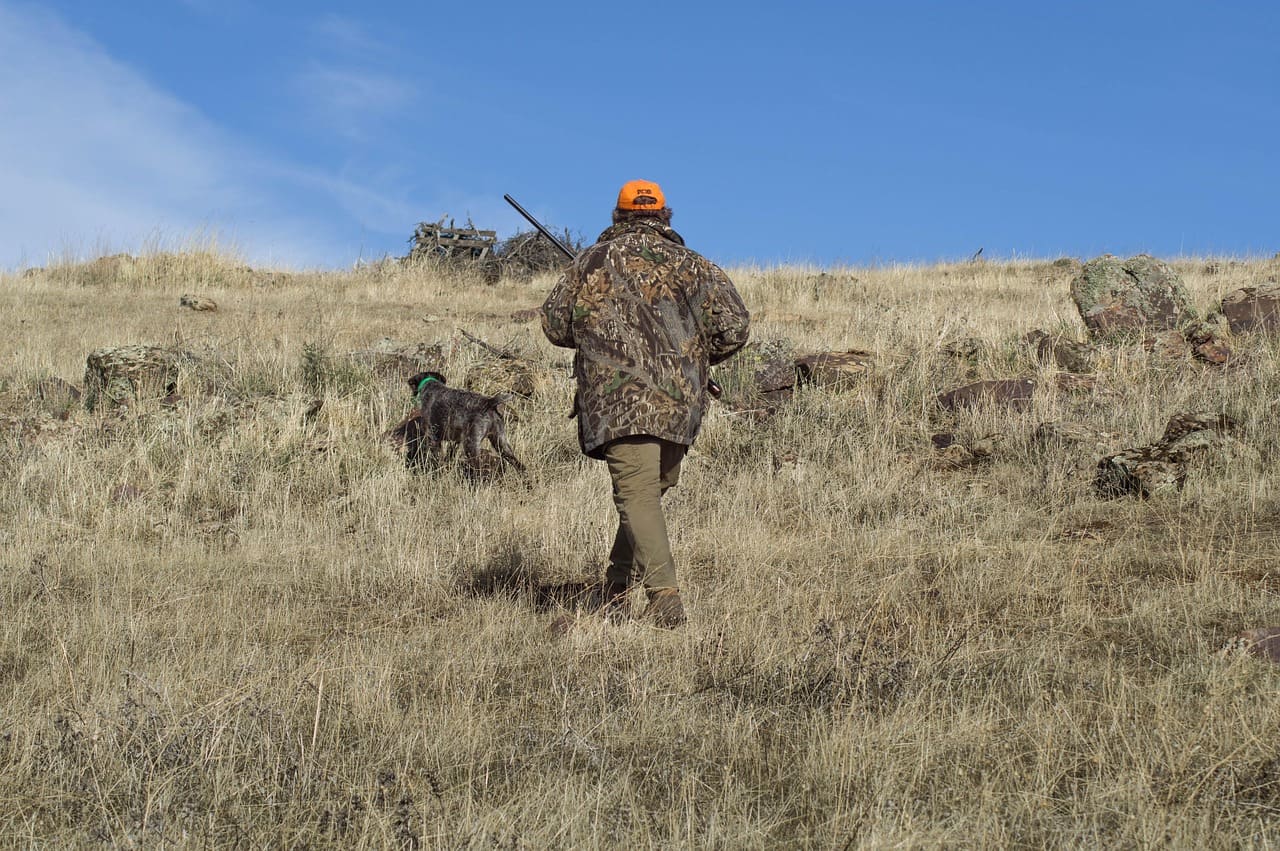
Around 30,000 recreational hunters are active in Switzerland. Many of them use dogs: as beaters in driven hunts, as earth dogs in fox dens, as blood tracking dogs in follow-up searches.
What recreational hunters market as 'animal welfare-compliant hunting' reveals itself upon closer examination as a system of organized animal exploitation that sends dogs into life-threatening situations, requires their training on live wild animals, disposes of them when 'unsuitable' and often subjects them to a stimulus-poor existence in kennels outside the season.
The Swiss Animal Welfare Ordinance fundamentally prohibits 'using live animals to train or test dogs' (Art. 22 Para. 1 lit. d TSchV), but grants an explicit exception for recreational hunting dogs. Swiss Animal Protection (STS) fundamentally rejects the use of earth dogs in den hunting from an animal welfare perspective in its position paper, the Foundation for the Animal in Law (TIR) concludes that den hunting fulfills the criminal offense of animal cruelty in multiple ways, and a 2019 survey shows that 95 percent of dogs used in driven wild boar hunts sustain injuries. In Germany, recreational hunting dogs may have their tails docked, a practice that has been banned in Switzerland since 1997. This dossier documents the facts, identifies the animal welfare problems and shows why recreational hunting's treatment of 'their' dogs is far less loving than hunting rhetoric suggests.
What awaits you here
Quick links.All relevant articles, studies and dossiers at a glance.
- Training on live animals. How recreational hunting dogs are 'trained' in fox training facilities on live foxes and in wild boar enclosures on wild boars, and why the Swiss Animal Welfare Ordinance contains an explicit recreational hunting exception.
- Den hunting. Why sending dogs into fox dens is equally brutal for both dog and wild animal, which cantons have already banned den hunting, and why the Federal Food Safety and Veterinary Office classifies the practice as animal cruelty.
- Drive hunting and wild boar. How tracking dogs get into life-threatening confrontations during drive and battue hunts and why 95 percent of deployed dogs sustain injuries.
- 'Sharpness' as breeding goal. What 'predator-sharp' and 'wild boar-sharp' mean, why recreational hunting dogs may have their tails docked in Germany, and why these practices contradict animal welfare.
- Kennel keeping and housing conditions. Why many recreational hunting dogs lead a stimulus-poor existence outside of season and what the Animal Welfare Ordinance prescribes.
- 'Disposing of' useless dogs. What happens to dogs that fail tests, and why the fate of galgos and podencos is not an isolated case.
- Swiss legal situation. How the Animal Welfare Act regulates the use of recreational hunting dogs, where the gaps lie, and what would need to change.
- Arguments. Answers to the most common justifications from recreational hunters.
- Quick links. All relevant articles, studies and dossiers at a glance.
Training on live animals: How dogs are drilled to 'usefulness'
The training of recreational hunting dogs begins for many already in puppyhood and includes methods that are highly problematic from an animal welfare perspective. Three training forms are particularly criticized: the fox training facilities, the wild boar enclosures, and training on live ducks. All three have one thing in common: Living wild animals are instrumentalized as training and testing objects, and this with explicit legal basis that breaks through general animal welfare for the interests of recreational hunting.
The Swiss Animal Welfare Ordinance (TSchV) prohibits in Art. 22 Para. 1 lit. d 'the use of live animals to train or test dogs'. Immediately following is the exception: 'except for the training and testing of hunting dogs according to Article 75 Paragraph 1 as well as for the training of livestock protection and herding dogs'. This exception is remarkable. It means in plain terms: What would be considered animal cruelty for all other dog owners – setting a dog on a live animal – is legal for recreational hunters. Art. 75 Para. 3 TSchV merely stipulates that 'facilities for training and testing hunting dogs on live wild animals' require cantonal authorization. The intervention itself is not prohibited, only its infrastructure is regulated.
In so-called fox training facilities, dogs are trained for den hunting prepared. These are artificially constructed tunnel systems in which a living fox is kept. The dog is supposed to track down the fox in the narrow tunnel and bark at it without attacking it. While dog and fox are separated by a glass pane or grating in modern facilities, the fox still suffers mortal fear. The organization Wildtierschutz Deutschland documented conditions at a tunnel facility near Hanau: 'A stench greets visitors approaching the far too small fox enclosure. For days, the excrement of the foxes remaining on bare concrete floors appears not to have been removed. Outside the fencing, a fox carcass covered in maggots is decomposing.' Around 100 such facilities exist in Germany. In Switzerland, there are hardly any legal training opportunities, which is why Swiss recreational hunters frequently have their dogs trained abroad. The Swiss Animal Protection organization concludes in its position paper: 'Training dogs on living foxes constitutes animal cruelty from the perspective of Swiss Animal Protection.'
In wild boar enclosures, dogs from about nine months of age are introduced to wild boar. The dogs are supposed to learn to find wild boar, bark at them, and set them in motion without endangering themselves. At least 19 such enclosures exist in Germany. In Switzerland, a working group of the Conference of Cantonal Hunting and Fishing Administrators has been examining for some time where a first wild boar enclosure could be established. The wild boar in the enclosure are hand-raised and accustomed to dogs; their behavior in no way corresponds to that of free-living members of their species. Dogs that 'function' there can behave completely differently in the wild. The question also arises of what happens to dogs that don't show the desired 'sharpness' in the enclosure. It is to be feared that many of these dogs are used anyway or disposed of as 'useless.' According to the hunting saying: 'If you want to harvest pig heads, you have to sacrifice dog heads.'
In training with living ducks, a mallard's wing is clipped, glued, or fitted with a paper cuff so it cannot fly. The duck is released in a body of water where the dog is supposed to find and retrieve it. In technical jargon, this is called 'work with temporarily flight-disabled ducks.' What this means for the duck is clear: it is degraded to a training object and subjected to an extreme stress situation from which it cannot escape. The German Hunting Association defends the practice as 'animal welfare compliant' and argues that without testing on living ducks, 'proof of suitability cannot be provided.' The conclusion is revealing: because recreational hunting doesn't want to change its examination systems, the animal must suffer.
The training of recreational hunting dogs follows a strictly instrumental understanding: the dog is a tool that must be made 'useful.' If the dog fails the test, a new one is purchased. While thousands of dogs in animal shelters wait for homes, every purchase of a new recreational hunting dog promotes overproduction through breeding.
More on this: Underground hunting – legal animal cruelty in the name of hunting tradition and Wild boar enclosures? No, thank you!
Underground hunting: Bloody battles beneath the earth
Underground hunting is among the most controversial hunting methods in Switzerland. In this form of recreational hunting, specially trained dogs – usually dachshunds or terriers – are sent into fox or badger dens to drive the wild animals into the open, where waiting recreational hunters shoot them. Reality regularly deviates from the 'ideal case' described by recreational hunters. Underground fights frequently occur in which dog and wild animal are seriously injured or die.
Veterinarian Dr. Ralf Unna reports from his practice: «If they do come out alive, they are often severely injured. I can tell you about seven- to eight-fold jaw fractures, animals that have multiple injuries to their front legs and facial area and must be cared for over weeks to even survive. This means there is a clear violation of animal welfare law.» Since dogs enter the burrow head-first during earth hunting, eyes, lips, jaws and neck are particularly vulnerable. Broken teeth, circulatory weakness, infectious diseases like mange and ear infections are among the typical consequences. Dirt and dust in the tunnels can cause the dogs' eyelids to stick together and become inflamed. In the canton of Bern, the hunting regulation stipulates that «wounded game and hunting dogs stuck in burrows» may only be «excavated with the assistance of the game warden.» The mere existence of this regulation shows that dogs getting stuck is not a theoretical possibility, but a regularly occurring reality.
For wild animals, earth hunting is no less brutal. The fox burrow is naturally a retreat where no enemies can penetrate. Earth hunting breaks this fundamental principle and subjects foxes and badgers to extreme stress. Particularly perfidious: Earth hunting is frequently practiced in the winter months until the end of February, i.e., at a time when heavily pregnant vixens are expecting their young in the burrow or are already raising cubs. In the DACH region, dog fighting, cockfighting and any form of setting animals against each other is prohibited, yet recreational hunters are allowed to do exactly that and call it «earth hunting.» The hunting language romanticizes: dogs «work» in the burrow, the fox is «blasted out.» The reality is: animal is set against animal, and an animal fight ensues.
The Foundation for the Animal in Law (TIR) has demonstrated in a legal expert opinion that earth hunting fulfills the criminal offense of animal cruelty under Article 26 of the Swiss Animal Welfare Act (TSchG) in multiple ways – both toward wild animals and toward the dogs used. A representative survey by STS from 2009 shows that 70 percent of the population support a ban on earth hunting. Criticism is increasingly coming from within recreational hunters themselves.
In Switzerland, several cantons have already banned or restricted earth hunting, including Bern, Zurich, Basel-Country, Vaud and Thurgau. The canton of Zurich has in its new hunting law completely prohibited fox earth hunting. But a cantonal patchwork remains: in other cantons, earth hunting is still practiced, and a nationwide ban is lacking. Yet the «necessity» of this hunting method is a myth: in 2006, only five to ten percent of all foxes killed in Switzerland were killed through earth hunting. Studies show that fox hunting generally has no long-term influence on the population because losses are compensated through increased reproduction. The canton of Geneva has shown since 1974, Luxembourg since 2015, that wildlife management works without any form of recreational hunting.
STS formulates its position clearly: «The burrow is naturally a retreat for foxes and badgers where no enemies can penetrate. Recreational hunters should also respect this. Earth hunting is also not necessary for hunting foxes, as there are more humane alternatives.»
More on this: Cruel Hunting Methods – Tolerated and Promoted and Small Game Hunting and Wildlife Diseases
Driven Hunt and Wild Boar: When Dogs Fight Against Wild Boar
In drive hunts and battue hunts for wild boar, tracking dogs are deployed to drive the game out of cover. What recreational hunters describe as 'necessary' for wild boar regulation poses considerable dangers for the dogs employed. The razor-sharp canine teeth (tusks) of a boar can tear gaping wounds; the tusks of a large boar reach 14 to 15 centimeters. A 2019 survey revealed that 95 percent of dogs used in wild boar hunts sustained injuries from wild boar. Around every third dog was injured on the hind legs, an area that even special protective vests ineffectively protect.
The spectrum of injuries is broadly documented. Typical traumas are falls, lacerations or stab wounds, bite injuries, and gunshot wounds. Since the dog always leads with its head in recreational hunting, eyes, head, and neck are particularly endangered. Besides skin injuries of varying degrees, the body and extremities are heavily exposed, especially during confrontations with wild boar. There are 'countless guides and manuals for treating wounds in hunting dogs' that explain to recreational hunters how to provide first aid. The existence of an entire advisory literature on wound care should give pause: injuries are not the exception, but the rule.
The recreational hunting industry has not responded to the injury risk by restricting the practice, but with a booming market for protective equipment. Kevlar-reinforced protective vests, collars with arterial protection, and GPS transmitters are marketed as 'solutions'. A pack leader with 32 dogs openly explains in a trade magazine that he rejects protective vests because dogs without painful boar contact become 'increasingly sharper and bolder', 'which inevitably leads to very severe injuries at some point'. Other pack leaders report average annual bags of 1,200 wild boar. This is not nature conservation, this is industrialized killing with the dog as a tool.
The danger does not only come from wild boar. In the chronicle of hunting accidents, cases repeatedly appear where recreational hunting dogs were shot by recreational hunters during drive hunts because they were mistaken for game. In December 2022, a recreational hunting dog was shot in northern Hesse, despite wearing a signal vest and not pursuing any game. In November 2019, a recreational hunting dog died from bullet impact during a wild boar hunt; two others were injured, one had to be euthanized. In Külsheim district, a recreational hunter mistook his colleague's dog for a wild boar and shot it. Legally, it applies: If the dog is struck by the boar during recreational hunting or remains in the den, the dog owner basically bears the damage, because 'he deployed his dog at his own responsibility and voluntarily'. The dog is legally a thing under insurance law, its suffering a calculation factor.
The collateral damage extends beyond recreational hunting. During a drive hunt in the Vordereifel, two recreational hunting dogs killed 15 sheep in 2023. Wildtierschutz Deutschland filed criminal charges against the hunt leader and dog handler. In Rhineland-Palatinate, a recreational hunter was convicted in 2017 for setting his 26 recreational hunting dogs on a cat and watching as the dogs killed the cat. In the Rhine-Lahn district, a recreational hunter in 2023 repeatedly set his dog on an injured wild boar with the words 'get her' and 'go ahead'. Such cases show that the boundary between 'usefulness' and brutalization is fluid.
More on this: Hunting and Animal Cruelty and Recreational Hunters and Their Joy in Animal Cruelty
'Sharpness' as a Breeding Goal and Tail Docking as a Symptom
Recreational hunting speaks of 'game sharpness', 'predator sharpness' and 'wild boar sharpness' when it means that dogs should react aggressively towards wild animals. This 'sharpness' is not natural behaviour, but is deliberately bred and promoted through training. In relevant forums, recreational hunters openly discuss which 'kennels' produce the most 'sharp' dogs and which breeds 'work uncompromisingly on predators and wild boar'. The term 'kennel' is used in recreational hunting dog breeding for breeding facilities, which linguistically reveals the instrumental treatment of the animals.
In Germany, animal protection law expressly prohibits 'training or testing an animal for sharpness against another living animal'. However, this prohibition is systematically undermined by hunting exceptions. The 'required game sharpness' is not classified as 'sharpness within the meaning of the Animal Protection Act' in administrative regulations – a legal technicality that effectively nullifies the prohibition. In wild boar enclosures, young dogs are introduced to live wild boar. Operators speak of 'controlled contact', yet dogs with 'excessive sharpness' receive enclosure bans, while dogs without 'sharpness' are considered useless. The system produces a narrow bandwidth of tolerated aggression that is neither animal welfare compliant for the wild animal nor for the dog.
A particularly telling symptom of the system is tail docking. In Switzerland, docking of ears (since 1981) and tails (since 1997) in dogs is prohibited – also for recreational hunting dogs. The import of docked dogs is likewise forbidden. In Germany, however, animal protection law permits an exception: For 'dogs to be used for hunting', the tail may be shortened in puppyhood if the procedure 'is essential in individual cases for the intended use of the animal'. The Hunting Dog Association (JGHV) adopted a resolution in 2021 declaring the 'retention of this regulation urgently necessary for animal welfare reasons'. The recreational hunting lobby defends the practice as 'health protection', because undocked dogs could injure their tails during tracking work in undergrowth. The Veterinary Association for Animal Protection (TVT) contradicts this, and the federal government also does not recommend docking.
The logic is the same as with protective vests: instead of ending the dangerous practice, the dog's body is adapted to the practice. Newborn puppies lose part of their tail so they can later 'function' better in service of recreational hunting. Scientific studies have refuted the claim that very young dogs feel no pain during docking. Newborn dogs even feel pain more intensely than adult animals. A docked tail also disadvantages the dog in communication with conspecifics and in movement.
More on this: Psychology of Hunting and Hunting Myths: 12 Claims You Should Critically Examine
Kennel housing: A life on standby
The living conditions of many recreational hunting dogs outside the season are a topic the recreational hunting community prefers not to discuss. In parts of the German-speaking area and especially in Southern and Eastern Europe, recreational hunting dogs are predominantly kept in kennels, often in cramped spaces, without sufficient social contact and without adequate stimulation. Even in Switzerland and Germany, recreational hunters sometimes keep their dogs in kennels because the high drive of these animals makes normal cohabitation in the household difficult, especially with breeds bred for maximum 'sharpness'.
The Swiss Animal Protection Ordinance stipulates in Art. 68 ff. that dogs must have daily adequate contact with humans and, where possible, with other dogs. Keeping dogs individually in boxes or kennels is prohibited. Dogs must be exercised outdoors daily according to their needs. These regulations also apply to recreational hunting dogs. In practice, however, oversight is inadequate, and recreational hunters argue that 'high-drive' dogs simply require special housing conditions.
The STS states in its position paper that recreational hunting dogs trained to kill represent 'a not insignificant danger to their environment (humans, domestic and livestock animals, wildlife)' and must be 'kept under constant control (or in kennels, on leashes, with muzzles),' which 'is not animal-appropriate.' The dilemma is inherent to the system: recreational hunting breeds dogs with extreme drives that can only be kept under restrictions in everyday life. The consequence is either non-animal-appropriate housing or permanent overwhelm of the owners. This is the recreational hunting variant of the irresolvable contradiction: one breeds a problem and offers restriction as the solution.
More on this: Switzerland hunts, but why still? and Dossier Hunting in Switzerland
'Disposing of' unusable dogs: When the tool no longer functions
The fate of recreational hunting dogs that fail to meet requirements is a blind spot of recreational hunters. Dogs that fail tests, become too old, are injured, or whose owners give up recreational hunting face an uncertain future. The Animal Protection Association Jägerhunde e.V. confirms: 'It has been shown that placement in an animal shelter is often the worst solution for a hunting dog, since the hunting dog as a demanding working dog and specialist does not encounter the right professional clientele there.' Some animal shelters refuse on ethical grounds to place dogs back into recreational hunting because they cannot justify their renewed deployment.
The placement platforms for 'second-hand' recreational hunting dogs reveal the extent of the problem. Dogs are surrendered because 'work, family and three hunting dogs overwhelmed the hunter,' because the 'hunting orientation of the owner has changed,' because the dog 'can no longer be adequately exercised,' or because a move makes taking the dog along impossible. The reasons are varied, the result is the same: the dog loses its home because it was acquired as a recreational hunting tool and has no 'use' without recreational hunting.
In Southern Europe, the problem manifests in its most extreme form. Every year in Spain, tens of thousands of Galgos and Podencos are culled after the end of the recreational hunting season on February 1st. They are abandoned, surrendered to kill stations (Perreras), shot, hanged, or killed in brutal ways. The animal protection organization VETO documents: 'Galgos are bred en masse and kept in mass enclosures. They are culled when supposed deficits are recognizable from birth, in case of injuries, poor performance, or when they become older than an average of four years.' The Perreras are massively overcrowded: after a period of 11 to 28 days, dogs that are not placed are killed. This is readily dismissed as a 'Southern European problem,' yet the pattern is universal: dogs are viewed as functional assets, and when the function disappears, the dog becomes a problem.
One suspects many recreational hunters have a certain love for their dogs. But is it really love or the satisfaction over the dog's loyal subordination and selfless dedication to hunting interests? As soon as reliability wanes, the supposed love in some turns to indifference or harshness. A new dog must be acquired, and the cycle begins anew.
More on this: Alternatives to hunting: What really helps without killing animals and What it takes to be a recreational hunter
Swiss legal situation: Gaps, exceptions, patchwork
Switzerland has a comparatively progressive animal protection law that recognizes animals as sentient beings and attributes dignity to them. Art. 4 Para. 2 TSchG states that 'no one may unjustifiably inflict pain, suffering or harm on an animal, frighten it or otherwise disrespect its dignity'. With dogs, Switzerland goes further than its neighboring countries in some areas: Cropping of ears and tails has been banned since the 1980s and 1990s, importing cropped dogs is prohibited, and solitary confinement in boxes or kennels is not permitted under Art. 68 ff. TSchV.
But in practice, this law is systematically undermined by recreational hunting legislation. Art. 22 Para. 1 lit. d TSchV prohibits the use of live animals for training and testing dogs, but grants an explicit exception for recreational hunting dogs. This exception is the legal core of the problem: it permits a practice that would be considered animal cruelty for all other dog owners.
Terrier work is banned in several cantons (Bern, Zurich, Basel-Country, Vaud, Thurgau), but remains legal in others. A nationwide ban is missing. The TIR has demonstrated that terrier work fulfills the elements of animal cruelty under Art. 26 TSchG. Authorities still do not intervene because recreational hunting legislation is treated as 'lex specialis': Animal protection law applies, but recreational hunting has its own rules. Cantonal hunting dog ordinances require that only trained dogs be used in terrier work, but leave open how this training should occur in compliance with animal protection. This is the Swiss variant of regulatory vacuum: training is mandated, but no legal training opportunities are provided, and training taking place in less regulated foreign countries is tacitly tolerated.
Different cantonal regulations apply for driven hunts and battues. In Canton Schwyz, for example, only recreational hunting dogs with passed retrieval and obedience tests may be used from 2024. Canton Zurich has created the possibility in its new hunting law to limit the number of driven hunts and completely ban fox terrier work. The STS fundamentally demands that 'only dogs trained for blood tracking work may be used' and that 'killing wounded game by dogs should urgently be avoided'. These demands have not yet been comprehensively enshrined in law. A reporting requirement for injured or killed recreational hunting dogs exists neither at federal nor cantonal level. Switzerland counts around 100,000 wild animals killed annually by recreational hunters. How many recreational hunting dogs are injured or killed in the process, nobody knows.
More on this: Trophy photo dossier: Double standards, dignity and the blind spot of recreational hunting and Model texts for hunting-critical initiatives
What would need to change
- Nationwide ban on terrier work: Terrier work is not necessary for fox regulation, causes unnecessary suffering to dogs and wild animals, and according to TIR assessment fulfills the elements of animal cruelty. The cantons that have already banned it show that it works. Model initiative: Model texts for hunting-critical initiatives
- Elimination of the recreational hunting exception in Art. 22 Para. 1 lit. d TSchV: The prohibition on training dogs with live animals must apply without exception. Fox dens, wild boar enclosures and training with live ducks are incompatible with a modern understanding of animal welfare. Mandatory reporting requirement for injuries and deaths among recreational hunting dogs: Currently there are no official statistics. A reporting requirement would make the true extent visible and create a foundation for regulatory measures. Model motion: Recreational Hunting and Crime: Aptitude Controls, Reporting Requirements and Consequences
- Tightening of keeping requirements: Pure kennel keeping of recreational hunting dogs outside the season must be consistently prosecuted as a violation of the Animal Protection Ordinance. The existing regulations (Art. 68 ff. TSchV) must also be actively enforced for recreational hunting dogs.
- Proof of whereabouts for all recreational hunting dogs: Recreational hunters should be required to provide complete proof of their dogs' whereabouts, analogous to the reporting requirement via microchip and database. This would make it more difficult to 'dispose of' unsuitable dogs.
- Restriction of dog use in driven and battue hunts: Maximum deployment times, mandatory protective equipment, veterinary supervision and a limit on the number of group hunts per season. Model motion: Ban on battue hunts and driven hunts
Arguments
'The hunting dog is the recreational hunter's best friend.' A 'best friend' that is sent into fox dens and against wild boar, who bears the damage himself when injured and ends up in animal shelters when 'unsuitable', deserves a different designation. The emotional staging of the human-dog relationship conceals an instrumental relationship: the dog is 'useful' or it is not.
'Without hunting dogs, animal welfare-compliant recreational hunting would not be possible.' The argument goes in circles: recreational hunting produces tracking situations because it wounds animals instead of killing them immediately. Then it argues that dogs are necessary for tracking. The Veterinary Association for Animal Welfare (TVT) reports that in battue hunts two-thirds of wild boar do not receive immediately fatal shots. According to TVT, approximately 60 percent of female roe deer show abdominal shots. The 'solution' to the problem that recreational hunting itself creates is not an argument for using dogs, but against recreational hunting.
'Badger baiting is necessary to regulate fox populations.' Badger baiting is factually irrelevant: in 2006, only five to ten percent of all foxes killed in Switzerland were killed through badger baiting. Studies show that fox hunting generally has no long-term influence on the population because losses are compensated by increased reproduction. Geneva has shown since 1974, Luxembourg since 2015, that it works without fox hunting and without recreational hunting.
'Dogs want to work – recreational hunting corresponds to their natural instinct.' 'Sharpness' toward wild animals is not a natural instinct but a breeding characteristic. There are countless ways to exercise dogs appropriately without sending them into life-threatening situations: tracking work, mantrailing, agility, rescue dog work. The claim that dogs 'need' recreational hunting confuses the need for exercise with abuse as a tool.
'Protective vests and GPS transmitters make recreational hunting safer.' Protective vests only protect the torso, not the most frequently injured areas. They restrict mobility and increase the risk of overheating. A pack leader rejects them because dogs without pain learning become 'increasingly sharp and bold.' Technical armament creates an illusion of control instead of eliminating the cause.
'These are isolated cases – most hunting dogs are treated well.' The injury rate of 95 percent in wild boar hunting is not an 'isolated case', but the norm. Training on live animals is not an exception, but standard practice. The disposal of 'unsuitable' dogs is the logical consequence of a system that views dogs as functional tools.
'Switzerland has the most progressive animal welfare law.' Switzerland banned tail docking in dogs in 1997. At the same time, Art. 22 TSchV permits an exception that allows recreational hunting to use live wild animals as training objects for dogs. A practice that would be punishable for any other dog owner. This is not progressive animal welfare law, but a two-tier society.
Quicklinks
Articles on Wild beim Wild:
- Den hunting – legal animal cruelty in the name of hunting tradition
- Wild boar enclosures? No, thank you!
- Cruel hunting methods – tolerated and promoted
- Recreational hunters and their pleasure in animal cruelty
- Hunting and animal cruelty
- Lowland hunting and wildlife diseases
- Zurich: First canton with alcohol ban for recreational hunters
- Initiative demands 'wildlife wardens instead of hunters'
- Switzerland hunts, but why actually?
- Poland ends fur farming: A victory for animals
Related dossiers:
- Hunting and wildlife diseases
- Night hunting and high-tech hunting: How thermal imaging cameras, night vision scopes, drones and digital lures expose the fairy tale of fair hunting
- Hunting dogs: deployment, suffering and animal welfare
- Lead ammunition and environmental toxins from recreational hunting: How a toxic legacy burdens birds of prey, soils and humans
- High hunting in Switzerland: traditional ritual, zone of violence and stress test for wild animals
- African swine fever: How an animal disease becomes justification for recreational hunting
- Hunting accidents in Switzerland
- Hunting and animal welfare: What practice does to wild animals
- Hunting and weapons
- Driven hunting in Switzerland
- Stand hunting: waiting, technology and risks
- Den hunting
- Trap hunting
- Pass hunting
- Special hunting in Graubünden
Our mission
Recreational hunting dogs are double victims: They are bred for a system that sends them into life-threatening situations, trains them on live animals, selects for aggression, disposes of them when 'unsuitable' and often does not keep them in species-appropriate conditions outside the season. At the same time, the wild animals they are set upon suffer from mortal fear, injuries and stress. Swiss animal welfare law grants recreational hunting exceptions that it does not grant to any other dog owner, and tolerates a cantonal patchwork that is unworthy of one of the wealthiest countries in the world. The recreational hunting community likes to portray itself as 'dog-loving', but the facts show a different picture: a system that views animals as means to an end and hides their suffering behind hunting jargon and traditional rhetoric. This dossier will be continuously updated when new data, judgments or political developments require it.
More on recreational hunting: In our hunting dossier we compile fact-checks, analyses and background reports.