
Trap hunting
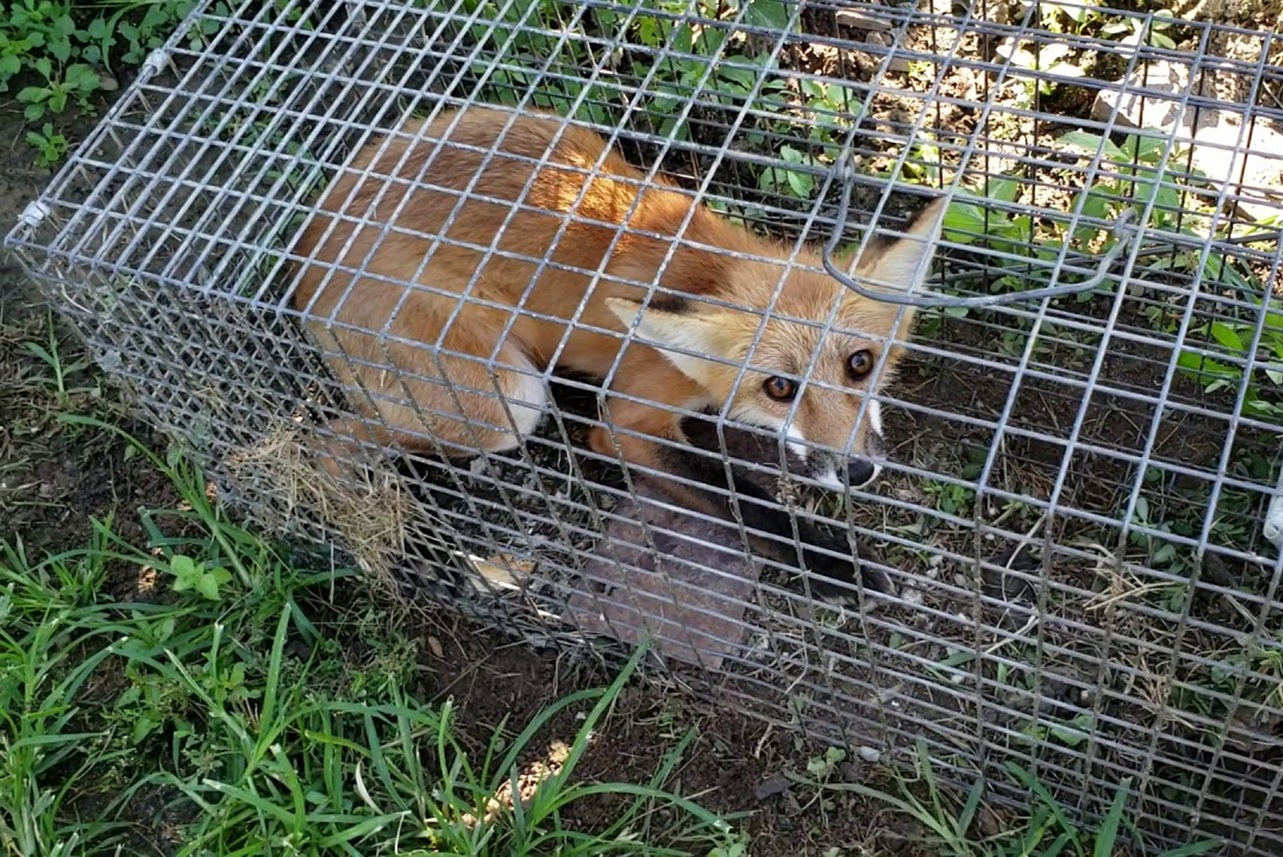
Trap hunting refers to the capture of wild animals using mechanical devices that trigger autonomously and without the presence of a hunter. The animal falls into a trap and is either caught alive or killed by the construction. The central problem lies not in individual misapplications, but in the principle itself: The suffering occurs out of sight. Stress, injuries and miscaptures are systemic. In Switzerland, trap hunting is largely prohibited at federal level – only narrowly defined exceptions are permitted, particularly box traps for live capture. In cantonal practice and in the area of self-help, grey areas nevertheless arise that are not tolerable from an animal welfare perspective.
Decisive for the debate: The Wildlife Protection Switzerland association states in its position on the Graubünden revision that a 'trap hunting should be banned' formulation factually changes nothing as long as hunters are still allowed to use box traps. It demands that only wildlife wardens be allowed to set traps – and only when no other possibility exists.
What awaits you here
- What trap hunting is and how it works: Trap types, procedures and the structural core problem of absence.
- Legal situation in Switzerland: Federal law, JSV revision 2025, cantonal practice – and what Canton Zurich specifically permits.
- The self-help problem: Where grey areas arise because laypeople are allowed to set traps.
- Miscaptures: Not an operational accident, but a system feature: Why traps cannot distinguish between target species and domestic cats.
- What research shows about live traps: Cortisol, capture myopathy, injuries – science refutes the myth of the 'gentle' live trap.
- Winter trapping and the lure principle: Why season and bait are particularly critical.
- Control as systemic failure: Why traps are not adequately monitored in practice.
- Human Trapping Standards: What the EU and international agreements say: AIHTS, EU standards and the limits of this regulation.
- Demands: What genuine transparency and comprehensive protection would mean.
- Arguments: Responses to the most common justifications.
- Quick links: All evidence, studies and dossier contributions.
What trapping is and how it works
Trapping differs from other hunting forms through one central characteristic: The trap acts autonomously. It is set up and reacts mechanically to movement, scent or bait – without a hunter being present. This very absence makes trapping particularly problematic from an animal welfare perspective: There is no possibility to intervene immediately when something goes wrong.
The main trap types:
- Box traps (live capture): Confine the animal in a narrow, often dark space. Are the only legally permitted exception in Switzerland under strict conditions. Wire box traps cause significantly more stress than darkened wooden constructions, because the animal sees its surroundings and tries to escape, which can lead to severe injuries to mouth, paws and teeth.
- Kill traps: Designed to kill the animal instantly. With malfunction or incorrect placement, they lead to prolonged, agonizing death processes. Banned at federal level in Switzerland.
- Spring traps, snares, glue traps: Generally banned in Switzerland. Nevertheless, there is illegal use in border areas and in the legal grey zones of hunting law.
In both permissible and impermissible categories, the principle applies: The animal can neither escape nor call out. It suffers without witnesses.
More on this: Den hunting and Hunting dogs in recreational hunting operations
Legal situation in Switzerland: Federal law, JSV 2025 and cantonal practice
At federal level, the legal situation is clear: The hunting ordinance JSV prohibits the use of most traps in principle. Only narrowly defined exceptions are permissible. The revised JSV came into force on 1 February 2025 – without fundamental changes to trap regulations.
Zurich canton's position is exemplary: The cantonal hunting ordinance permits box traps for live capture of fur-bearing game in residential areas as well as in and around residential and commercial buildings. This sounds narrowly limited – but in practice it is not always so. Control intervals are prescribed, implementation is difficult to verify. In the Graubünden draft hunting law revision 2025/2026, trapping was formally banned – while simultaneously box traps remained permitted. Wildtierschutz Schweiz describes this aptly: «Nothing has changed.»
The STS document on self-help measures states: Traps are generally banned, box traps are the only exception – and even these are only justifiable if control, expertise and short capture times are guaranteed. Precisely these conditions are difficult to ensure comprehensively in practice.
More on this: Hunting laws and control: Why self-regulation is not enough and Recreational hunting starts at the desk
The self-help problem: Laypeople set traps
The area of self-help is particularly critical. Under certain conditions, private individuals or farmers may take measures against wildlife if significant damage is claimed. In cantonal practice, box traps are thus effectively shifted from professional hunting operations into an area where expertise, animal welfare-compliant application and effective control are systematically lacking.
In the Canton of Zurich, animals killed under self-help measures must be reported to the hunting association within 24 hours. What happens before this reporting is uncontrolled. Anyone setting up a box trap does not have to prove in practice that they actually checked the trap multiple times daily. Those who catch a cat instead of a fox usually do not report it. The self-help principle thus creates structural control failure – while simultaneously legitimizing it legally.
More on this: Unseriöse Schweizer Jagdverwaltungen and Verbot tierquälerischer Fallen- und Lockjagd (Mustervorstoss)
Bycatch: not operational accidents, but system characteristics
Traps do not distinguish. They react mechanically to anything that exceeds their trigger threshold. This means: bycatch is not an exception, but a predictable and structurally unavoidable feature of the method. In residential areas, this particularly affects:
- Domestic cats: One of the most frequent 'bycatch' in box traps in residential areas. Especially in wire cage traps, cats suffer severe injuries from panicked escape attempts – injuries to mouth, teeth and paws that can permanently prevent the animal from eating.
- Protected wildlife: Polecat, stoat and other marten species with protected status end up in the same traps set for foxes.
- Young animals: Smaller and less wary animals fall into traps more easily than adult target individuals.
For the affected animal, the legal classification plays no role. The situation of fear, confinement and loss of control is the same – regardless of whether the trap was legally set.
More on this: Jagd und Tierschutz: Was die Praxis mit Wildtieren macht and Wildtiere, Todesangst und fehlende Betäubung
What research shows about live traps
Live traps are often portrayed as a 'gentler' alternative because the animal is not immediately killed. Scientific studies paint a different picture:
- Bosson et al. (2012, Journal of Zoology) show that even short time in a live trap measurably alters stress hormone profiles of wild animals – this even falsifies biological baseline measurements that are supposed to be collected in field studies.
- Delehanty & Boonstra (2009) examine stress profiles in the context of live capture and establish: even short capture times produce measurably high cortisol loads.
- Huber et al. (2017, BMC Veterinary Research) measure 'capture stress' in roe deer: heart rate, body temperature and blood parameters increase significantly. The study documents how much capture and handling circumstances determine physiological stress.
- 'Capture myopathy' is a muscle disease that can be triggered in wild animals by extreme stress reactions during capture. It leads to muscle necrosis and can be fatal, even if the animal is released after capture.
The conditions that would make live traps scientifically defensible – very short capture times, permanent control, high professional competence – cannot be reliably guaranteed in the practice of Swiss trap hunting.
More on this: Studien über die Auswirkung der Jagd auf Wildtiere und Jäger
Winter trapping and the luring principle
In several cantons, trap hunting also takes place during winter months. Animals are lured with food or scent substances. Especially in winter, the energy balance of wild animals is critical: cortisol release through capture stress mobilizes energy reserves that the animal urgently needs for thermoregulation in the cold. Stress, movement restriction and panic can have particularly fatal consequences during this season.
The luring principle exacerbates the ethical problem: The animal is not surprised in a natural situation. It is actively led into a trap – through food that signals safety, and a situation that means threat. This breach of trust may not be a legal argument, but it is an ethically relevant element that receives too little weight in public debate.
Control as structural failure
Trapping is only as controllable as the surveillance of the traps – and this is precisely the systematic weak point. Traps lie hidden, often away from public paths. Control intervals are prescribed but not verifiable. Documentation is rarely publicly accessible. Who has checked a trap need not prove this anywhere.
Recreation seekers, dog owners and residents usually only notice traps when an animal is already caught – or when a pet goes missing. The social control that emerges at least partially through visibility in other hunting forms is structurally absent in trapping. The more hobby hunting is outsourced to invisible, autonomous processes, the lower the chance of detecting abuses early, and the more democratic legitimation of this practice declines.
More on this: Independent hunting supervision: External control instead of self-control (model motion) and Transparent hunting statistics (model motion)
Human Trapping Standards: What international agreements say
The Agreement on International Humane Trapping Standards (AIHTS) is an international agreement concluded between the EU, Canada, Russia and the USA. It defines minimum standards for trapping methods and prohibits traps that do not meet these standards. The agreement primarily serves international fur trade and has weaknesses: It continues to allow numerous trap types that are problematic from an animal welfare perspective, and its implementation lies with the contracting states.
The EU Commission recognizes Human Trapping as a relevant animal welfare issue and strives for a 'sufficient welfare level' for trapped animals. However, 'sufficient' is not an animal welfare standard – it is the lower end of a compromise between animal welfare and trade interests. Switzerland is not a member of the EU and thus not directly bound by the AIHTS. Swiss animal welfare standards must therefore be defined autonomously – at a higher level than the international minimum.
Demands
- Box traps exclusively by wildlife management: No laypeople, no farmers, no hobby hunters – traps may only be set by trained state personnel.
- Live capture only for relocation, not for killing: Captured animals must be released in more distant areas, not shot.
- Transparency obligation: Public statistics on trap locations, control times, bycatch, injured or deceased animals as well as follow-up controls.
- Ban on winter luring: Baits and scents for trap activation are prohibited in the months November through March.
- End of self-help traps by laypeople: The self-help principle for box traps is limited to documented exceptional situations with prior authorization by an independent authority.
- Priority for prevention: Waste management, structural measures, conflict counseling and monitoring are more sustainable and animal welfare-appropriate alternatives. Trapping must not remain the standard solution where prevention would be simpler.
Arguments
'Box traps are animal-friendly because the animal does not die.' The animal may not die immediately – but it suffers measurably. Scientific studies document significant stress hormone levels after just a short time in box traps. 'Capture myopathy' can be fatal even after release. And: What happens next is often a killing shot in practice – the permitted method for captured wild animals in Switzerland. The box trap is not an endpoint. It is step one in a system designed for killing.
'Trap hunting is necessary for pest control.' Pest is not a biological category. Foxes and martens are native, ecologically important animal species. Where real conflicts arise – livestock are killed, buildings are inhabited –, there are effective, non-lethal alternatives: structural exclusion, livestock protection, waste management. These solve conflicts at their source. Trap hunting solves them in secret and temporarily.
'Control intervals prevent prolonged suffering.' Control intervals are only as effective as their enforcement. Who checks that a trap was actually inspected twice daily? No one. There is no independent documentation requirement, no random checks by state authorities, no public statistics. The regulation exists – its enforcement is not structurally secured.
'Only the use of box traps is permitted – everything else is prohibited.' This is formally correct at the federal level. In practice, self-help regulations, cantonal differences and lack of enforcement create grey areas that systematically circumvent this prohibition. Wildtierschutz Schweiz explicitly states regarding the Graubünden revision: 'Nothing has changed.' A prohibition that does not change practice is not protection.
Quicklinks
Articles on Wild beim Wild:
- Trap hunting – Dossier Original Article (January 2026)
- Ban on animal-torturing trap and lure hunting (Model motion)
- Statement by Wildtierschutz Schweiz on the hunting law revision in Graubünden
- Hunting and animal welfare: What practice does to wild animals
Related dossiers:
- Hunting and wildlife diseases
- Night hunting and high-tech hunting: How thermal imaging cameras, night vision devices, drones and digital lure calls expose the fairy tale of fair hunting
- Hunting dogs: Use, suffering and animal welfare
- Lead ammunition and environmental toxins from hobby hunters: How a toxic legacy burdens birds of prey, soils and humans
- Driven hunting in Switzerland: Traditional ritual, violence zone and stress test for wild animals
- African swine fever: How an animal disease becomes justification for hobby hunters
- Hunting accidents in Switzerland
- Hunting and animal welfare: What practice does to wild animals
- Hunting and weapons
- Driven hunting in Switzerland
- Stand hunting: Waiting, technology and risks
- Den hunting
- Trap hunting
- Pass hunting
- Special hunting in Graubünden
Our standards
Trap hunting is the invisible form of hobby hunting. The animal suffers without witnesses, dies without control and disappears without statistics. This is precisely why this method needs the sharpest transparency: Those who set traps must document. Those who cause unwanted catches must take responsibility. And those who ignore alternatives must be able to justify this. This dossier compiles legal foundations, study findings and control failures so that the debate begins where animal welfare ends: in secret. It will be continuously updated when new revisions, judgments or studies require it.
Call to Action: Do you know of cases of unwanted catches, uncontrolled traps or missing pets in connection with box traps? Report them to us: wildbeimwild.com/kontakt
More on the topic of hobby hunting: In our hunting dossier we compile fact checks, analyses and background reports.