Wild boar enclosures in Switzerland: pure animal cruelty
Wild boar enclosures originated in East Germany in the 1950s. Recreational hunting dogs are “tested” there on hand-tame wild boars. The enclosure produces unnatural behaviour and is contrary to animal welfare standards. More on recreational hunting.


The notorious wild boar enclosures originated in the former East Germany in the mid-1950s.
Work in the wild boar enclosure is supposedly used to assess how a hunting dog behaves around wild boar — whether the dog reacts aggressively or too timidly. The wild boars in the enclosure are hand-reared and accustomed to dogs and people.
As a result, they display behaviour that would not occur in the wild — least of all when fear and panic are added to the mix during actual hunting practice, such as driven and battue hunts.
No realistic training possible
Nor can the enclosure replicate how a dog performs in real hunting situations — for example, when multiple dogs are chasing and baying wild boar sounders. Equally, the behaviour of dogs that, through experience, become increasingly aggressive towards wild boar with age — and are therefore more frequently injured by them — can never be practised or even monitored in a wild boar enclosure.
Injuries to the wild boars — animals that will never leave this enclosure alive — nevertheless occur. They are subjected to severe stress during training sessions on a continuous basis. The dogs rotate constantly, as recreational hunters come from all directions to train their animals. For the wild boars, however, there is no respite. Being chased, pursued, and cornered is their daily reality.
From an animal welfare perspective, work in wild boar enclosures and earth dog trial facilities must be clearly rejected. It is a training method conducted on live, hand-tame animals — taken from the wild or from zoos — that spend their lives confined to an enclosure and are killed once they are no longer of use or are deemed unsuitable.
Clearly unacceptable from an animal welfare standpoint
Experience has shown that severe injuries to animals occur time and again during work in the enclosure — analogous to the earth dog trials with foxes — and at the latest during hunting with trained hunting dogs.
The Stiftung Tier im Recht (Foundation Animal in Law) has produced a landmark legal opinion on this matter, which makes it clear that, from the perspective of animal welfare law, the practice of earth hunting, for example, fulfils the criminal offence of animal cruelty in several respects.
The question also arises as to what happens to dogs that fail to demonstrate the desired performance in the wild boar enclosure, or that are certified as unsuitable for wild boar hunting. There is reason to fear that many of these dogs are put to use regardless, or are disposed of by recreational hunters as useless — in keeping with the hunting motto:
«Whoever wants to reap boars' heads must be willing to sacrifice dogs' heads.»
Working in a wild boar enclosure is not necessary for practical hunting. Until now, there have always been enough well-trained dogs from abroad capable of performing this work to a suitably high standard.
A declaration of bankruptcy by the recreational hunters
To now invoke wild boar enclosures under the flimsy pretext that this form of hunting dog training would help address the wild boar overpopulation — a problem partly caused by recreational hunters themselves — is not only yet another declaration of bankruptcy on the part of the recreational hunting community.
There is a strong suspicion that precisely now, when training on live animals is facing intense criticism, hunting associations have a heightened interest in also training their dogs on live wild boar.
Furthermore, it is well known that the hunting dogs of recreational hunters not infrequently spend the entire year leading a miserable and cheerless existence in a kennel, only being let loose during the hunting season.
Some recreational hunters also appear to see an opportunity to increase the breeding value of their dogs by demonstrating their performance in a wild boar enclosure.
It is to be expected that in the future many dogs will be tested in wild boar enclosures solely for these purposes, and that extremely dangerous dogs may be bred as a result.
This means that precisely those dogs that show extraordinarily little natural respect for wild boar are to be promoted for hunting purposes — and this problematic behaviour is to be further encouraged through training in enclosures! Dogs selected in this way could also pose a danger to their surroundings if they “transfer” what they have learned to other situations without commands, whether due to boredom, insufficient mental stimulation, excessive aggression, displacement behaviour, false association, sensory overload, etc.
The Swiss Animal Protection organisation (STS) recently published a position paper on what to make of the training and use of hunting dogs in Switzerland — namely absolutely nothing (except for tracking wounded game).
Experience from Germany (where there are at least 19 enclosures distributed across the country) also shows that wild boar enclosures cannot sustainably reduce either agricultural “damages” or the wild boar population to the desired extent. What is often referred to as damage is not damage at all, but natural behaviour.
Recreational hunters, farmers, and foresters cause far more serious damage in forests and fields.
Wild boar enclosures promote driven hunts and battue hunts, and thus miserable meat quality, animal cruelty, dog abuse, and so on.
Cantons of Zurich and Aargau show interest
A working group of the Hunting and Fisheries Administrators’ Conference (JFK) — the association of cantonal hunting administrators — is currently examining where a first wild boar enclosure in Switzerland could be established, writes the FOEN. The cantons of Zurich and Aargau, among others, have expressed interest. Both cantons have recorded massive wild boar damage to agriculture in recent years — no surprise there.
The main cause of an alleged overpopulation and resulting damage always lies in incorrect hunting practices, such as the culling of lead sows by recreational hunters.
Recreational hunting has failed for decades and is responsible for damage, including through incorrect hunting practices — for example, the shooting of lead sows, which are not at all easy to identify. This is especially true during the many cruel driven hunts taking place throughout Switzerland. Recreational hunting fails as a population control measure.
The Geneva model as a blueprint
The Canton of Geneva is decades ahead with its modern wildlife management using game wardens. There, no driven hunts with dogs are needed, even though very large numbers of wild animals flee from surrounding areas into the canton of Geneva and stay there when driven hunts are practiced in France or the canton of Vaud.
«Regulation is carried out exclusively by game wardens; no amateur hunters are involved,» says Gottlieb Dandliker. For these «Gardes de l'environnement,» safety, ethics, and animal welfare play a major role: «We cannot afford a single accident.» Animal welfare means above all avoiding wounded animals. «That happens en masse in the surrounding area, in Vaud, in France. Driven hunts are conducted there, animals are shot and wounded, and they are found or not found — or only a week later,» reports the fauna inspector. «Stress situations like those during driven hunts — where the animals know: that was a truly terrible thing — do not occur in our form of regulation.» Lead sows are not shot — for ethical reasons. Because when the nursing mother is absent, the young die. The lead sows and large boars are also not shot. «In doing so, we hope to achieve stability within the sounder and in the animals' behavior,» explains Dandliker. «We regularly have groups of wild boar orphans here from the French hunt, who have lost their mother and come into the villages.» Such leaderless piglets can of course cause great damage. And it is well known that wild boar reproduce uncontrollably after the lead sow has been shot.
Immunocontraception as an ethical alternative
In other countries such as England or Italy, wild boar are managed in an even more ethical and animal-welfare-friendly way through birth control (immunocontraception).
Immunocontraception is used today to limit animal populations in the wild or in zoos. Unlike hormonal methods, immunocontraception has virtually no side effects. So far, immunocontraceptive applications have been successfully tested in over 100 different animal species, including wild horses, deer, wild boar, bison, squirrels, dogs, cats, African elephants, and others. Studies have shown that deer treated in this way are, for example, infertile for up to 5 years.
Wild boars, naturally diurnal animals, have adapted to humans and shifted their activities largely to the night. These shy animals have an excellent sense of smell and very good hearing. Even the click of a rifle bolt being engaged or a weapon being released from safety is enough to prompt them to retreat (Animal Portrait: Wild Boar).
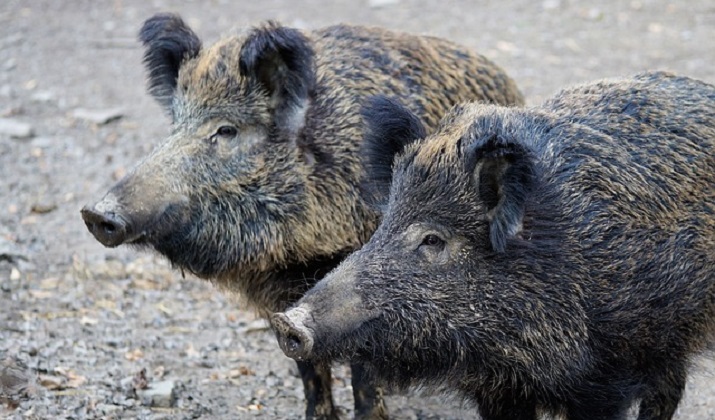
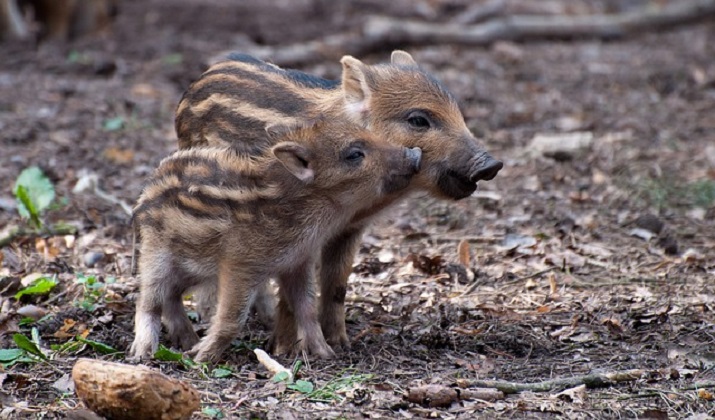
In addition, wild boars are capable of learning. If a sow has had a bad experience in a particular place, she will avoid that spot for an extended period. And because wild boars — with the exception of older, solitary boars — always travel in sounders, meaning in groups of 2 to 3 sows and several young animals, a collective knowledge develops. Researchers believe that the strong social structure is one of the main reasons why wild boars are so difficult to hunt. So difficult, in fact, that hunting parties frustratedly throw in the towel or keep devising ever more cruel methods.
The IG Wild beim Wild calls for new, meaningful, and sustainable approaches to solving today's problems.
The actions of recreational hunters in wild boar enclosures and on hunts are diametrically opposed to Swiss animal welfare laws, e.g. Art. 26 and Art. 4.
Recreational hunting has never — historically or today — constituted wildlife management, and it produces more harm than good. Hunting statistics have for decades told a clear story of who is responsible for animal cruelty, damage, overpopulation, environmental destruction, violence, abuse, disrespect, falsehoods, brutality, and so on.
More on this in the dossier: Hunting and Animal Welfare