The Wild Boar

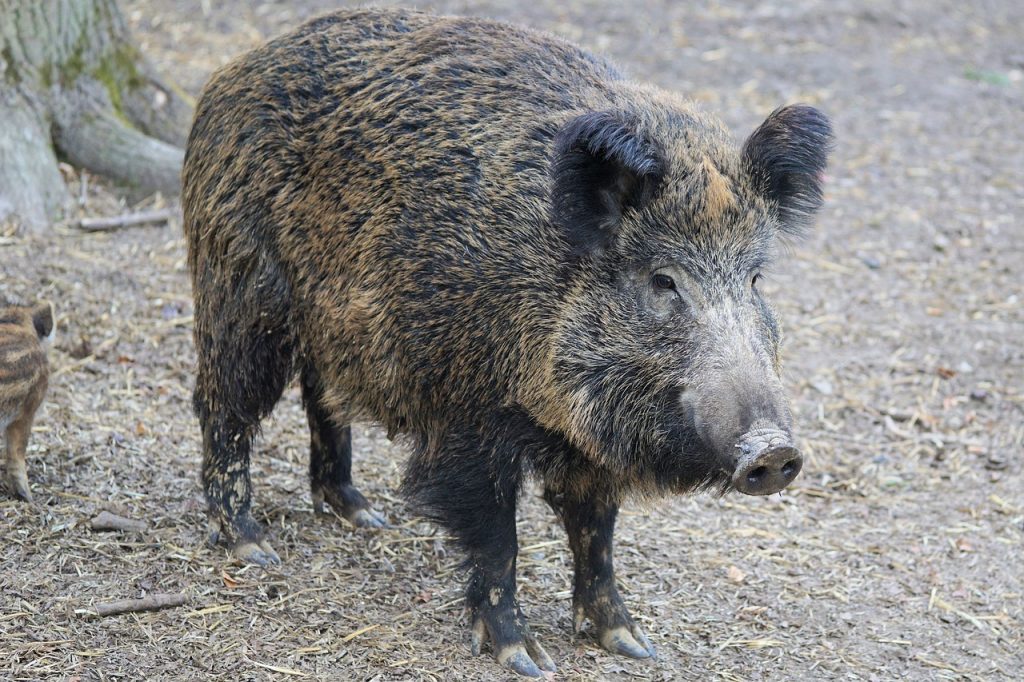
The wild boar (Sus scrofa) is an even-toed ungulate and a close relative and ancestral form of the domesticated pig.
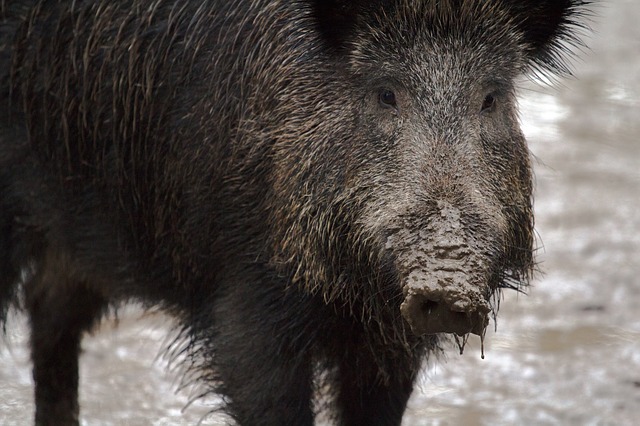
The adult male can be distinguished from the female – when viewed from the side – by the shape of its snout. While it runs long and straight in females, it appears shorter in males. Wild boars are great adaptability artists. They can be found in cities, meadowlands and preferably in deciduous or coniferous forests.



![Track in snow Photo: James Lindsey at Ecology of Commanster [CC BY-SA 2.5]](https://wildbeimwild.com/wp-content/uploads/2016/03/sus-scrofa-tracks-on-snow.jpg)
Interesting facts about the wild boar:
- Wild boars are between 130 and 180 cm long and their shoulder height is about 55 to 100 cm.
- The coat is dark grey to brownish-black in winter with bristly guard hairs and in summer free of wool hair with light-colored and soft hair tips.
- Wild boars weigh approximately 50–150 kg.
- Wild boars have 15–40 cm long tails.
- Wild boars have a strong set of teeth with 44 teeth. The tusks on the lower lip are one of the most distinctive features of a wild boar. The tusks in males are longer and curved. Unlike sows, boars possess additional tusks on the upper lip that are used to sharpen the lower ones. Boars use their tusks during mating season for hierarchical fights.
- Wild boars have a long, rubbery snout that is used for digging up roots and tubers.
- Wild boars are omnivores. Rooting through the soil while foraging leads to an increase in biodiversity and germination capacity of plants.
- Wild boars live together in maternal families, harems or groups of yearling animals. Particularly male animals live as loners. In a sounder with a lead sow, 6–30 animals live together.
- The natural enemies of wild boars are wolves, brown bears, lynx, foxes, and wildcats. Birds of prey also occasionally capture young animals.
- As a result of intensive hunting by humans, wild boars today are mostly shy and nocturnal. Males during mating season and females with piglets can occasionally become aggressive toward humans, primarily when they are accompanied by dogs. During the day, wild boars sleep up to 12 hours in nests made of leaves.
- Wild boars enjoy moving through the most diverse habitats.
- Mating season is from November to January.
- After a 115-day gestation period, a sow gives birth to four to six piglets between March and May.
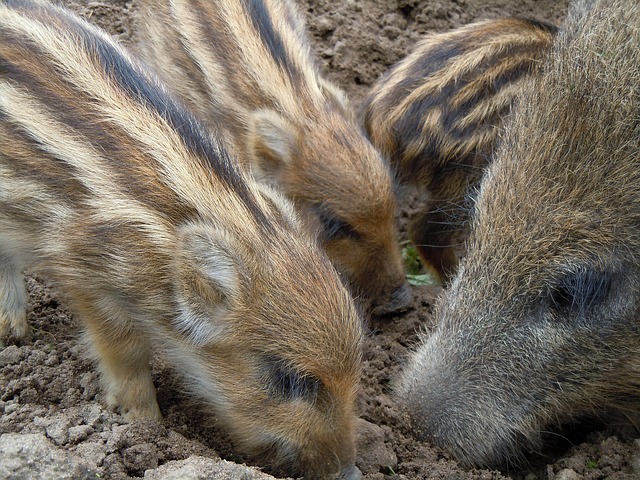
- Young animals are born in nests made of leaves. The piglets are born sighted and with hair (bristles). The mother takes care of raising them.
- Piglets have light yellowish-brown fur with yellowish stripes that serve as camouflage. The stripes disappear from the fourth month onward. After one year, they look like adults.
- After 7 months, the young animals are no longer dependent on their mother. However, a bond with the mother can last up to 18 months. Mortality among young animals is very high due to cold snaps, wet periods and predators.
- In the wild, wild boars live up to 10 years. In captivity up to 21 years.
- In Switzerland, around 6,000 wild boars are currently shot per year. If wild boars are left in peace, they live together in stable communities where typically only the lead sow produces offspring. Pheromones – chemical signaling substances that transmit information among members of the same species – are omnipresent in the animal kingdom. In domestic pigs, many studies have shown that in addition to pheromones, social hierarchy influences the regulation of reproduction. If this sensitive social structure is destroyed through hunting, it can lead to explosive population growth.
What does Wild beim Wild do to protect wild boars?
We are committed to ensuring that populations and their habitats are preserved and connected with each other. Natural corridors enable genetic exchange between individual populations. Not only the protection of predators, but also of their prey animals is an essential part of our work. This happens by defending wildlife from unnecessary hunting and poaching wherever possible.
Animal Portraits