The Badger
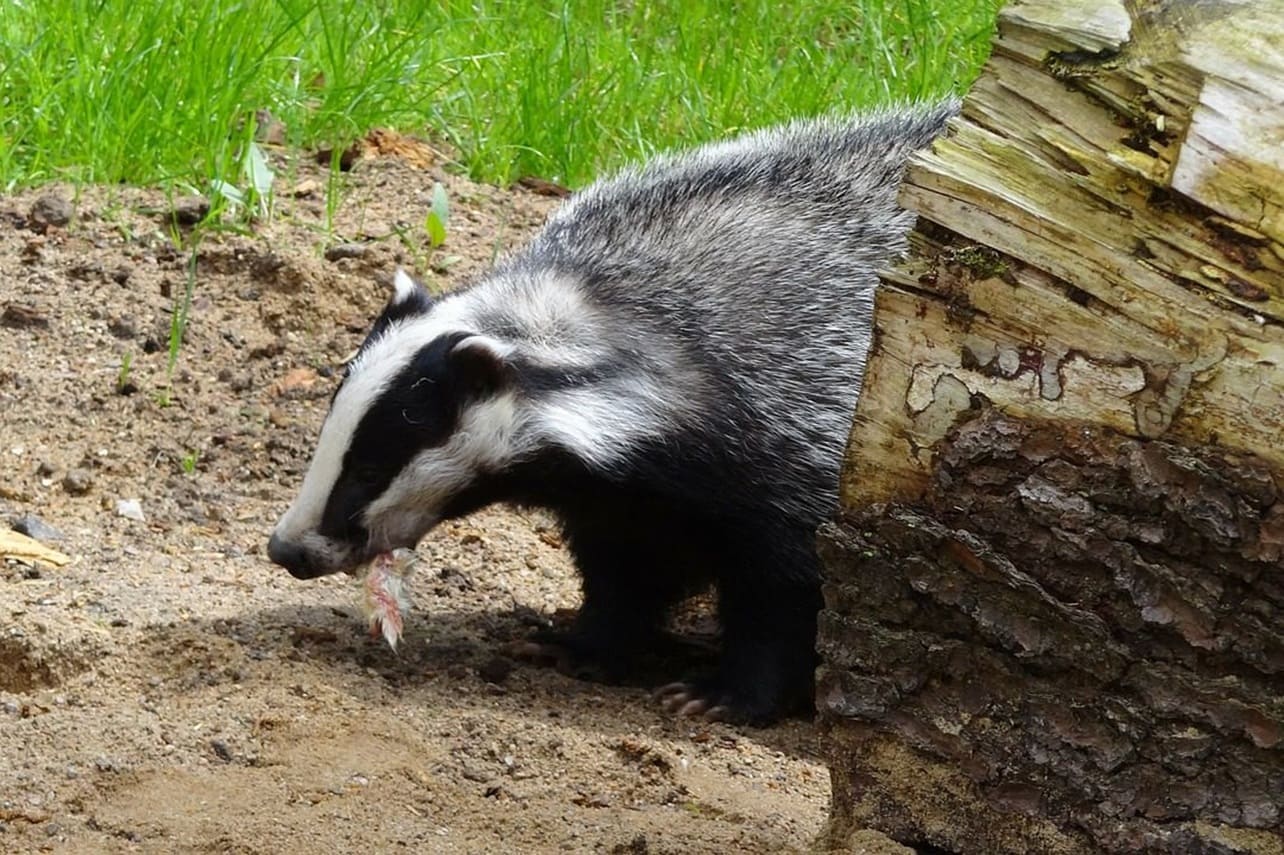
The Badger (Meles meles) is a short-legged, omnivorous mammal from the family of mustelid predators, like otters, polecats, weasels and wolverines.
Deciduous and mixed forests of the lowlands and low mountain ranges are its habitat. In the mountains, its habitat can extend up to 2000 meters altitude. Increasingly, badgers are also found in urban green spaces. Badgers are believed to have spread westward from Asia.


Interesting facts about the badger:
- The badger can reach up to 90 cm in length and weigh 7 – 22 kg and become massive. Its weight depends on age, sex, habitat and season. Females are generally lighter than males. External visual sex determination is not possible.
- The fur is black underneath and silvery-grey on top and is shed once a year. The skin underneath is pink-colored.
- The face is white and has black stripes on both sides, running from the nose over the eye to the ear.
- Badgers have a stocky-looking body and short, black legs. The front feet are equipped with strong claws, which the badger, unlike cats, cannot retract. Therefore, claw marks are always visible in tracks. The claws are suitable for digging up soil. The loosened material is pushed outside with the hind legs.
- Badgers have an approximately 15 cm long tail.
- Badgers have an extremely strong set of teeth with 38 teeth. The dagger-like canine teeth in the upper jaw are strongly developed, the carnassial and molar teeth rather blunt. The lower jaw is firmly locked with the upper jaw in the skull. Dislocation of the jaw is nearly impossible. This enables badgers to hold on tenaciously when biting in defense. Nevertheless, it is not a typical predator dentition like that of a cat, for example.
- Badgers have an excellent sense of smell, however the short-sighted badgers cannot recognize colors, but can see contrasts.
- Like several other animals that dig extensively, badgers have small ears. They can close these while digging, which helps them keep them clean.
- Badgers can run or gallop for short periods at 25–30 km/h.
- The badger is considered a site-faithful animal. In areas with viticulture, however, it often migrates several kilometers when berries ripen.
- Badgers have an extensively branched burrow system with up to 30 m diameter, mostly at forest edges with surrounding fields and meadows. The fox is often taken in as a subtenant. At about five meters depth lies the living chamber, which is connected to the surface through numerous tunnels. These tunnels serve for air supply and as entrances and exits. Unlike the fox, the badger cushions the living space of its burrow with dry leaves, moss or ferns. A badger sett can be used for decades or presumably even centuries. Each generation expands it further and adds additional living chambers. A badger sett examined in England comprised 50 chambers and 178 entrances, connected by a total of 879 meters of tunnels.
- The peaceful badgers are omnivores and it is a natural pest controller. Roots, mushrooms, seeds, tubers, fruits, honey, windfall, corn, oats and small animals like insects, mice, ant hills and snails are dug from the ground with its funnel-shaped nose. Worms are the main food, beetles a delicacy. The badger does not hunt, but collects everything lying on the ground that is edible.
- Badgers are occasionally seen «intoxicated» after eating rotten fruit.
- By autumn, it has eaten up a winter reserve.
- Badgers are distinctly secretive and adaptable nocturnal animals that rely on their good nose. In colder regions they maintain a winter rest, which depending on climatic conditions can last from a few days to several months. During this time it occasionally leaves the burrow to use its badger latrine, a small pit away from the burrow.
- Natural enemies are wolf, lynx, birds of prey and occasionally brown bears. Badgers can swim excellently when necessary.
- The badger grunts as soon as it feels threatened. The call during mating season resembles a human scream.
- Badgers have a high juvenile mortality of up to 75 percent due to wetness and cold. Additional dangers are road traffic and diseases.
- Like all martens, badgers can spray a liquid from glands below the base of the tail, which serves for marking. This delimits a badger territory of a clan.
- Badger pairs are faithful to each other for life and social.
- Badgers become sexually mature at about one year of age. The main mating period is in July and August. Badgers have delayed implantation. The actual embryonic development is only 7–8 weeks until birth. This delayed implantation is also known in other animal species, e.g. in roe deer, pine marten, stone marten and ermine. Badgers are born in Central Europe in February or March. A litter comprises one to six young, but usually two. They are completely white and blind; the black spots in the fur only develop later. The males are tolerated until about October, sometimes even until after the winter rest in the burrow. After that, the male and some female offspring leave the burrow.
- Badgers live 15–18 years.
- The massive, officially ordered gassing of red fox dens led to a dramatic population decline of the badger until the 1970s. Meanwhile, the populations are recovering again, and the badger is quite common again in some places. Badgers are often hunted using live traps. The hunting bag in Switzerland is around 2'500 per year. Continuously, even more fall victim to road traffic. The population regulates itself largely independently according to population biological findings through food supply and diseases. Deterrence is the best defense to protect a lawn. Badgers are harmless to humans and pose no danger to agriculture, forestry, or wild and domestic animals. Badgers do not attack cats. When they must defend themselves against dogs, usually the dog loses.
What does Wild beim Wild do to protect badgers?
We are committed to ensuring that populations and their habitats are preserved and connected with each other. Natural corridors enable genetic exchange between individual populations. Not only the protection of predators, but also of their prey is an essential component of our work. This happens by defending wildlife from unnecessary hunting and poaching wherever possible.
Animal Portraits