The Golden Jackal

The Golden Jackal (Canis aureus) is a canid species closely related to the wolf.
It is spreading from the Middle East increasingly into northern and western Europe. Climate change has favoured its distribution since the 1980s. Golden jackals are highly adaptable and prefer open landscapes. They avoid dense forests and snow-rich high altitudes. The golden jackal was not brought by humans to another distribution area and is therefore not a neozoan. Golden jackals are widespread throughout the Balkans, in Romania and eastern Hungary they occur extensively.


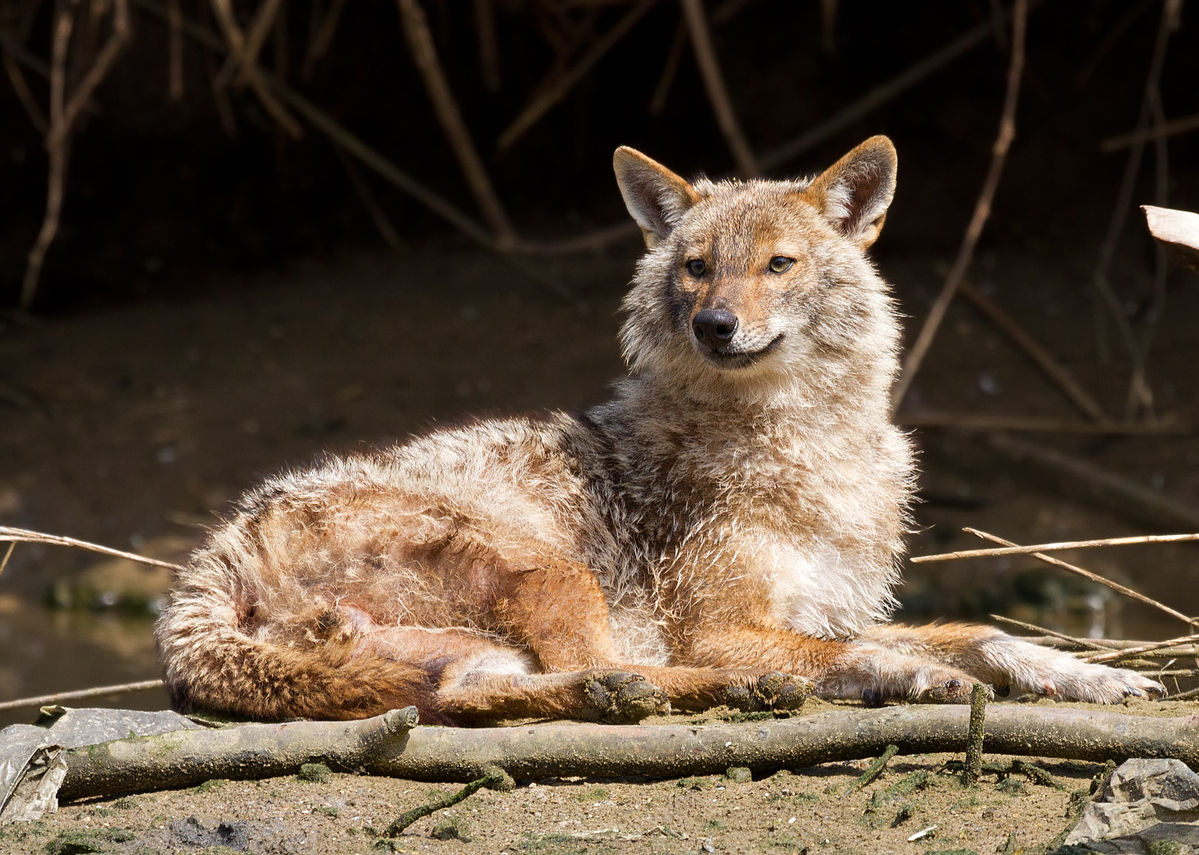


Interesting facts about the Golden Jackal:
- The Golden Jackal is between 80 and 95 cm long and the shoulder height is about 35 to 50 cm. It is smaller than the wolf, but larger than the red fox.
- The fur is normally golden yellow, rust-colored or silver-colored.
- Jackals weigh approximately 8–10 kg.
- Jackals have bushy, 20–30 cm long tails.
- Jackals are opportunistic eaters. They eat whatever is available: snakes and other reptiles, ungulates, insects, fruits, berries and sometimes even grass. Carrion is only occasionally on the menu.
- Jackals can be solitary, part of a pair or member of a social pack. Pack life provides protection from predators and ensures larger prey.
- The main enemies of the jackal are hunters, wolves and eagles. Young animals in particular are threatened by eagles.
- Jackals are territorial animals. They mark with urine and defend their territory.
- Jackals are fast sprinters. They can reach up to 65 km/h. Usually, however, they only travel at 15 km/h over longer periods.
- Jackals are very vocal. They use various whimpering, howling and barking sounds to communicate. They produce siren-like sounds when they have located food. Jackals only respond to sounds from their own family. They ignore all other calls.
- Jackals are rarely seen in the wild because they are crepuscular and nocturnal.
- Mating season in Europe is from December to March.
- Jackals have a lifelong monogamous relationship for reproduction. After a 60-day gestation period, a litter of six to nine pups is born.
- Young are born in cave-like environments. The mother changes location every 14 days to protect them from predators. Young are born with fur and are completely blind for the first ten days.
- After six months, the young are no longer dependent on their parents. However, sometimes one or two young remain with their parents to help raise the next litter. These then take turns with the parents in guarding the den and bringing food. Jackals reach full sexual maturity after 20 months.
- In the wild, jackals live 8 to 9 years. In captivity up to 16 years.
- In Switzerland only individual animals have been sighted so far: In winter 2011/12, according to camera traps, at least one individual was present in the cantons of Bern, Vaud and Fribourg. In January 2016, a Golden Jackal was killed in Graubünden and in March one in Canton Schwyz.
What does Wild beim Wild do to protect Golden Jackals?
We work to ensure that populations and their habitats are preserved and connected with each other. Natural corridors enable genetic exchange between individual populations. Not only the protection of predators, but also of their prey is an essential component of our work. This is done by defending wildlife from unnecessary hunting and poaching wherever possible.
Animal Portraits