Low Milk Prices Prevent Innovation
Raising calves together with their mothers is not only more animal-friendly than the otherwise common practice of separation, but also reduces the use of antibiotics.

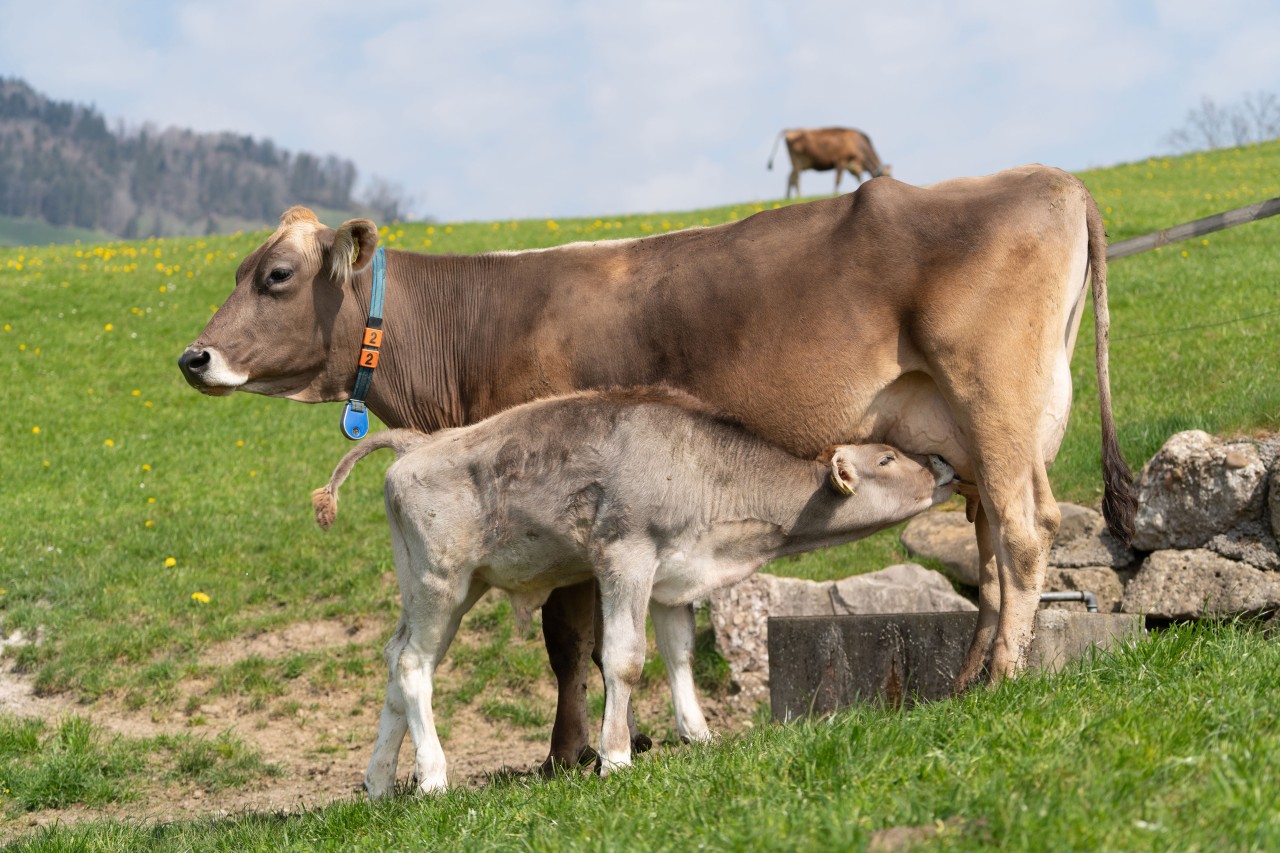
To maximise milk yield, dairy cows have their calves taken away shortly after birth.
The Zurich Animal Protection Organisation is calling on the federal government and the industry to promote the animal-friendly mother-calf husbandry system – so that there can be a happy ending for cows, calves, and farmers.
The dairy cow suffers: as a calf from being separated from its mother, as a cow from the loss of her calves, and as a farm animal from high performance demands and the resulting health deterioration. Today’s intensive milk production only works with large amounts of concentrated feed and antibiotics.
In «Tyra – the Story of a Swiss Dairy Cow» the Zurich Animal Protection Organisation outlines a way to change the sad fate of the dairy cow: by allowing her to be a mother.
The most animal-friendly milk comes from mother-calf husbandry
Normally, dairy cows have their calves taken away shortly after birth. But innovative farmers allow calves to suckle from their mothers while still milking them – because today’s cows produce more milk than a calf needs.
This is the most animal-friendly form of milk production. The stress of separation after birth is eliminated, and cow and calf develop a close bond. The calf benefits from its mother’s presence: it is licked, nursed, protected, and learns natural social behaviour. As a result, calves also do not develop behavioural disorders such as cross-suckling.
Nadja Brodmann from the Zurich Animal Protection Organisation
No preventive antibiotics
Less stress also means better health and fewer medications for both cow and calf. The calves stay with their mothers for at least three months, continuing to benefit from the protection provided by maternal antibodies. Traditionally, calves would be transported to a rearing or fattening operation within the first weeks of life. The stress of separation and transport causes a collapse of their immune system, while simultaneously exposing them to unfamiliar pathogens at their new location. This system only works because all calves are routinely treated with antibiotics as a preventive measure.
The catch
Mother-calf husbandry (MuKa husbandry) is excellent for the animals, but demanding in terms of management. According to projections by the Thünen Institute (DE), a MuKa operation can yield up to 1’600 litres, or around 20%, less milk per cow per lactation — partly because the calves drink a portion of the milk, and partly because certain cows hold back some milk during milking. For a herd of 20 cows, this translates to roughly CHF 20’000, and up to CHF 25’000 less revenue per year for organic milk. Much more research is needed to reduce this loss. Among the approximately 19’000 Swiss dairy farms, there are currently only 13 MuKa operations.
Low milk prices stifle innovation
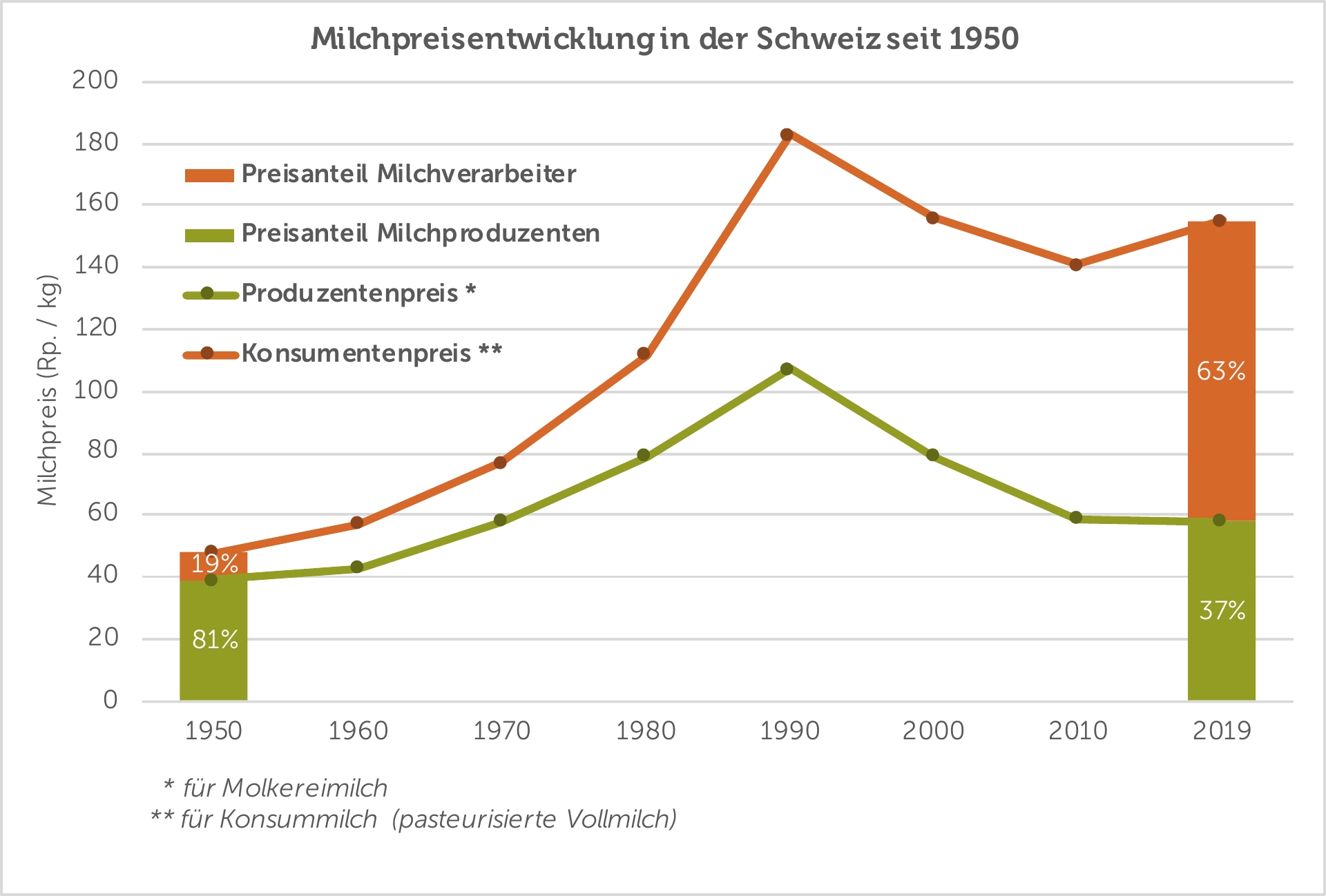
Since 1990, the milk price has fallen by around 40 centimes. Farmers today receive just 60 centimes per litre of milk. Strikingly, the farmers’ share of the price has dropped from 81% in 1950 to just 37%, while the share taken by milk processors has risen from 19% to 63%. While the latter benefit from inflated margins, producers can barely cover their costs. Brodmann criticises the unfair milk prices that are borne on the backs of farmers: «The innovative MuKa system has no chance under these conditions. At present, MuKa husbandry can only be profitable through direct marketing, which is difficult for remote farms.«
Promoting MuKa husbandry through direct payments
The agricultural budget includes around 1 billion francs for market support and around 2.8 billion for direct payments to farms, of which only 10% goes towards animal welfare contributions. «This is a glaring imbalance«, Brodmann criticizes. A survey conducted for the 2019 Agricultural Report found that Swiss animal products are preferred — for the sake of the environment, animal welfare, and farmers. If Switzerland wants to preserve this competitive advantage, a redistribution within the agricultural budget is needed, along with more direct payments in favor of advanced, innovative animal husbandry programs such as the MuKa system. «This is the key to improving animal welfare in Swiss cow barns, reducing antibiotic use in cows and calves, and achieving a happy ending for dairy cows, their calves, and farmers alike«, says Brodmann.
More on the subject of recreational hunting: The scientific evidence is presented in the overview Studies on the Effects of Recreational Hunting.
The position of IG Wild beim Wild: IG Wild beim Wild rejects recreational hunting. Our model is the canton of Geneva, which has managed without recreational hunting since 1974: without hunting seasons, without hunting dogs, without driven hunts, without high seats, without the animal cruelty and crime that go hand in hand with hunting season elsewhere. What has worked there for over fifty years disproves every position paper by JagdSchweiz. An association that bases its policy on claims it refutes in its own documents is not a professional organisation, but a factory for misinformation.