War in the forest, and everyone else is supposed to watch out
As long as the shooting goes on in the canton, others bear the risk and the wild animals pay the price.
It is high hunt season again in the canton of Grisons, and with it comes the annual guide on how hikers, cyclists, mushroom pickers and dog owners can get «safely through the hunting season».
Keep dogs on the lead, wear bright colours, make yourself noticed, don't stray off the paths, avoid dawn and dusk. The message is always the same. It isn't dangerous, as long as everyone is considerate.
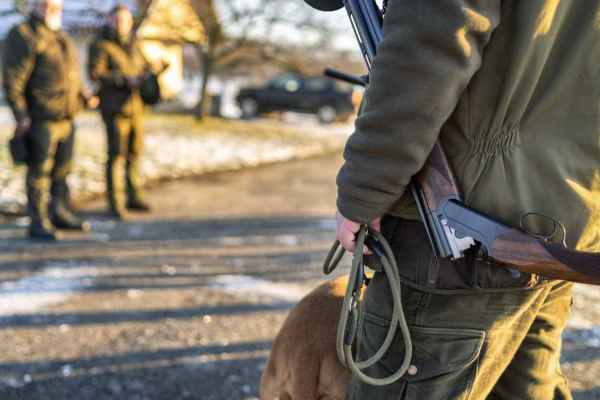
For wild animals and for everyone else who uses the forest, however, the hunting season feels like a months-long state of emergency, a war in the forest in which everybody else is expected to adapt. Because it has long since ceased to be only about the three weeks of high hunt in September. The high hunt is followed by the low hunt and the special hunt, and in parallel the proactive wolf regulation is under way. Depending on the type of hunt, the species and the region, hunting operations run from September into the winter; wait hunting and trap hunting are even provided for by law until the end of February. And the message stays the same. It is not the thousands of people heading armed into the forest who are supposed to restrain themselves, but everyone else.
The forest belongs to everyone — but not during the hunt?
This reversal deserves a second look. The forest belongs to everyone. Yet it is not only during the high hunt in September that it is effectively declared hunting territory. Over roughly half the year, this public natural space is claimed for hunting in one form or another. The price of this prioritisation is not borne by those who shoot, but by the wild animals and by everyone else who uses the forest for recreation, for exercise or with their animals. They are the ones expected to adapt so that the private licence hunting of a minority can proceed as undisturbed as possible.
Imagine another hobby group demanding that families, riders and mountain bikers alter their routes through the forest for months on end. The outcry would be certain.
The «important mandate» does not stand up to scrutiny
With the claim that hunting fulfils an «important mandate for the benefit of the general public», the authority justifies licence hunting. It is precisely this claim that deserves critical scrutiny. Robert Brunold, former president of the militant cantonal licence hunters' association of Grisons, said of the low hunt: «The low hunt is not necessary, but it is justified.»
That is remarkable. For it shows how openly necessity and justification come apart within the recreational hunting lobby. Where a form of hunting is said not to be necessary yet is still deemed legitimate, it becomes clear what licence hunting actually rests on. Not on ecological management alone, but equally on tradition, entitlement and leisure interest. If this is stated openly for the low hunt, the question arises as to how different things really are with the high hunt.
Practice supports this scepticism. Alongside the high hunt, the canton maintains the special hunt in November and December as an additional instrument. That raises the question of how viable the system of licence hunting is as a self-contained management model at all. Moreover, where hunting is intensive, nature partly compensates for the losses through stronger reproduction. A management model that regularly requires additional hunts carries its own questionability within it.
That it can be done differently is shown by the Canton of Geneva since 1974. There, professionally trained game wardens in cantonal service handle all tasks, without private individuals holding a licence. The predicted problems have not materialised in more than fifty years. In the Swiss National Park, the hunting-free area has been working for over a hundred years.
Why it is a hobby, even if the authorities call it something else
The authorities speak of an «important mandate», yet a sober examination of the term leads elsewhere. A hobby is a leisure activity pursued voluntarily and regularly, one that serves one's own pleasure or relaxation and contributes to one's self-image. That is precisely what applies to licence hunting. It is practised in the free time of people who have jobs, nobody today has to hunt in order to feed themselves, and the licence is taken out voluntarily. The term recreational hunting therefore describes in linguistically precise terms what actually happens. It is not an invention of opponents, but the accurate designation.
The fact that a hobby can nevertheless be well trained changes nothing about this. Even ambitious amateurs remain amateurs as long as they are not employed game wardens in professional service. The comparison with sport sums it up. Nobody would think of according a leisure tournament the same standing as a professional league, merely because both use the same pitch.
The difference is not hair-splitting. Professional wildlife management is measured against comprehensible criteria: actual need, efficiency, shot quality, follow-up search, animal welfare and transparent monitoring. Licence hunting must be measured against exactly the same standards. A look at the documented individual cases is sobering. In the canton of Geneva, according to figures from the hunting community itself, a professional game warden requires around eight hours for a necessary intervention in the wild boar population, whereas recreational hunters in the surrounding area need between 60 and 80 hours for the same, and the game warden manages with just a few cartridges per animal. From Grisons, by contrast, it is documented that, according to cantonal hunting statistics, every tenth red deer is merely wounded rather than cleanly killed.
That undermines the justification. Anyone who wants to fulfil an «important task for the benefit of the general public» organises that task efficiently, accurately and in a way that spares animals, just as the professional model demonstrates. A leisure operation that takes many times as long, hits its target far less reliably and is guided by fixed hunting seasons rather than by actual need is not a task. It is a hobby posing as a task.
This is also evident in the way recreational hunting is organised. Research into hunting tourism suggests that, for long stretches, it is much like a travel agency providing attractive hunting experiences, planned and scheduled by the authorities themselves. Attractive hunting by calendar, not by necessity. Anyone who puts together a package designed to give pleasure is not managing a wildlife problem but a national affliction. They are serving a demand. And a demand for a leisure pleasure is by definition a hobby, not a task on behalf of the general public.
The natural regulators are being deliberately pushed back
In the wolf there is a natural predator that influences ungulate populations and their behaviour. Its effect depends on habitat, prey animals, population density and human land use. Unlike licence hunting, its ecological function requires neither hunting licences nor the mobilisation of thousands of private individuals with rifles. Instead of giving this function greater weight, Grisons is applying for far-reaching kills.
For the regulation period from 1 September 2026 to 31 January 2027, the Federal Office for the Environment has approved the canton's applications. In twelve packs, up to two thirds of the young may be killed where offspring have been confirmed; in four further packs this is possible where offspring are proven. The Calderas pack in central Grisons may be removed entirely. During the high hunt and the special hunt, hunters will additionally be involved in wolf regulation.
A widespread misconception deserves clarification here. These interventions are neither a law of nature nor an automatic federal requirement. The canton submitted the applications itself and thereby decides politically how fully it exploits the scope granted by federal law for proactive kills. What is sold here as regulation is in truth an unnecessary massacre without any scientific basis. That young animals in particular, and in the Calderas case an entire family group, are deliberately targeted is a decision taken by the cantonal hunting administration, not a matter of chance. A canton that pushes back the natural regulator to such an extent while at the same time claiming that recreational hunting fulfils an indispensable mandate is caught in a contradiction. A simple cantonal popular initiative could put a stop to this.
Nor is the wolf regulation based on scientific work. The office itself concedes that a robust assessment of the effects would require data spanning several years, yet it continues to regulate before that basis exists. Environmental organisations have criticised the lack of any monitoring of effectiveness for years, as well as the targeted killing of young animals as the collective punishment of entire family groups. The claim that kills make wolves more wary is not scientifically substantiated and is at the same time self-contradictory, since that very wariness makes further kills more difficult. What is being managed here is less a wildlife population than a permanent political conflict. Ultimately, the aim is to keep a social hostility towards the wolf alive, and the costs are borne by those most in need of protection, namely the young animals and the packs themselves.
Grisons is therefore not an isolated case but the visible example of a pattern. For the current regulation period, several cantons have submitted wolf regulation applications to the federal authorities, among them Valais, Vaud, St. Gallen and Ticino, and Valais, like Grisons, involves recreational hunters in the kills. The same applies to the basic structure of recreational hunting, which rests on the same principles in other mountain and Alpine cantons such as Ticino, Valais or Uri. The criticism of Grisons is therefore not criticism of an outlier, but of a system that repeats itself in canton after canton.
Hunting during the rut and the ideal of fair chase
The Grisons high hunt falls in a period when, in many regions, the red deer rut begins in mid-September. The animals are then focused on reproduction and particularly exposed. Shooting them precisely in this phase stands in tension with the frequently invoked ideal of hunting ethics. A craft that hunts animals in a phase when they are focused on reproduction and particularly exposed can hardly invoke respect for the animal with any credibility.
Just how much this is about pleasure and not about a mandate was stated openly by, of all people, a former head of the Office for Hunting and Fisheries of the canton of Grisons. On killing a familiar animal, Georg Brosi said: «It gives you particular pleasure when you can shoot an animal that you know.» The contradiction with the official rhetoric of a mandate could hardly be expressed more clearly. It is not necessity that stands at the centre, but the personal pleasure in killing — heightened, moreover, when there is closeness and familiarity with the animal.

Imagine someone outside recreational hunting saying publicly that it gave them particular pleasure to kill a living being they knew. The reaction would be unequivocal. Within recreational hunting culture, by contrast, such a sentence comes from the mouth of an office director without any consequences whatsoever. That says less about a single individual than about a culture that normalises killing for pleasure while at the same time selling it to the general public as an «important mandate».
Divided even among hunters, opposed from within the authorities and politics
That recreational hunting in Grisons is not the unanimous popular mandate it is portrayed to be becomes clearest where the criticism comes from hunters themselves. The popular initiative to abolish the special hunt was launched in 2013 from hunting and nature conservation circles and submitted with over 10’000 signatures, a record number. Part of the hunting community therefore expressly does not support the way the high hunt and special hunt are conducted.
Instead of taking this criticism seriously, officialdom and politics fought it. The government and the Grand Council declared the initiative invalid. Only in 2017 did the Federal Supreme Court in Lausanne rule that it was in fact valid, forcing the canton to put it to a vote. The same pattern repeated itself with the initiative «For a nature-compatible and ethical hunt», which the government, parliament and the administrative court declared partially invalid, until the Federal Supreme Court found in favour of the initiators in 2020. Twice the highest court had to correct Grisons politics.
Most serious of all is how it could ever come to this. Around a month before the Grand Council ruled on the special hunt initiative, the Federal Office for the Environment had informed the responsible cantonal minister, Mario Cavigelli, in writing that the initiative did not manifestly violate federal law. Cavigelli did not present this letter to parliament. Unaware of the FOEN assessment, the Grand Council declared the initiative invalid. Only under the pressure of a parliamentary question did Cavigelli himself concede, in the question hour of December 2017: «I should have presented the letter to the Grand Council.» The administrative court also later held that it would have been desirable, in the interest of transparency, had he submitted the FOEN opinion.
For the IG Wild beim Wild this was not mere negligence but a deliberate misleading of parliament, which is why it filed a criminal complaint. The consequences were borne by the initiators. They had to take the costly road to Lausanne and advance some 113’000 francs in legal fees, merely so that their concern could be put to a vote at all.
That completes the picture. A system that is not even uncontested within its own ranks, that blocks critical popular initiatives with declarations of invalidity, and whose responsible cantonal minister withholds the decisive assessment from parliament, wrongly claims to be acting on a broad, undisputed mandate from the general public.
Bad for wild animals, bad for tourism
With Davos, St. Moritz, Lenzerheide, Arosa and Flims/Laax, Grisons is one of Switzerland's most important tourism cantons. The canton depends on guests experiencing its forests and mountains as an open, restorative space. A natural area in which hunting takes place over months, in which guides on warning colours and leash requirements are published, and in which riding horses may be startled and dogs put at risk, sits uneasily with that promise. Professional wildlife protection and coexistence with predators could be used as an argument for sustainable tourism. Recreational hunting is of no use for that.
A change of course would be possible
Politically, a change of course would be possible, and indeed without a federal revision and without years of deadlock. Art. 3 para. 1 of the hunting act leaves the cantons room to regulate hunting. Grisons could gradually replace private licence hunting with professional, transparently monitored wildlife management, following the Geneva model, which has operated without licence hunting for decades. A cantonal popular initiative could set this in motion. The template texts for it have been drawn up.
As long as that does not happen, the same inversion of responsibility repeats itself from September well into the winter: it is not those who head into the forest armed who are expected to limit their activities. Hikers, families, bikers, mushroom pickers, riders and dog owners are expected to adapt. The forest and the mountains are not an exclusive recreational hunting ground. They belong to the general public and are above all habitat for wild animals.
More on the topic:
More on the subject of recreational hunting: In the dossier Poaching and hunting crime in Switzerland we document cases, legal questions and recurring patterns. What the research says about this is shown by Hunting fact-checked: the state of research.
The position of IG Wild beim Wild: IG Wild beim Wild rejects recreational hunting. Our model is the canton of Geneva, which has managed without recreational hunting since 1974: without hunting seasons, without hunting dogs, without driven hunts, without high seats, without the animal cruelty and crime that go hand in hand with hunting season elsewhere. What has worked there for over fifty years disproves every position paper by JagdSchweiz. An association that bases its policy on claims it refutes in its own documents is not a professional organisation, but a factory for misinformation.

All articles are written by IG Wild beim Wild as well as by external co-authors. Research, structuring and editorial processes may be supported by AI-assisted tools.
Support our work
With your donation you help to protect animals and to give their voice a hearing.
Donate now →